Where are the main kiwifruit producing areas distributed?
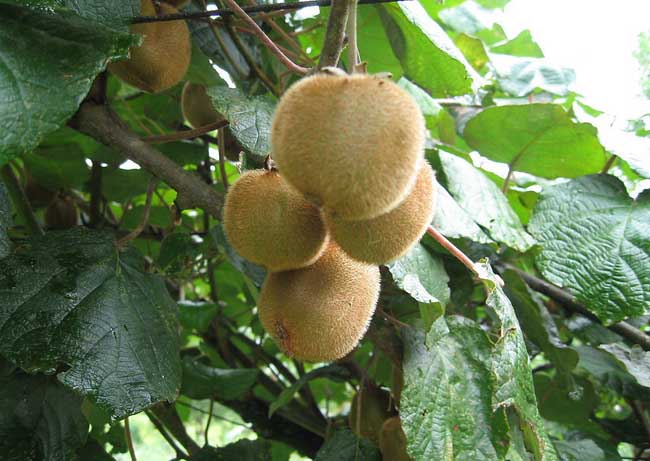
Kiwifruit producing areas are mainly distributed in China. Kiwifruit is actually the name for the cultivated fruit of the Chinese gooseberry (Actinidia chinensis), also called fox peach, vine pear, sheep peach, muzi, hairy wood fruit, kiwi fruit, hemp vine fruit, etc. In the mountain forests of low mountain areas, it generally appears mostly in tall grass thickets, shrub forests or secondary open forests. Now let's take a look at what kiwifruit producing areas there are!
Kiwifruit producing areas
In China, kiwifruit is mainly distributed in Shaanxi, Sichuan, Henan, Hunan, Guizhou, Zhejiang, Jiangxi and other provinces:
1. The Qinling mountain area of Shaanxi (mainly Zhouzhi County of Xi'an, known as the hometown of Chinese kiwifruit, and the adjacent Huxian County, Meixian County of Baoji and Wugong County of Xianyang).
2. The Dabie Mountain area, the Funiu Mountains and Tongbai Mountains of Nanyang, Henan, and Tiantai Mountain of Huanggang, Hubei.
3. The Guizhou Plateau and western Hunan.
4. Heping County, Heyuan, Guangdong.
5. The northwestern region of Sichuan and the southwestern region of Hubei.
6. Jiangshan, Zhejiang.
7. Fengxin County, Jiangxi.
8. Shaanxi is the largest kiwifruit planting province in China, mainly distributed in Zhouzhi County and Huxian County of Xi'an, Meixian County of Baoji, and Wugong County of Xianyang.
The producing environment of kiwifruit
Kiwifruit likes cool and humid conditions, fears drought, waterlogging and wind, is cold-tolerant, and is not tolerant of late spring frost.
1. Temperature: annual average temperature 11.3-16.9°C, extreme maximum temperature not exceeding 42.6°C, extreme minimum temperature not lower than -15.8°C, no sharp cold wave in early winter that causes the temperature to suddenly drop below -12°C, effective accumulated temperature ≥10°C between 4500-5200°C, daily average temperature during the growing period not lower than 10-12°C, no strong wind, absolute temperature during the late frost period not lower than -1°C, frost-free period 160-240 days.
2. Light: annual sunshine hours 1300-2600 hours, natural light intensity 42%-45%.
3. Precipitation: annual rainfall of about 1000 mm.
4. Humidity: relative humidity above 70%.
5. Soil: deep, loose and fertile mountain forest soil rich in organic matter, pH 5.5-6.8, with good drainage, red, yellow, brown or black sandy loam or loam.
Of course, there are not many places that fully meet these conditions. If the arid north has irrigation conditions, the humid south has drainage and irrigation measures, and areas with strong wind have shelterbelts, then it can also be cultivated.