What are the conditions for growing kiwifruit? Learn it all in one article
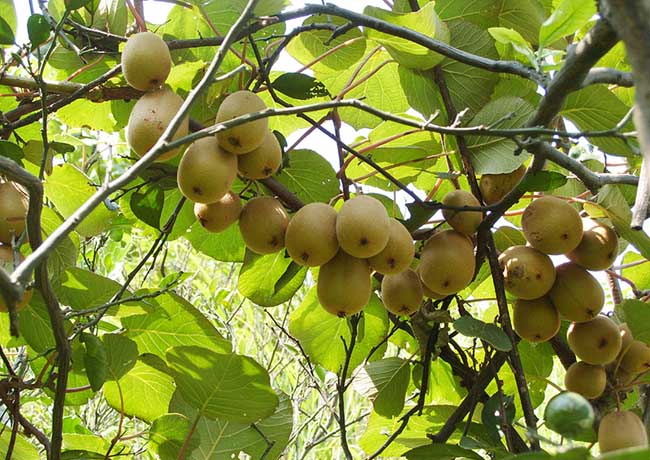
Kiwifruit prefers a cool and moist growing environment and is afraid of drought, waterlogging and wind. It is cold-tolerant but not tolerant of late spring frost. The planting time runs from late autumn to early spring, in late October of autumn and late February of spring before the sap-bleeding period of the branches. Kiwifruit harvesting takes place from mid-September to mid-October. Now let us take a look at the conditions needed for growing kiwifruit!
Conditions for growing kiwifruit
It is understood that most of the varieties currently cultivated are mainly the two species Actinidia deliciosa (fuzzy kiwifruit) and Actinidia chinensis (Chinese kiwifruit), which originated mainly in the central and southwestern regions and the central and southeastern regions of China respectively. In the later process of cultivation and spread, it was found that it can be grown from Beijing to Hainan, and from Yunnan, Guizhou and Sichuan to Taiwan, China.
1. Light conditions
First, let us discuss that it likes light but fears sunburn. If you are observant and live near mountainous areas where wild kiwifruit grows, you will find that kiwifruit in the mountains basically grows on shady slopes or semi-shady slopes, or else by riversides. Why? Because it fears sunburn. The kiwifruit plant has a very strong ability to use diffused light; even growing twined around and attached to a large tree is no problem at all, but it cannot be too heavily shaded. If there is a severe lack of light, its branches will die back. This is why production emphasizes a reasonable spacing between plants and rows. Why does New Zealand set kiwifruit row and plant spacing at 5*5 or 5*6? It is precisely by making full use of this habit of kiwifruit that they have, to a certain extent, made their kiwifruit the world's number one. In plain terms, it likes sunlight but fears high temperatures.
2. Precipitation conditions
Next, it likes water but fears waterlogging. The main reason is that kiwifruit is a broadleaf fruit tree, and especially in summer the transpiration from the leaf surface is very vigorous, so its water demand is relatively large. Therefore, in the three months of June, July and August, soil moisture content is generally required to be maintained at 70%, which is ideal. But at the same time, the root system of kiwifruit is a fleshy root with strong respiration and needs a relatively high oxygen content in the soil, that is, it needs the necessary soil permeability. Therefore, according to the relationship between soil water and air, one cannot water too much. This is a very contradictory unity. What should be done? So one should grow grass on the ground, apply more organic fertilizer, strengthen the soil's water-holding capacity, and emphasize the scientific water-use principle of mulching and preserving soil moisture first, and irrigation second. In production, many orchards have large numbers of trees die in summer and autumn for unknown reasons, when in fact the trees were watered to death, soaked to death and drowned. Large kiwifruit trees will never die of drought; they only die of waterlogging. Many fruit growers have experience that in summer, if it rains continuously, or if it rains just after watering, once the weather clears and the temperature quickly rises again, many kiwifruit trees immediately show wilting (fruit growers commonly call it "afternoon droop"). If not handled in time, the trees will soon die. This is the typical pattern of liking water but fearing waterlogging.
3. Fertilization management
Finally, it likes fertilizer but fears burning. The growth amount and extremely strong growth vigor of kiwifruit determine the urgency of its demand for nutrients. Coupled with the production mentality of pursuing yields in a predatory manner, once kiwifruit lacks inorganic nutrients it shows yellowing, small leaves, halted growth and other phenomena. Therefore, kiwifruit is relatively sensitive to nutrients, but the fleshy root system is also very sensitive to soil salt concentration (especially under sustained high temperature and drought), thus forming a new set of contradictions. In view of this, production requires that fertilization of kiwifruit must grasp the principle of "far, scattered and dilute", that is, the method of applying small amounts many times, which can meet nutrient needs without causing fertilizer damage. This is what is meant by kiwifruit liking fertilizer but fearing burning.
4. Temperature conditions
Temperature is the main factor limiting the distribution, growth and development of kiwifruit. Each species has a suitable temperature range; beyond this range it grows poorly or cannot survive. Most kiwifruit species require a warm and humid climate, that is, a subtropical or temperate humid to semi-humid climate, and are mainly distributed across vast areas between 18 and 34 degrees north latitude. The annual average temperature is about 11.3 to 16.9°C, the extreme maximum temperature is 42.6°C, the extreme minimum temperature is about -20.3°C, the effective accumulated temperature above 10°C is 4500 to 5200°C, and the frost-free period is 160 to 270 days.
5. Other conditions
In addition to considering the natural environment, kiwifruit cultivation must also consider the local social, economic, transportation, microclimate and site conditions. Generally speaking, good public security, sufficient investment, convenient transportation, flat land, fertile soil, convenient drainage and irrigation, sufficient light and a mild climate, and plots that are not in wind gaps or hail paths, are all ideal orchard site selections.
Main production areas for kiwifruit cultivation
China is the native center of kiwifruit. The world's place of origin for kiwifruit is China, especially the Qinling Mountain area in Guanzhong, Shaanxi Province. Kiwifruit grows on mountain slopes at forest edges or in thickets, and some is cultivated in orchards. In China it is distributed in Shaanxi, Sichuan, Henan and other areas north of the Yangtze River basin. Our seven major kiwifruit production areas are:
1. The Qinling Mountain area of Shaanxi (mainly Zhouzhi County of Xi'an, known as China's hometown of kiwifruit, and the adjacent Huxian County, Meixian County of Baoji and Wugong County of Xianyang).
2. The Dabie Mountain area, including the Funiu Mountains and Tongbai Mountains of Nanyang in Henan Province, and Tiantai Mountain of Huanggang in Hubei Province.
3. The Guizhou Plateau and western Hunan Province.
4. Heping County of Heyuan in Guangdong.
5. The northwestern area of Sichuan Province and the southwestern area of Hubei Province.
6. Jiangshan of Zhejiang Province.
7. Fengxin County of Jiangxi Province.
8. Shaanxi Province is China's largest kiwifruit-growing province, mainly distributed in Zhouzhi County and Huxian County of Xi'an, Meixian County of Baoji and Wugong County of Xianyang.