Key Points of Cashew Cultivation Techniques: A Detailed Explanation of Cultivation and Management Methods
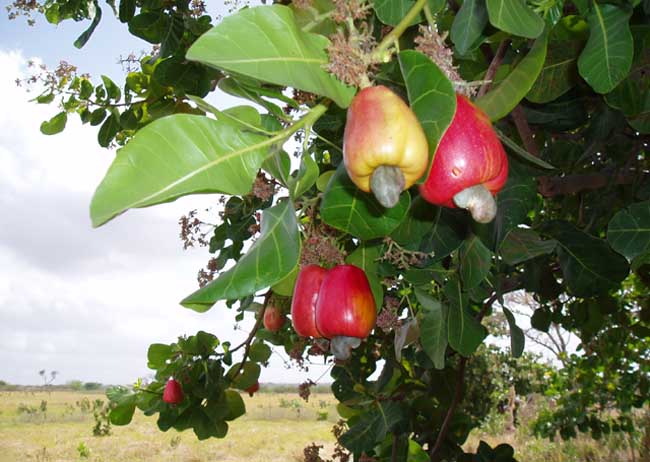
Cashew, also known as the cashew tree, chicken cashew, or Jieshou fruit. It is an evergreen tree with an upright trunk, reaching up to 10 m tall. The cashew is a kidney-shaped nut belonging to the genus Anacardium in the family Anacardiaceae of the order Sapindales. Cashews are rich in nutritional value, can be used in cooking, and can also be used medicinally; they are one of the world's four famous dried nuts. It originated in northeastern Brazil, within 10° south latitude. It was introduced to Asia and Africa in the 16th century and has now spread throughout East Africa and the countries of South Asia. The countries with the largest cashew cultivation areas in the world include India, Brazil, Vietnam, Mozambique, and Tanzania. In China, cashews are mainly distributed in Hainan and Yunnan, and have also been introduced in Guangxi, Guangdong, Fujian, and Taiwan, China.
The Growth Habits of Cashew
Cashew has extremely strong adaptability and is a warmth-loving, strongly heliophilous tree species. It is tolerant of drought and poor soil and has a certain wind resistance. It is best grown below 400 m elevation. It has low soil requirements; apart from poor growth on heavy clay and limestone, it can grow on red soil, sandy loam, or rocky mountainous land with soil organic matter content of less than 1%.
Cashew is not cold-tolerant and requires very high temperatures during its growing period. Flowering and fruiting are normal at a monthly average temperature of 23-30°C, growth is slow at 20°C, it is prone to cold damage below 17°C, and below 15°C it suffers severe damage and dies. Annual sunshine of more than 2000 hours and annual precipitation of 1000-1600 mm are more suitable. It should not be planted in areas where the groundwater level is too high or where water accumulates during the rainy season. Rainy and overcast weather is unfavorable during the flowering period.
The peak growth period is generally in the early rainy season. The taproot of a 4-5-year-old tree reaches 5 m deep, with well-developed lateral roots; the lateral roots of a 6-year-old tree reach about 7 m long. After planting, it flowers in 2 years, bears fruit in 3 years, and enters the full fruiting period after 8 years, with the full fruiting period lasting 15-25 years.
Propagation Techniques for Cashew
Because the yield and characteristics of seedling progeny of cashew are unstable, asexual propagation is mostly used. Cashew asexual propagation techniques include layering, cuttings, epicotyl grafting, side grafting, approach grafting, budding, cleft grafting, cut grafting, softwood grafting, tissue culture, and so on.
1. Seed Propagation
Soaking seeds with 30 mg/100 g of indolebutyric acid (ITT) for 24 hours can increase the seedling formation rate by 61.11%; soaking seeds in warm water at room temperature of 55°C for 24 hours can increase the seedling formation rate by 50%. In addition, soaking seeds with 60 mg/100 g of ITT for 24 hours and soaking seeds with 1/2 strength ADNK for 24 hours can also promote the germination of cashew seeds. Soaking seeds with 90 mg/100 g of naphthaleneacetic acid (NAA) for 24 hours has the best effect on promoting seedling height growth.
2. Layering Propagation
Air layering for cashew nursery should be carried out from February to April or from October to November each year, when the survival rate is highest, at more than 93%. The age of the mother plant used for layering is best under 10 years; roots can form 35 days after layering, and it can be separated from the mother tree after 45 days. If the mother plant is more than 20 years old, it is very difficult to root after layering. The materials used for layering are preferably peat, moss, and wood shavings. Before layering propagation, treat the mother tree with 0.00025 g/mL of ethephon or 0.001 g/mL of chlormequat, then treat the air layers with 0.003-0.005 g/mL of ITT and 0.0002 g/mL of p-carboxybenzyl, which can promote root formation of the branches and increase the number and length of roots.
3. Tissue Culture
Cotyledon explants cultured on a medium supplemented with 0.5 mg/L of IAA and 0.5 mg/L of kinetin can directly form organs and directly form complete plants after about 5 weeks, without the need for further culture and induction of plant rooting.
Cashew Cultivation Techniques
1. Training and Pruning
Training and pruning can regulate the canopy structure and improve ventilation and light penetration in the tree, thereby increasing the fruit-setting rate and yield. The principle for pruning young cashew trees is to prune lightly rather than heavily, and early rather than late, using a method of pruning in several stages and batches; pyramid-shaped pruning and training gives good results.
2. Fertilization Management
Although cashew trees are tolerant of poor soil and drought, cultivation practice has proven that cashew trees growing in a natural state have almost no yield. The yield of mature fruit trees increases severalfold after fertilization. In terms of fertilizer types, mixed application of N, P, and K gives the best yield increase; next is applying P alone, followed by mixed application of N and P. Higher levels of N can prolong the flowering period, while higher levels of P and K shorten the flowering period. Applying 600 g of N, 200 g of P, and 200 g of K per tree each year can significantly increase the number of nuts per tree and improve total yield and kernel outturn rate.
Pest and Disease Control of Cashew
At different stages of its growth, cashew is harmed by more than 60 kinds of pests and diseases. Among them, the main cashew diseases include inflorescence blight, damping-off, gummosis, branch rot and leaf fall disease, leaf rot, yellow leaf spot, and little leaf disease; the main insect pests include the cashew tea mosquito bug, cashew leaf miner, cashew stem borer, and scarab beetles.
The cashew stem borer is a pest of the trunk of cashew trees. The best control is carried out during the egg-laying period in July-August. Generally, 0.15% carbaryl or 0.05% monocrotophos can be used to treat the exposed roots of cashew trees.
Scarab beetle larvae mainly harm the roots of cashew trees. For chemical control, applying 1 kg of effective ingredient of lime sulfur mixture per hectare gives the best effect; 15 days after application, the pest population is reduced by 74.4%.