Where Are Chestnuts Produced? A Detailed Guide to the Main Producing Regions
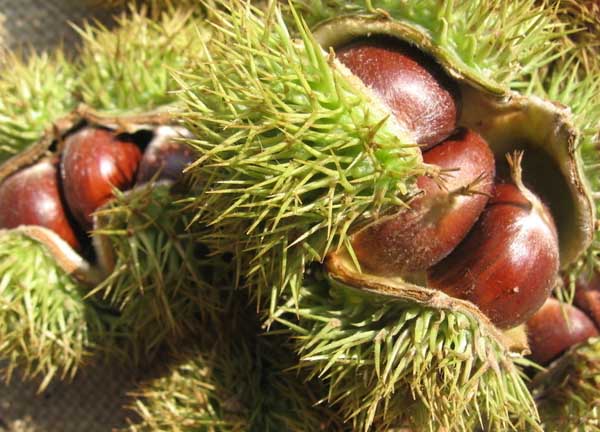
The chestnut (Castanea mollissima) originated in China and is now distributed across Vietnam, Taiwan, China and mainland China. It grows at altitudes of 370-2800 m, is mostly found in mountainous areas, and has been widely cultivated artificially. The most famous chestnuts are those from Luotian in Hubei and Qianxi in China.
Luotian Chestnuts
“Silkworms spin silk, bees make honey, trees yield oil, and the mountains produce chestnuts.” This is the specialty that the people of Luotian in the Dabie Mountains of eastern Hubei take pride in, and the source of their prosperity. Artificial cultivation of chestnuts in Luotian began before the Spring and Autumn and Warring States periods. There are many varieties with unique color and flavor, grown throughout the county, but all products sold outside are labeled “Luotian Chestnuts.”
The unique quality and reputation of Luotian chestnuts have attracted many foreigners. Professor Luoton of Auburn University in the United States traveled a long way to Luotian for field research. After on-site study of Luotian chestnut varieties, he concluded that Luotian is the "gene bank of the world's chestnuts" and actively introduced American businesspeople to come to Luotian, China to develop chestnut product lines. Experts from Japan, Canada, Italy and other countries have visited Luotian more than 20 times for research, marveling at the quality of its chestnuts. It is said that Japan imports Luotian chestnuts, processes them into uniquely flavored chestnut foods, and calls them "ginseng fruit."
Qianxi Chestnuts
“China's chestnuts are found in Jingdong, and Jingdong's chestnuts are found in Qianxi.” Qianxi County is located at the southern foot of the Yanshan Mountains, beneath the Great Wall, on the banks of the Luan River. Qianxi chestnuts are a traditional specialty agricultural product of Hebei Province, with a cultivation history of more than 2000 years. The unique soil and climate conditions create their excellent taste and flavor. The products are mainly sold to the United States, Japan, South Korea, Hong Kong, China, Taiwan, China and more than 60 large and medium-sized cities in China including Shanghai, Guangzhou, Dalian, Shenzhen and Kunming, and are deeply loved by consumers at home and abroad.
Qianxi chestnuts are exquisite in shape, bright in color, and do not stick to the inner skin; the kernel is cream-colored, highly glutinous, sweet and aromatic, with an excellent mouthfeel; they are rich in vitamins, carotene, amino acids and trace elements such as iron and calcium. Long-term consumption can achieve health benefits such as nourishing the stomach, strengthening the spleen, tonifying the kidneys and beautifying the skin. They have the laudatory names of the Orient's “pearl” and “purple jade,” and are called by the Japanese “the best food among Chinese sweet chestnuts.”
Qianxi chestnuts are grown in a purely natural, wild state, without chemical fertilizers or pesticides, and farmers harvest by gathering naturally fallen nuts. The chestnuts have good maturity, high sugar content, store well, and are rarely infested by insects. The cultivation area of Qianxi chestnuts reaches 600,000 mu (400,000 hectares) and 30 million trees, all of which have passed the pollution-free fruit production area certification of Hebei Province, with an annual output of more than 20,000 tons. In 2004, Qianxi County won the “Special Award of the National Top Ten Chestnut Industry Counties”; in 2005, the “Qianxi Chestnut” certification trademark was rated as a “Famous Trademark of Hebei Province.”
Dandong Chestnuts
Dandong chestnuts are produced in Dandong City, Liaoning Province. Chestnut cultivation in Dandong began in the late Ming and early Qing dynasties. The fruit is called lizi (chestnut) and can be eaten raw, candied and roasted, baked, or made into canned goods, ground into flour for cakes, and used in soups and cooked dishes. It contains sugar, protein, fat and various vitamins, and has high nutritional and economic value. In December 2006, the General Administration of Quality Supervision, Inspection and Quarantine approved geographical indication product protection for Dandong chestnuts.
Dandong chestnuts are a dominant economic forest tree species in the Dandong region, mainly cultivated on hillsides, with very few grown on flat land. The total number of chestnut trees reaches more than 65 million. Among them, large trees over 40 years old were mainly planted in the 1960s, about 10 million trees; 20-30 year old chestnut trees were mainly planted in the 1980s, more than 15 million trees; after the 1990s, the cultivation area of Dandong chestnuts expanded rapidly, and by 2002, more than 30 million chestnut trees had been added over more than ten years. The main varieties include Jinhua, Yuewang, Danze, Liping, Youmo, Tu 60, 9113, 9210 and more than 20 others. The area of improved chestnut varieties reaches 3.82×10⁴ha
Dandong chestnuts are famous for their excellent quality. The fruit is large, white in color, good in taste, does not split open, is easy to process, and has high comprehensive value. The moisture content of the kernel is about 40%, containing 5.7%-10.7% protein, %-7.4% fat, about 50% starch, and vitamins A, B1, B2 and C as well as various minerals such as phosphorus, potassium, magnesium, iron, zinc and boron.
Yanshan Chestnuts
The Yanshan Mountains are a famous mountain range in northern China. Chestnut cultivation in the region began to take shape during the Spring and Autumn and Warring States periods, with a history of 2000 years. Yanshan chestnuts, known for their thin shells, plump kernels, and fresh, sweet, long-lasting flavor, were enjoyed by imperial courts through the ages. In Xiwanzi Village, Shicheng Town within the Yanshan region, chestnut trees grow all over the mountains, with hundreds of trees over a hundred years old, so it is called the “source of Yanshan chestnuts.”
Zhen'an Chestnuts of Shaanxi
Chestnuts are produced in all counties of the Qinba mountainous area in southern Shaanxi, but Zhen'an large chestnuts are the most famous. Zhen'an large chestnuts are mainly produced in Zhen'an, Ningshan, Zhashui, Chang'an, Danfeng, Shanyang, Ningshan and other counties in the Qinling mountainous area of Shaanxi. Ningshan County has the highest output, while Zhen'an has the best quality.