A Detailed Guide to Fig Planting Techniques and Management Methods
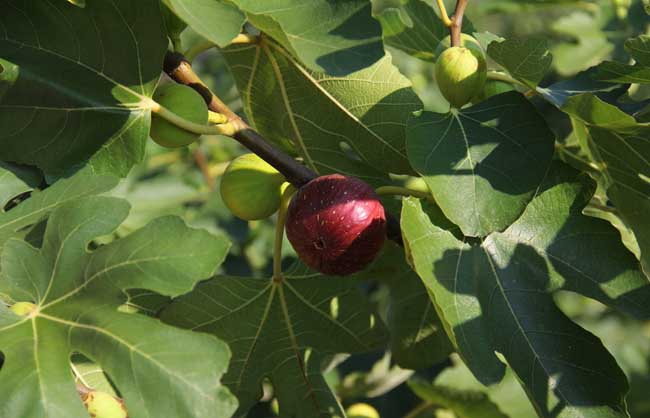
The fig is native to Mediterranean countries and is one of the oldest cultivated fruit trees in the world, having been introduced to our country as early as the Han Dynasty. The fig is a syconium formed by the enlargement of the receptacle, with the tiny flowers hidden inside the receptacle; people can only see the false fruit formed by the receptacle and cannot see the flowers, hence it is called the "fig." It is a perennial deciduous fruit tree. The fig has a relatively long fruiting period, with summer figs and autumn figs. The fig has strong adaptability and is not strict about soil requirements; it can grow normally in environments where the temperature does not fall below -12 degrees C. In the cold season of northern China, it can also be planted if cold-protection and heat-preservation measures are taken. It is drought-tolerant, shade-tolerant, and salt-alkali-tolerant, and has the advantages of fast growth, early fruiting, and high yield.
Cutting Propagation Techniques
There are many propagation methods for figs, but cutting propagation is generally used most often. Cuttings can be taken in most months of the year, and the survival rate is high.
1. Site selection: Choose soil free of salt and alkali. Although it is resistant to salt and alkali, if the salt and alkali content is slightly high, the cuttings are prone to damage and death during the cutting period, so fertile sandy loam soil and soil with high organic matter content are preferable.
2. Collecting cuttings: They should be collected in autumn after leaf fall when the sap has stopped flowing. If collecting cuttings in spring, it should be done before bud break. Take sprouting branches from the ground level of the mother tree or from the lower part of the main trunk as cuttings. To ensure storage quality, the cuttings should be soaked in clean water for about 3 days before storage; after removing them, store them with one layer of cuttings and one layer of fine sand, watering an appropriate amount to keep the soil moist.
3. Cutting method: Use cuttings of suitable thickness, with smooth cuts free of burrs and splits, and a length of about 20 cm. Adapt to local conditions by first breaking up the soil finely and applying fertilizer to make beds. Generally the bed width is 50 cm and the bed height is about 33 cm, or make small ridges 35 cm high with a ridge spacing of about 35 cm. Make the ridges, insert the cuttings, and water as you go, with a cutting depth of 17-18 cm. The cutting time should be about 3 days before the local period when healing and rooting can occur; cutting at this time can reduce the effects of adverse external climate, and the healing and growth speed is faster.
Management After Cutting
Although fig cuttings heal and root easily, attention must still be paid to management after cutting. The key management points are:
1. During the period when the callus tissue forms, the temperature requirement is relatively high, so the low temperature should be raised promptly; at the same time, strengthen the water supply. In the later stage of healing and rooting, the cuttings grow a large number of fibrous roots. At this time the temperature gradually rises, and attention should be paid to increasing soil moisture.
2. After healing and rooting and during the leafing stage, avoid watering with muddy water and strictly prevent leaf scorching, especially for low-bed cuttings.
3. Persist in watering according to soil moisture conditions. When the soil is moist, water less or not at all; if the soil is dry, water more. Keeping the soil in a moist state is suitable.
4. Fig seedlings are not cold-tolerant. Before the first frost or late spring cold, cold-protection (freeze-protection) and heat-preservation work should be done. The simple method is to bury them well with soil or cover them well with grass curtains, leaves, rice straw, and other coverings.
5. Around the time the seedlings enter the vegetative growth stage, persist in lightly applying a compound fertilizer based mainly on nitrogen fertilizer once a month. The amount of fertilizer applied gradually increases as the seedling age increases. As the seedling root system deepens, deep-trench application gives better results, but care should be taken to avoid damaging the roots when fertilizing.
Fig Planting Techniques
1. Planting: They can be grown in pots or cultivated on barren slopes, in fields, and in courtyards. For cultivation using barren slopes, fields, courtyards, and the like, the planting density is generally appropriately increased to 1 x 2 m, with a single planting hole 50-70 cm deep and 40-60 cm in diameter, using a mixed fertilizer containing phosphorus and potassium (such as human and livestock manure, poultry manure, green manure, cake fertilizer, chemical compound fertilizer) as base fertilizer. The suitable planting time in North China should be around Qingming, in Northeast China around Guyu, and in the south they can be transplanted and planted after leaf fall in autumn, but the flowering and fruiting period should be avoided.
2. Training and pruning: The training and pruning of figs is relatively simple, and the technical requirements for pruning and training are not high. Generally, the multi-main-branch natural open-center training method is used, but 3-5 main branches should be retained for the whole plant, with no lateral branches left, and branch groups directly borne on the main branches. During the young tree period, focus on cultivating the main branches and pay attention to raising the angle of the main branches to promote more branch growth, so as to rapidly expand the tree canopy. After entering the initial fruiting stage, focus on cultivating more branch groups in order to promote the formation of a certain yield. During the full fruiting stage, pay attention to cultivating scaffold branches, renewing medium and large branch groups, and pruning and reducing weak branch groups. For trees that are aging or severely affected by pests and diseases, sprouts or latent buds sent out from the base or branches can be used to retrain the main branches and branch groups. Figs begin in mid-July and mature successively through November. Fig harvesting is generally best done in the morning or evening on sunny days. Pick when the top of a ripe fruit has a small opening slightly open and the peel shows the color of the inherent variety (mostly red and yellow varieties).
3. Fertilizer and water management: During the growth period of young fig trees, fertilizer should be applied if the base fertilizer is insufficient. The method is to apply about 5 kg of decomposed miscellaneous fertilizer per plant at a distance of about 40 cm from the main root; for potted plants, apply at least 1 kg. For mature trees, apply about 15 kg of decomposed farmyard manure per plant. Apply base fertilizer before and after leaf fall, and topdressing is best during the peak new shoot growth period and the rapid fruit enlargement period. The fig is a fruit tree that is relatively tolerant of fertilizer, but emphasis should be placed on applying phosphorus and potassium fertilizers. Generally the ratio of nitrogen, phosphorus, and potassium is 0.5:1:1. Because it is relatively drought-tolerant but not waterlogging-tolerant, it requires a relatively large amount of water during new shoot growth and fruit enlargement, but long-term waterlogging or heavily waterlogged environments can easily cause flower drop, fruit drop, leaf drop, and even death, so drainage and water removal should also be done well. Potted plants should also be given attention for drainage, especially during continuous rainy seasons after heavy rain or torrential rain; pay attention to rain sheltering or tipping the pot to control water.