Apricot Tree Pruning Techniques: Key Points and Methods Explained
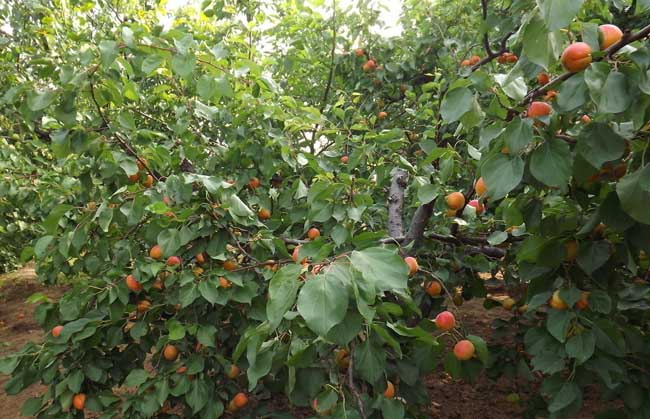
Apricot trees are extremely light-loving. Whether you use the natural round-headed form, the natural open-center form, or the delayed open-center form, the main branches should not be too numerous, but the spacing between tiers should be large so that sunlight can penetrate the inner canopy, improving ventilation and increasing light use efficiency. Proper pruning allows young trees to rapidly expand their canopy, increase the number of branches, bear fruit earlier, and achieve early high yields; during the full bearing period it enables consecutive years of high and stable yields and extends the length of the full bearing period.
Bud removal
Bud removal means that after bud break in spring, densely crowded young buds or tender shoots in unsuitable positions or in excessive numbers are promptly removed to reduce nutrient consumption, so that the remaining branches receive adequate nutrients and light. This method is mostly used on young trees. The earlier the buds are removed, the better, and it is best when the young shoots are no more than 3-5 cm long. At this point the shoots are not yet lignified, so they can be removed by hand, and the wounds caused also heal easily. When old trees are renewed, many useless small shoots tend to sprout near pruning and saw cuts, and these should also be removed early.
Branch bending
With some varieties, young trees tend to produce vigorous upright shoots, causing the canopy to remain closed. For such branches, after sap flow begins and before bud break, they can be tied with rope and bent to a certain angle to moderate their vigor, encourage fruiting branches, and bring fruiting earlier. The bending angle should not be too large; 45-50 degrees is appropriate. If the angle is too large or the branch is bent flat, upright vigorous shoots will again develop on the upper side, and these will still grow vigorously and affect flower formation and fruiting.
If such upright vigorous branches are left unpruned and not bent, some fruiting branches may still form on the front (upper) part, but after fruiting the lower part tends to become bare, reducing the fruiting area and affecting yield and quality.
Pinching
Pinching means removing the tender young tip of a new shoot. Within the canopy, pinching can be applied to water sprouts, renewal shoots, extension shoots, and moderately vigorous upright shoots on the upper side that are in suitable positions with good light conditions. The best time for pinching is when the new shoot is about 40 cm long. However, the extension shoots of main and lateral branches at all levels and the branches replacing extension shoots need not be pinched; if the goal is to widen the angle and increase branch order, they may also be pinched, but pinching should not be done too many times, lest the branches fail to mature properly.
About 10 days after pinching a new shoot, branching can occur on the lower part, and it can also reach lignification. But if pinching is done more than 3 times and the branches do not mature properly, it may cause freeze damage, or weaken the tree vigor due to an excessive number of branches.
When pruning, pay attention to light conditions. Only with sufficient light can enough nutrients be produced to meet growth needs and prevent the inner canopy from becoming bare and the fruiting area from shifting outward. Therefore, the tree structure should be small at the top and large at the bottom, and branch distribution should be sparse outside and dense inside, sparse above and dense below, and sparse on large branches and dense on small branches, so as to achieve the desired results.