Complete Guide to Watermelon Disease Prevention and Control Measures, a Must-Read for Growers
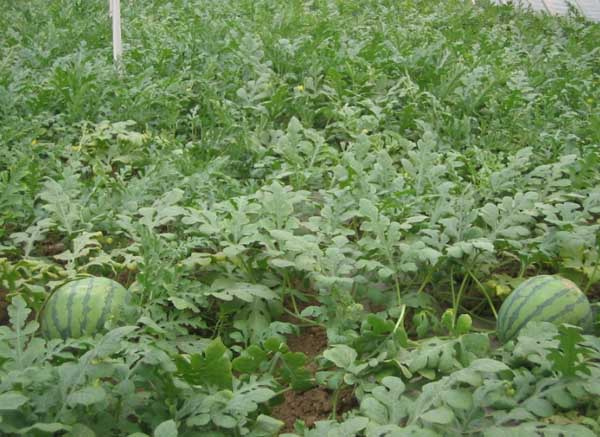
The main diseases of watermelon include: watermelon anthracnose, watermelon damping-off, watermelon viral disease, watermelon powdery mildew, watermelon blight, watermelon cottony leak, watermelon southern blight, watermelon gummy stem blight, watermelon brown rot, watermelon root-knot nematode disease, watermelon leaf blight and watermelon fusarium wilt, etc. The prevention and control methods are as follows.
1. Watermelon anthracnose
[Symptoms] At the seedling stage, semicircular or circular brown spots appear on the edges of the cotyledons, on which small black dots or pale red sticky matter are produced. When young stems are affected, the diseased part turns dark brown and constricts, causing the seedlings to topple. Leaf spots are actually circular pale yellow water-soaked small spots, which later turn brown, with purple-brown edges and a pale brown center, bearing concentric rings and small black dots. The spots tend to perforate.
[Occurrence pattern] The optimum temperature for the growth of the pathogen is 24°C-25°C, with humidity above 90%. Under high temperature and dry conditions, the disease is relatively mild.
[Prevention and control methods] First use disease-free seeds, or disinfect the seeds by soaking them in warm water at 55°C for 15 minutes, or soaking them in a 100-fold dilution of 40% formaldehyde for 30 minutes, then rinse with clean water and sprout. In the early stage of the disease, spray a 400-500-fold dilution of 70% mancozeb, or a 500-fold dilution of 65% zineb or carbendazim, once every 5-6 days, for 2-3 consecutive sprays.
2. Watermelon damping-off
[Symptoms] In the early stage of the disease, the area of the seedling near the ground surface appears yellow and water-soaked, then turns yellow-brown, dries up and shrinks, and the seedling breaks off as soon as it is pulled.
[Occurrence pattern] The pathogen spreads with rain and flowing water. Low soil temperature (10°C-15°C), high humidity in the seedbed, cool nights and insufficient light during the day are conducive to the disease. More pathogen carried on seeds and in the seedbed soil means more chances for seedlings to become infected.
[Prevention and control methods]
① Agricultural control. Strictly select soil that is high-lying, well-drained and has never been planted with cucurbits. Strengthen seedbed management, and do a good job of heat preservation, ventilation and humidity reduction. When the seedbed humidity is too high, a small amount of plant ash or dry soil can be scattered, and ventilation can be used to reduce humidity.
② Chemical control. As soon as diseased plants appear, immediately remove the diseased seedlings and spray copper-ammonia mixture to prevent the disease from spreading. A 700-800-fold dilution of 75% chlorothalonil can also be sprayed.
3. Watermelon viral disease
[Symptoms] Symptoms first appear on the upper leaves of melon plants, showing a mosaic mottling of alternating dark and light green; the leaves become smaller and curled, the stems become twisted and stunted, and the plants are dwarfed. The fruits become smaller and also bear mottling of alternating dark and light green. When watermelon is affected, yellow-green mottled patches appear on the leaves, the leaf surface becomes uneven, and newly grown leaves are deformed; infected leaves are narrow and long, shriveled and twisted, the flower organs develop poorly, and no fruit is set or the fruit is deformed.
[Occurrence pattern] High temperature and strong sunlight favor the disease, and melon fields lacking fertilizer and with weak growth vigor often suffer severe disease.
[Prevention and control methods] Kill aphids in time. Effective agents include a 3000-fold dilution of 20% fenvalerate emulsion, a 2000-3000-fold dilution of 2.5% deltamethrin, and a 1500-2000-fold dilution of 40% dimethoate emulsifiable concentrate. In severe cases, use 4 vials of 800,000-unit penicillin diluted in 15 kg of water for spraying. Alternatively, 2 vials of antitoxin (20 ml) plus 50 g of zinc sulfate diluted in 15 kg of water sprayed on the leaf surface also has a significant effect.
4. Watermelon powdery mildew
[Symptoms] In the early stage of the disease, small circular white spots appear on the leaves, which later expand into white powdery patches; the spots connect into sheets, covering the leaves and stems with white powder.
[Occurrence pattern] When field humidity is high and the temperature is 16°C-24°C, the disease is severe. Watermelon and melon grown in greenhouses and plastic tunnels often develop the disease earlier and more severely than open-field cultivation because of poor air circulation and high humidity.
[Prevention and control methods] Pay attention to field sanitation, remove diseased leaves in time and burn them in a centralized manner. Strengthen cultivation management, apply more phosphorus and potassium fertilizers, and improve plant resistance. In the early stage of the disease, spray a 120-200-fold dilution of agricultural antibiotic 120, or a 1500-2000-fold dilution of 15% triadimefon, or a 800-1000-fold dilution of 70% thiophanate-methyl wettable powder.
5. Watermelon blight
[Symptoms] Both seedlings and mature plants can develop the disease, harming leaves, stems and fruits. When cotyledons are infected, water-soaked dark green circular spots first appear, the center gradually turns reddish brown, and the area near the ground constricts or dies. When true leaves are infected, dark green water-soaked circular or irregular spots first appear and expand rapidly; under high humidity they rot or look as if scalded by boiling water, and after drying they become pale brown and easily broken. When the stem base is infected, spindle-shaped water-soaked dark green sunken spots form, surround the stem and rot, and everything above the affected part dies. When fruits are infected, dark green circular water-soaked sunken spots form and then rapidly spread to the whole fruit, causing the fruit to rot and give off a silage-like odor.
[Occurrence pattern] The temperature range for the disease is 5°C-37°C. The optimum temperature is 20°C-30°C. During the rainy season and under high temperature and high humidity, the disease develops rapidly. Poor drainage, overly dense planting, dense stems and leaves, or poor ventilation lead to severe disease.
[Prevention and control methods] From the early stage of the disease, begin spraying a 700-800-fold dilution of 50% copper metalaxyl wettable powder, a 800-fold dilution of 35% oxadixyl-copper wettable powder, a 800-fold dilution of 72.2% propamocarb aqueous solution, or 58% Ridomil-manganese zinc (metalaxyl-manganese zinc) wettable powder.
6. Watermelon cottony leak
[Symptoms] Infection at the seedling stage causes damping-off. During the fruiting stage, it mainly harms the fruit. Watermelons touching the soil surface are affected first; the diseased part is initially brown and water-soaked, then rapidly softens, causing the entire watermelon to turn brown and soft-rot.
[Occurrence pattern] An average temperature of 22°C-28°C, many consecutive cloudy and rainy days, or high humidity favor the occurrence and spread of this disease.
[Prevention and control methods]
① Use antagonistic bacteria to inhibit the pathogen. For example, spray a 600-fold dilution of "5406" No. 3 agent in the melon field, so that antagonistic bacteria in the soil increase rapidly and, once dominant, inhibit the growth of the pathogen, thereby achieving disease prevention.
② Adopt high-ridge cultivation. Avoid flood irrigation, drain water promptly after heavy rain, and if necessary prop up the melons.
③ In the early stage of the disease, spray a 300-fold dilution of 14% copper ammonia complex aqueous solution, or a 500-fold dilution of 50% copper bis(8-hydroxyquinoline) acetate (DT) wettable powder, once every 10 days or so, for 2-3 consecutive treatments.
7. Watermelon southern blight
[Symptoms] The affected part first shows dark green spots, which then expand and become slightly sunken.