How to Grow Muskmelon for High Yield? Detailed Explanation of Cultivation Techniques
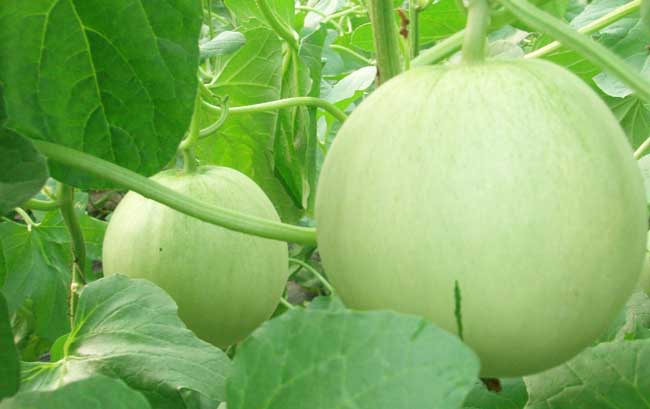
The muskmelon fruit has fleshy tissue, with multiple locules and numerous seeds, much like a berry, but the receptacle and exocarp of these fruits fuse together, often forming a thick outer rind, and in classification they are specifically called "pepo" fruits; the muskmelon is a typical example.
Selecting Suitable Varieties
Muskmelon varieties cultivated in plastic greenhouses must have such characteristics as tolerance to low temperatures in the early stage, tolerance to high temperatures in the later stage, good fruit set, early maturity, high yield, and good quality. Several years of practice have proven that Qitian No. 1, Baitangguan, Longtian No. 1, Elizabeth, and Huangdaozi can all be cultivated.
Seedlings should be raised in a solar greenhouse. Generally, raising seedlings around the lunar term "Start of Spring" is more suitable. First, treat the seeds and remove impurities. Sun them for 1-2 days, soak them in 50°C warm water for 10 minutes, stirring while pouring the water; when the water temperature drops to 30°C, soak the seeds for 4 hours, then drain off the water, put them in a clean wet cloth bag, place them in a basin to germinate. The germination temperature should be within the range of 25-30°C, wash them twice a day, and after 36 hours, once the seeds have sprouted, they can be sown directly into nutrient bags. If the seedlings are planned to be transplanted in early March, hardening off should begin half a month before planting. The method of hardening off is to lower the temperature in the greenhouse and increase ventilation. Generally, the daytime temperature should be below 20°C, the nighttime temperature must not be above 10°C, and the temperature should also be gradually lowered.
Reasonable Close Planting
Generally, muskmelons cultivated in greenhouses are best at a seedling age of about 55 days; seedlings raised around the Start of Spring are roughly transplanted in late March. One month before transplanting, first cover with plastic film to warm the soil, and at the same time carry out deep plowing, applying 5000 kg of high-quality decomposed base fertilizer per mu and 10 kg of diammonium phosphate, then make beds 0.65 m wide, planting two rows per bed with a plant spacing of 30 cm; you can also make 60 cm ridges, cover between two ridges with plastic film to retain 2500 plants per mu. Because the outside temperature is relatively low during this period and cold waves often occur, it is best to use plastic film plus small arch covers when transplanting, and cover with two layers of paper quilts at night.
Pruning and Pinching
If greenhouse muskmelons are not trellised, the main pruning method is to keep vines on both sides; pinching begins when the seedlings have 2 true leaves unfolded. In order to bring them to market earlier, only one fruit is kept on each vine after a fruit appears, pinching is done leaving 4 leaves above the fruit, and any new shoots that appear are removed.
Field Management
1. Muskmelon fertilization is mainly based on base fertilizer; when pinching is done at the 4-leaf stage, in order to promote the emergence of secondary vines and the needs of early fruit development, 15 kg of diammonium phosphate can be applied per mu as a top dressing, and 0.3% potassium dihydrogen phosphate can be sprayed on the leaves. After the first harvest of melons, decomposed manure water and potassium dihydrogen phosphate can be applied per mu as a top dressing.
2. In principle, watering muskmelons is mainly controlled; do not water unless there is drought. The entire growth period can be watered four times. The first time is after transplanting and seedling recovery; the second time is before the first flower blooms, a pre-flowering watering; the third time is when the melons have grown to egg size, a swelling watering; the fourth time is 10 days before harvest, a leaf-surface watering.
3. Pest and disease control. Following the principle of prevention first, at transplanting time, use 70% Dexon at a ratio of 1:5 to prepare medicated soil, apply it into the ammonium, or use the biological pesticide Nongkang 120 to drench the roots, to control fusarium wilt and other root diseases. Grafting can also be used to control fusarium wilt, with Yunnan black-seed pumpkin as the rootstock. For aphids, Xunya No. 2 developed by the Shenyang Academy of Agricultural Sciences can be used.
Timely Harvesting
Greenhouse muskmelons can be harvested as early as June 2; if grafted muskmelons, about 1 week earlier; the first crop of fruit sets on June 20, and the yield per mu can reach 2500 kg. The early price is 10 yuan/kg, and the average price is 6 yuan/kg. The output value per mu can reach 7500 yuan, and the net income per mu is 6000 yuan.