Detailed Explanation of Chestnut Planting Techniques and Management Key Points
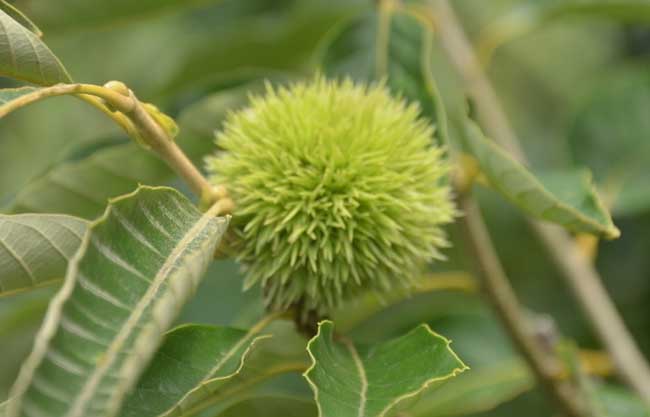
Chestnut, also known as chestnut or Chinese chestnut, is a plant of the genus Castanea in the family Fagaceae. It originated in China and is distributed in Vietnam, Taiwan, China, and the Chinese mainland. It grows in areas at altitudes of 370-2800 m, is mostly found in mountainous regions, and has been widely cultivated artificially.
Growth Characteristics of Chestnut
Chestnut has a relatively wide range of adaptability to climate and soil conditions. Its suitable annual average temperature is 10.5—21.8°C. If the temperature is too high, dormancy is insufficient and growth and development are poor; if the temperature is too low, it is prone to freezing damage. Chestnut likes moist soil, but it also fears the effects of waterlogging. If rainfall is excessive and the soil is waterlogged for a long time, it can easily affect root growth, especially mycorrhizal growth. Therefore, chestnut orchards should not be developed in low-lying, easily waterlogged areas. Chestnut is relatively sensitive to soil pH and is suitable for growing in slightly acidic soil with a pH of 5—6. This is because the chestnut tree is a manganese-loving plant, and under acidic conditions, nutrient elements such as manganese and calcium can be activated, which is beneficial to the absorption and utilization by chestnut. The Xuzhou area is located on the southern edge of the Huangtan Sea, with an annual average temperature of 13.7-14.1°C and annual precipitation of 782—946 mm, suitable for the growth and development of chestnut trees.
Cultivation and Management Techniques for Chestnut
1. Selection of chestnut orchard site. A chestnut orchard should be established on sandy loam soil with a relatively low groundwater level and good drainage. Planting is prohibited in places with saline-alkaline soil, low humidity and easy waterlogging, or strong winds. When opening chestnut orchards on hilly and mound land, areas near mountains with gentle terrain and thicker soil layers should be selected, and development should later gradually expand to areas with poorer conditions.
2. Variety selection. Variety selection should mainly use excellent local varieties as the main planted varieties, such as Paoche No. 2, Chenguo No. 1, etc., and appropriately introduce varieties such as Shifeng, Jinfeng, Haifeng, Qingmao Ruanci, and Chushu Hong. According to different edible requirements, chestnut varieties for roasting should be the main focus, with appropriate development of excellent vegetable chestnut varieties. Consideration should be given both to foreign trade exports and to domestic market demand. At the same time, early, middle, and late varieties should be reasonably matched.
3. Reasonable arrangement of pollinizer trees. Chestnut trees mainly rely on wind to spread pollen, but because chestnut trees have the phenomena of dichogamy and self-pollination fruiting, a single variety often produces empty burs due to poor pollination. Therefore, newly built chestnut orchards must include 10% pollinizer trees. Practice has shown that in Xinyang City, using Chushu Hong as a pollinizer tree is better.
4. Reasonable close planting. Reasonable close planting is a basic measure for increasing yield per unit area. In plain chestnut orchards, 30—40 trees per mu is suitable, and in mountainous chestnut orchards, 40—60 trees per mu is suitable. In planned close-planting chestnut orchards, 60—111 trees per mu can be planted, and later row and tree thinning should be carried out gradually.
5. Reasonable fertilization. Reasonable fertilization is an important foundation for high yield in chestnut orchards. Base fertilizer should mainly be farmyard manure to improve the soil, enhance the soil's ability to retain fertilizer and water, and provide relatively comprehensive nutrient elements. The application time is best in autumn after fruit harvest. During this period, the temperature is relatively high, and the fertilizer is easy to decompose; at the same time, this is the period of new root occurrence, which is conducive to absorption, thereby promoting the accumulation of tree nutrients and having a good effect on female flower differentiation the following year. Topdressing should mainly be quick-acting nitrogen fertilizer, combined with phosphorus and potassium fertilizers. The topdressing time is early spring and summer. In spring application, generally 0.3—0.5 kg of urea should be applied per newly planted fruit tree, and 2 kg of urea per large tree in full fruit stage. After topdressing, watering should be combined to fully exert the fertilizer effect. Summer topdressing is carried out from late July to mid-August. At this time, applying quick-acting nitrogen fertilizer and phosphorus fertilizer can promote fruit enlargement, plump flesh, and improve fruit quality. Foliar topdressing can be carried out multiple times a year, with emphasis on doing two applications well. The first is in early spring when the leaves at the base of the branches just unfold and change from yellow to green, spraying 0.3%-0.5% urea plus 0.3%-0.5% borax. Its role is to promote basic leaf function, improve photosynthesis, and promote female flower formation; the second is spraying 0.1% potassium dihydrogen phosphate twice at 10-15 day intervals one month and half a month before harvest. Its main role is to improve photosynthetic efficiency, promote the transfer of nutrients from leaves and other organs to the fruit, and significantly increase single-grain weight.
6. Irrigation. Chestnut prefers water. Generally, irrigation should be carried out once before germination and once during the period of rapid fruit growth, which is beneficial to the normal growth and development of the fruit trees and the improvement of fruit quality.
7. Training and pruning. Chestnut tree pruning is divided into winter pruning and summer pruning. Winter pruning is carried out from after leaf fall to before bud break the following spring, and it can promote the growth vigor of chestnut trees and the formation of female flowers. The main methods include heading back, thinning branches, renewal pruning, delayed pruning, branch bending, and notching. Summer pruning mainly refers to bud removal, pinching, male flower removal, and branch thinning during the growing season. Its role is to promote branching, increase female flowers, and improve fruit set rate and single-grain weight.
①Heading back. Cutting off part of a one-year-old branch. Heading back can promote branching, enhance tree vigor, make the crown compact, reduce male flowers, and adjust the distribution of nutrients. For vigorous trees and vigorous branches, delayed pruning can be used, and heading back can be carried out after bud break.
②Renewal pruning. This is heading back perennial branches. It is mostly used for perennial branches that are weak in growth, have fruiting parts moved outward, and have severe bareness in the inner canopy.
③Branch thinning. That is, removing competing branches, shading branches, and slender branches in the inner canopy from the base.
④Hat pruning. Winter heading back is carried out near the bud scale scars of new shoots that have been pinched different numbers of times. Leaving 2-4 small buds above the new shoot scar and heading back is called live-hat pruning. If handled properly, the small buds on the hat and the large buds below the scar can sprout fruiting branches. Heading back without leaving buds above the new shoot scar is called dead-hat pruning, causing the large buds below the scar to sprout fruiting branches. Under normal circumstances, dead-hat pruning is used for branches with weak vigor, and live-hat pruning is used for branches with strong vigor.
⑤Delayed pruning. Delayed pruning means not pruning. Its main role is to disperse nutrients and moderate tree vigor. Delayed pruning is mostly used for vigorous trees.
⑥Branch bending and notching. For vigorous auxiliary branches in the crown that have not been pinched, pull them flat in spring during the period from sap flow to bud break, and make notches above each bud at the positions where sprouting is desired, so that they produce vigorous branches. At the time of winter pruning, the delayed and flattened branches are then renewal-pruned back to the positions where vigorous branches were produced.