Detailed Explanation of Blueberry Planting Techniques and Cultivation Management Methods
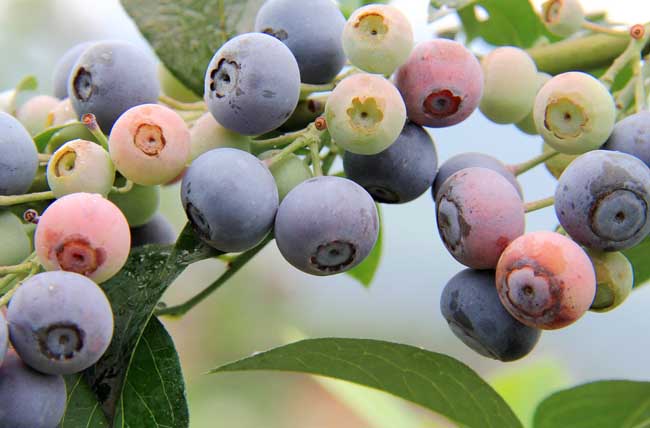
Blueberry is a berry shrub of the genus Vaccinium in the family Ericaceae. The substances unique to its fruit, such as blueberry anthocyanins, have effects including improving eyesight, anti-aging and cancer prevention. It is known as the "functional health berry of the 21st century" and the "queen of fruits", and has been listed by the International Food and Agriculture Organization as one of the five major health foods for humans. In recent years it has become popular in Europe, America and Japan. Because blueberry has unique nutritional and health functions, there is enormous demand on the international market, and the price is high, with products in short supply.
Variety Characteristics of Blueberry
The blueberry fruit is similar in size to a cherry, and is blue and bright blue in color, with a sweet-and-sour flavor and a special aroma, and an excellent taste. The blueberry seeds are extremely small and almost imperceptible when eaten. Unlike cherries, there are no inedible parts such as fruit stalks and seeds, making it very convenient to eat.
The blueberry plant is classified as the collective name for plants of the genus Vaccinium in the family Ericaceae. Because its fruit is blue, it is called blueberry. It is mainly distributed in North America and Europe. The tree height is 1-2 m. It prefers acidic soil and is not tolerant of drought. At present, there are nearly 200 cultivated varieties worldwide worth promoting, and they can be divided according to different climatic characteristics into:
1. Lowbush blueberry and northern highbush blueberry, suitable for the colder regions of the north;
2. Southern highbush blueberry, suitable for the warm temperate regions of the south;
3. Rabbiteye blueberry, etc., suitable for the southern regions.
Among these, northern highbush blueberry is superior to the other two types in both flavor and blueberry anthocyanin content, and is in greatest demand on the international market.
Blueberry is a perennial deciduous or evergreen shrub. The fruit is blue, nearly round, with a single fruit weight of 0.5-2.5 grams, and the seeds are extremely small. The flesh is delicate, moderately sweet and sour, and aromatic. It can be eaten fresh, or processed into jam, juice, fruit wine, etc. Blueberry cultivation first began in the United States. Almost all of China's original blueberry varieties are wild and not suitable for cultivation. More than 20 years ago, China began introducing excellent foreign varieties, and to date more than 20 varieties have been introduced, but large-scale production capacity has not yet been formed.
Orchard Site Construction for Blueberry Planting
1. Site Selection
Blueberry has a relatively wide cultivation range, and suitable varieties can be selected according to the local climate, but northern regions that are dry with little snow and prone to frost damage are not suitable for development. The selected site should have a small slope, not exceeding 10 degrees; soil pH 4.0-5.5, with the most suitable range being 4.3-4.8; soil organic matter content not less than 5%; the soil should be loose, well aerated, moist but not waterlogged.
2. Site Preparation
After the site is selected, in the year before planting, deep plowing should be carried out together with green manure incorporation, with a depth of 20-25 cm being appropriate, and the land should be leveled after deep plowing and ripening. Before planting, soil that does not fully meet the requirements must also be improved to facilitate blueberry growth.
3. Planting
Blueberry can be planted in both spring and autumn, with autumn planting giving a higher survival rate, while spring planting should be done early rather than late. For plant and row spacing, rabbiteye blueberry commonly uses 2 m x 2 m or 1.5 m x 3 m, highbush blueberry uses 1.2 m x 2 m, and lowbush blueberry uses 0.5-1 m x 1 m. Rabbiteye blueberry does not set fruit with its own flowers, so it is best to plant highbush blueberry as a pollinating variety. Highbush and lowbush blueberries have a relatively high fruit-setting rate with their own flowers, but planting pollinating trees can improve fruit quality and yield. The ratio of main varieties to pollinating varieties is 1:1 or 1:2.
Soil, Fertilizer and Water Management for Blueberry Planting
1. Soil Management
The blueberry root system is relatively shallow and fine, without root hairs, so it requires loose soil with good aeration.
① Clean cultivation. Clean cultivation can be carried out from early spring to August, but after autumn begins, clean cultivation is unfavorable for overwintering. Highbush blueberry cultivated on sandy loam commonly uses clean cultivation. The depth of clean cultivation should be 5-10 cm, as too deep a depth easily damages the root system.
② Sod culture. Inter-row grass is used, while herbicides are used within the rows. Compared with clean cultivation, sod culture is likewise beneficial for increasing yield and has the advantages of maintaining soil moisture and facilitating mechanical operations.
③ Soil mulching. Soil mulching is widely used in blueberry production. It has multiple effects such as increasing soil organic matter, improving soil structure, regulating and maintaining soil moisture, lowering soil pH, and controlling weeds. Mulching lowbush blueberry soil with 5-10 cm of sawdust can increase yield by 30% within 3 years and increase single fruit weight by 50%. Leaves, rice straw and other crop straw can also be used, but the effect is not as good as sawdust.
④ Weeding. In blueberry orchard management, weeding is a very important part, and doing it well can increase yield by more than 1 times. In blueberry production, chemical herbicides are widely used. This is because manual weeding is costly and easily damages the root system, especially in lowbush blueberry cultivation, where, because the rhizomes run and spread, after a few years the entire orchard becomes one continuous patch, making manual weeding simply impossible. Commonly used herbicides in blueberry orchards include diuron, simazine, chlorbromuron, 2,6-dichlorobenzene, glyphosate, paraquat, etc.
2. Fertilization
① Types of fertilizer. Applying nitrogen-phosphorus-potassium compound fertilizer is more effective than applying a single fertilizer; the ratio of nitrogen, phosphorus and potassium fertilizers should preferably be 1:1:1; it is best to apply ammonium-form nitrogen fertilizers such as ammonium sulfate, and nitrate-form nitrogen fertilizers should not be applied; blueberry is sensitive to chlorine, so do not choose chlorine-containing fertilizers such as ammonium chloride and potassium chloride.
② Fertilization method and timing. Highbush and rabbiteye blueberry can use the furrow application method, with a depth of 10-15 cm being appropriate; lowbush blueberry, after the orchard is established, forms one continuous patch, so broadcasting is mainly used. Fertilization is carried out before budding in early spring, and can also be applied once more during the berry ripening period.
③ Fertilization amount. Excessive fertilization can very easily injure the blueberry tree or even kill the entire plant, so the determination of fertilization amount must be made very carefully and must be based on soil fertility and the nutritional status of the tree.