Detailed Explanation of Key Pineapple Cultivation and Management Techniques
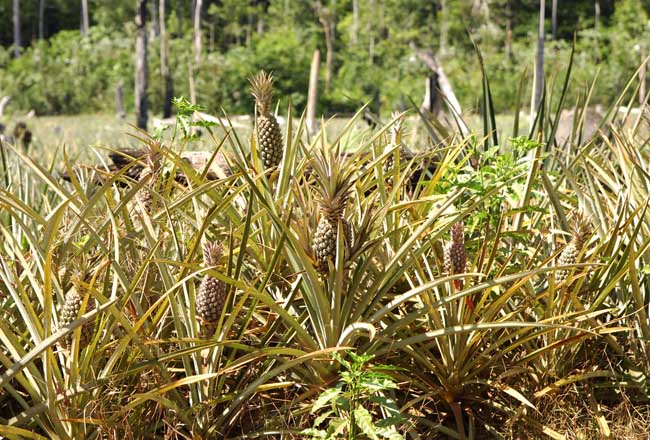
Pineapple is a tropical perennial herbaceous fruit tree. It prefers warmth and humidity and is intolerant of low temperatures and frost. It has strong drought tolerance, but good growth and development require sufficient water. If rainfall is insufficient, excessive, or unevenly distributed, it should be regulated through drainage and irrigation. Pineapple originated in tropical rainforests and tropical plateau regions. It has relatively strong shade tolerance and prefers diffused light over direct light, but abundant light is still needed for high yield and good quality. Pineapple has broad adaptability to soil, but neutral or alkaline soil, clayey soil, or structureless silty sand soil is unsuitable; it requires a pH of 5--6. Pineapple plants are short, so wind damage is relatively minor, but strong winds above level 6 can still cause damage.
Planting and Seedling Propagation
Pineapple is planted at 3800--4000 plants per 666.67 sq m, requiring a large quantity of seedlings. Three methods are commonly used: flower induction with morphactin for bud propagation, vegetative propagation, and tissue culture. Time and method of bud induction: from May to November, select plants with 40 cm long green leaves, usually 40 leaves for the Cayenne group and 35 leaves for Philippine varieties. For each plant, pour 25 ml of a mixed solution of 250 mg/L ethephon plus 1% urea and 0.5% potassium chloride into the heart to induce buds. On the 5th and 12th days after treatment, pour 25 ml of 1200--1500 times and 600--750 times morphactin solution respectively into the heart. For vegetative propagation, small seedlings are commonly cultivated, that is, small terminal buds, small slip buds, small suckers, and fruit tumor buds from the field are classified and temporarily planted in a nursery for cultivation before being taken out. Small slip buds remaining on the fruit stalk after harvest are grown and cultivated into seedlings; old stems are also used for cut-block propagation and for propagation from old stems in renewal fields. For tissue culture seedling propagation, Ms medium is used, and culture is carried out in a culture room at room temperature of 30°C with 12 hours of light or natural light.
Pineapple Planting Techniques
1. Choose a good garden site: choose a site facing south, with ample sunlight, abundant water sources, and convenient transportation as a commercial production base.
2. Scientific planting: before planting, improve poor soil and apply sufficient base fertilizer; select strong seedlings for planting. Density: 3000--4000 plants per 666.67 sq m for the Cayenne group, and 4000--5000 plants for the Queen group.
3. Strengthen fertilizer and water management after planting
① Fertilizer amount: in Guangxi, China, apply 42.2 kg of nitrogen, 26.8 kg of phosphorus, and 38.5 kg of potassium per 666.67 sq m, with N : P2O5 : K2O = 1 : 0.62 : 0.9;
② Fertilization periods: usually apply bud-promoting fertilizer from December to February of the following year before flower bud emergence, and apply sprout-strengthening fertilizer in July to August after harvest; between the bud-promoting fertilizer and sprout-strengthening fertilizer, apply fruit-strengthening and bud-inducing fertilizer; apply foliar fertilizer once each in April, June, July, and September every year, and apply topdressing twice each in May and August, using 1% urea plus 0.5% potassium sulfate solution; apply base fertilizer after harvest.
③ Water management: drain and irrigate in a timely manner to prevent waterlogging and resist drought.
4. Do a good job in other management tasks: for example, to avoid affecting fruit growth and development, remove and retain buds appropriately; to promote flowering, carry out flower induction; to increase fruit weight and quality, spray the fruit. After all florets have faded, spray the fruit with 50 mg/L gibberellin plus 0.5% urea solution, spray a second time after 20 days with 70 mg/L gibberellin plus 0.3% urea solution. To make the fruit ripen uniformly, when the fruit develops to 70% maturity, spray the fruit with 300 mg/L ethephon to promote ripening.
Pest and Disease Control
1. Disease control
① Control of wilt disease: after the plant becomes diseased, the leaves soften and droop, the leaf color changes from light green to red, the base rots, and finally the whole plant dies. This disease is caused by damage from mealybugs. The control method is first to strictly avoid using diseased seedlings for propagation. Second, promptly eliminate mealybugs. At planting, soak the heads in 500 times dimethoate solution, invert and air-dry, then plant. If mealybug damage is found after planting, promptly spray 500 times dimethoate solution, or 25% Zhongke Meiling 1500 times solution. If diseased plants are found, promptly dig them out to prevent spread.
② Control of black rot: the affected fruit core turns black and gradually expands until the whole fruit rots. The pathogen mostly invades through wounds at bud removal sites and fruit stalk wounds from harvesting. The control method is to avoid topping and harvesting on rainy days, so as to reduce opportunities for pathogen invasion. This disease is also a major disease in the storage of fresh pineapple fruit.
③ Control of seedling heart rot: seedlings rot at the heart and die. It is mainly caused by heating from piling or water accumulation. The control method is to avoid piling seedlings for too long, especially during long-distance transport, where piling for too long should be minimized as much as possible, so as to avoid heat damage to seedlings caused by high temperature, high humidity, and poor ventilation. After arriving at the destination, spread them out immediately, dry them slightly in the sun for 1~2 days, then plant. Avoid planting on rainy days, and pay attention to deep plowing and shallow planting.
2. Insect pest control
When the fruit ripens, it may be bitten by the large-headed cricket, which makes the fruit poor in quality and turns it into an off-grade fruit. Control method: stir 5 dry kg of rice bran and 1 kg of cooked sweet potato into a small amount of pickled vegetable juice, then add 100 g of 90% crystal trichlorfon to make poison bait the size of beans. In the evening, scatter each bait around the plants to trap and kill the pests.
Harvesting and Processing
The appropriate harvest time depends on whether the fruit is for fresh consumption or processing, and whether it is for nearby sale or distant sale. Generally, for nearby sale, harvesting when 1/2 of the small fruit has turned yellow is appropriate; for distant sale or fruit used as processing raw material, harvesting when the small fruit is grass-green or 1/4 of the small fruit has turned yellow is the suitable harvest period.
Pineapple can be eaten fresh and can also be processed into canned pineapple in syrup, pineapple juice, and so on. Fresh pineapple fruit can also be quick-frozen: after washing, peeling, coring, and cutting into pieces, it is frozen at -35°C and stored at -20°C, which can keep the nutrition the same as fresh pineapple. In addition, by-products from pineapple processing can be used to make sugar, alcohol, monosodium glutamate, citric acid, and so on.