How many years does a kiwifruit tree generally need to be planted before it bears fruit?
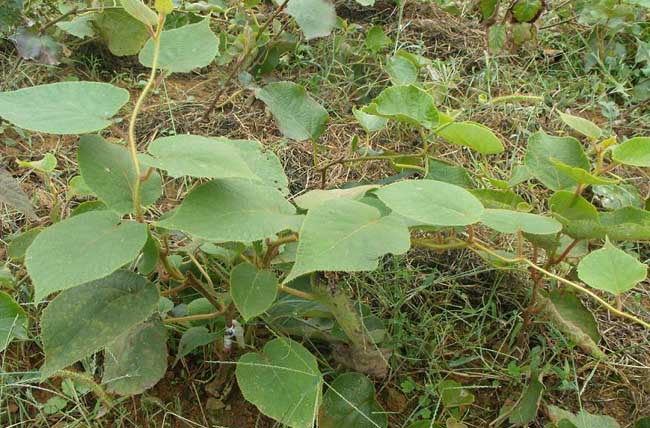
Kiwifruit is also known as qiyiguo, fox peach, vine pear, yangtao, and so on. It is an ancient wild vine fruit tree native to China. It is named kiwifruit because macaques like to eat it; some say it is named because its fuzzy skin resembles a macaque. It has extremely high cultivation value, and the history of artificial cultivation among the people reaches more than a thousand years. Now let us take a look at how many years it takes for a kiwifruit tree to bear fruit!
How many years does it take for a kiwifruit tree to bear fruit?
Kiwifruit is a large deciduous woody vine with separate male and female plants. Under normal conditions, it generally takes 5 years to bear fruit. If managed properly, it can bear fruit as early as 4 years. So-called proper management means that fertilizer keeps up every year. Of course, remember to apply thin fertilizer frequently when fertilizing, and never apply a large amount of fertilizer all at once, so as not to cause fertilizer damage and burn the plants to death.
Ripening time of kiwifruit
The flowering period of kiwifruit is in June, and the fruit ripening period is from August to October. The berry is ovoid to oblong, with a cross-sectional radius of about 3 cm, densely covered with yellow-brown branched long soft hairs. A ripe fruit is about the size of a duck egg. The dark brown, hairy skin is generally not eaten, while inside is bright green flesh and multiple rows of black seeds. Because the skin is covered with hair and resembles a macaque, it is named kiwifruit.
Growing environment of kiwifruit
1. Climate: Kiwifruit is a sun-loving tree species, tolerant of partial shade, and prefers a cool and humid environment. It is afraid of drought, waterlogging, and wind. It is cold-tolerant but not tolerant of late spring frost. It is advisable to choose areas with a mild climate, sufficient sunlight, abundant rainfall, relatively even precipitation during the growing season, high air humidity, and few early and late frost and freezing injuries. It can generally be planted from 800 to 1800 m, but 1000 to 1600 m elevation is more suitable.
2. Soil: The growing soil for kiwifruit is preferably deep, fertile, well-aerated sandy soil with a groundwater level below 1 m, high organic matter content, and a pH of 5.5 to 6.5, slightly acidic. Strongly acidic or alkaline soil needs to be improved before cultivation.
3. Light: Kiwifruit likes light but is afraid of sunscald. Wild plants basically grow on shady slopes, semi-shady slopes, and riversides, and have a very strong ability to use diffused light. Even growing wrapped around and attached to a large tree is no problem at all, but it cannot be too heavily shaded. If there is a severe lack of light, branches will die. In plain terms, it likes sunlight but is afraid of high temperatures.
4. Temperature: Temperature is the main factor limiting the distribution, growth, and development of kiwifruit. Each species has a suitable temperature range, and beyond this range it grows poorly or cannot survive. Most kiwifruit species require a warm and humid climate, that is, a subtropical or temperate humid or semi-humid climate.
5. Fertilization: Kiwifruit likes fertilizer but is afraid of burning. Once it lacks inorganic nutrients, it shows yellowing, small leaves, stopped growth, and other phenomena. Therefore, kiwifruit is relatively sensitive to nutrients, but the fleshy root system is also very sensitive to soil salt concentration (especially during continuous high temperature and drought), thus forming a new contradictory pair. In production, a method of applying fertilizer in small amounts many times is required, which can meet nutrient needs without causing fertilizer damage. This is what is meant by kiwifruit liking fertilizer but being afraid of burning.
6. Water: Kiwifruit likes water but is afraid of waterlogging. In summer, leaf transpiration is very vigorous, and water demand is relatively large. Therefore, from June to August, the soil moisture content is generally required to be maintained at 70%, which is ideal. At the same time, however, the root system of kiwifruit is a fleshy root with strong respiration and needs a relatively high oxygen content in the soil, that is, necessary soil aeration. Therefore, according to the relationship between soil water and air, do not water too much.