Key Cultivation Techniques and Management Methods for the Black Beauty Watermelon
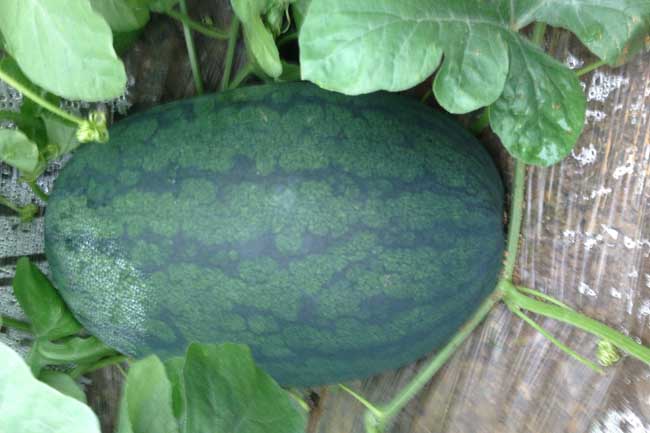
The Black Beauty watermelon is a new high-quality watermelon variety that has recently appeared on the market. Each melon weighs 1.5-3.5 kg. The fruit is oblong-elliptical and has the characteristics of high sugar content, excellent flavor, and superior quality. It is resistant to storage and transport, highly marketable, and of high economic value. By adopting early-maturing techniques such as film seedling raising and plastic mulch covering to cultivate the Black Beauty watermelon, yields can be increased by 30%-50%, and the fruit can mature and reach the market 20-25 days earlier, giving very significant economic benefits.
Sowing and Seedling Raising
1. Preparing nutrient soil: Use nutrient cups for seedling raising. Each mu requires 150-180 kg of nutrient soil. The nutrient soil is made by sieving and thoroughly mixing 70% pond mud, 20% decomposed organic fertilizer, and 10% pure red mud. Each bag weighs about 0.5 kg, and 6-7 granules of compound fertilizer are placed in the middle of each nutrient bag. The raw materials used to prepare the nutrient soil must not be soil that has previously been used to grow watermelons.
2. Sprouting and sowing: Soak the seeds in a 500-fold dilution of 50% carbendazim for 30 minutes to disinfect them, then soak them in clean water for 4 hours. Remove them and keep them warm to sprout until 70% of the seeds show white radicals, then sow. When sowing, first drench the nutrient soil thoroughly with a 500-fold dilution of carbendazim. Place the seeds flat, about 1 cm deep, with the sprout facing downward. After sowing, cover with nylon film to keep warm and raise the seedlings, keeping the nutrient soil moist. Generally, seedlings emerge 5-7 days after sowing. After emergence, the seed shells must be removed by hand to encourage the cotyledons to unfold as quickly as possible.
3. Cultivating strong seedlings: Spray the seedlings once every 7-10 days with a 800-fold dilution of 50% dimethoate and a 500-fold dilution of 50% carbendazim. When the first true leaf grows out, begin watering with decomposed human manure and urine diluted 10 times with water, once every other day. On clear mornings, the film can be opened for hardening the seedlings, and it should be covered again in the evening. When the seedlings grow to 2-3 true leaves, they are ready for transplanting.
Land Preparation and Transplanting
1. Site selection and land preparation: Choose a sandy plot with ample sunlight, convenient drainage and irrigation, and deep, loose soil to build beds for planting. The bed width is 3 m, the ditch width is 0.5 m, and the bed surface is slightly arc-shaped. During land preparation, 50 kg of quicklime can be evenly spread per mu, which both disinfects and neutralizes soil acidity. Apply 1000-1500 kg of decomposed pig and cattle manure, 20-25 kg of superphosphate, 30 kg of compound fertilizer, and 10 kg of potassium sulfate per mu as base fertilizer, placing them into the planting holes and mixing them evenly with the soil.
2. Transplanting: Transplant when the seedlings grow to 2-3 true leaves, with a plant spacing of 0.5 m and 300-330 plants per mu. After transplanting, use a 500-fold dilution of 50% carbendazim as the rooting water. Then lay one strip of film on each side of the seedlings on the bed surface, keeping the film tightly against the bed surface and pressing it down firmly so it will not be lifted off.
Field Management
1. Fertilization: Begin applying the first fertilizer 3 days after transplanting, then apply once a week thereafter. In the early stage, mainly use urea; in the later stage, mainly use potassium fertilizer. Especially during the fruit-swelling stage, heavier fertilization is required. When the melons grow to the size of an egg, apply 1000 kg of decomposed human manure and urine per mu, plus 20 kg of compound fertilizer and 20 kg of potassium sulfate. On a clear afternoon, open the plastic mulch and apply it 60 cm away from the watermelon seedlings, then apply once more after 10 days. At the same time, foliar fertilizer can also be sprayed together with pesticide application for pest and disease control.
2. Vine training: Keep one main vine and two strong secondary vines per plant, and promptly prune other secondary vines and tertiary vines. When the watermelon seedlings change from an upright state to creeping growth, spread grass near the root crown so the vines can climb and twine, and to prevent the film from reflecting sunlight and scorching the seedlings.
3. Pest and disease control: During the seedling stage, mainly control underground pests. The main diseases during the growing period include fusarium wilt, phytophthora blight, and powdery mildew, which can be controlled with guakuning, carbendazim, and dasen powder. The main pests include watermelon leafminer, yellow squash beetle, and watermelon webworm, which can be controlled with dimethoate, shachongshuang, pumieke, and sangli No. 1.
4. Artificial supplementary pollination and fruit selection and retention techniques: Black Beauty watermelon generally does not require artificial pollination in good weather, but when rainy weather affects fruit set, open male flowers can be picked from 6-8 a.m. for artificial pollination. Generally, keep 3 melons per plant, one on the main vine and one on each side vine. For the fruit-setting node, generally remove the first female flower and select and keep the second female flower, that is, set fruit at around the 10th node. The retained melons should be cushioned with grass, and the contact surface should be kept dry. After the fruit is securely set, when the main and side vines grow to about 25 nodes, pinch off the growing tips so that nutrients are concentrated in supplying the fruit.
Timely Harvesting
Watermelons should be harvested at the right time. They generally mature about 28 days after female flower pollination. Before harvesting, 1-2 melons can be cut open on a trial basis for inspection to determine the harvest date.