Detailed Explanation of Key Management Techniques for Strawberries During the Flowering and Fruiting Period
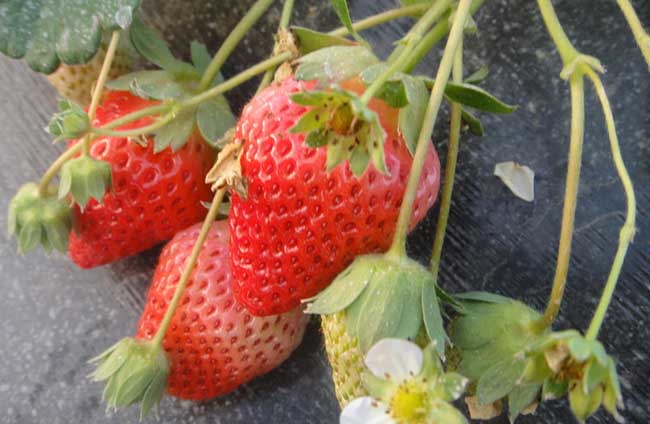
During the flowering and fruiting period, strawberries require a field water-holding capacity of 80%, a temperature of 18°C to 26°C, and 12 to 15 hours of daily sunlight. The key management points are as follows:
Topdressing
In early to mid-April, apply 10 to 15 kg of urea or compound fertilizer per mu to accelerate plant growth, promote new leaf development, and encourage flowering and fruiting. In addition, spray a 0.3% to 0.5% potassium dihydrogen phosphate solution on the leaves 2 to 3 times.
Runner Removal
Removing strawberry runners can increase yield by 40% to 50%. For propagation purposes, an appropriate number of runners can be retained; excessive runners consume a large amount of nutrients and affect subsequent flower bud differentiation. Generally, runners are removed as soon as they emerge, and this should be done 3 to 4 times per year.
Bud Thinning
The later-opening flowers on a strawberry inflorescence often fail to form fruit, have no economic value, and consume nutrients. They should be thinned when the flower buds are separated from one another, with removal of about 20% of the inflorescence being appropriate. Weak inflorescences need not be retained.
Fruit Padding
Strawberry plants are short, and the fruit easily hangs down and touches the ground, becoming contaminated by soil and susceptible to pests and diseases, which can also cause uneven fruit coloration. Chopped straw or wheat straw can be spread around the plants as a cushion.
Timely Harvesting
Ripe strawberries are soft and juicy and must be harvested promptly to prevent rotting.