Key Points of Osmanthus Cultivation Techniques and Video Explanation
Osmanthus is an evergreen tree of the genus Osmanthus in the family Oleaceae, also known as muxi, yangui, jinsu, jiulixiang and so on. It has a cultivation history of more than 2,500 years in China and is one of China's ten traditional famous flowers, as well as one of the most precious flowering trees in modern urban landscaping. It originated in the southwestern and central-southern regions of China and is now widely cultivated in the provinces along the Yangtze River basin, while in North China and Northeast China it is mostly grown in pots. It has a graceful tree form, lush branches and leaves, verdant foliage and evergreen throughout the four seasons, and is especially attractive for its subtle and delicate floral fragrance, truly "dominating the three autumns and surpassing all other flowers," and has been designated as the city flower by world-famous tourist cities such as Suzhou, Hangzhou and Guilin.
Overview of Osmanthus Cultivation
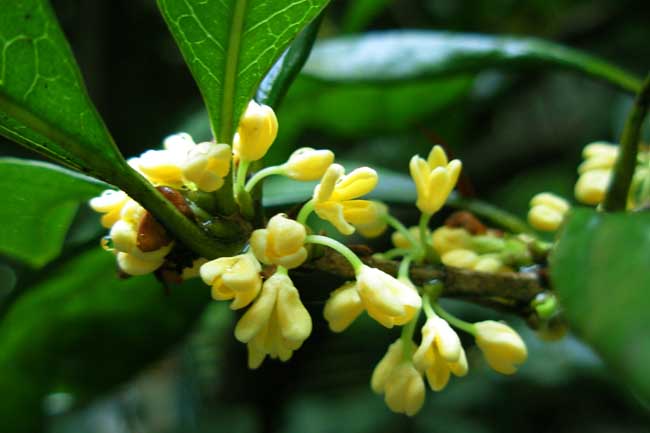
1. Varieties of osmanthus: There are many varieties of osmanthus, mainly including Jingu, Yingui, Dangui and Sijigui. The Jingu tree is tall with a rounded crown; its leaves are large, deep green and glossy, elliptical in shape, with wavy leaf margins and thick blades; the flowers are golden yellow and have the strongest fragrance. Yingui leaves are smaller, elliptical, ovate to obovate, and relatively thin; the flowers are yellowish-white or pale yellow, with a fragrance slightly weaker than that of Jingu, and the flowering period is also 1 week later than that of Jingu. Dangui leaves are smaller, lanceolate or elliptical, with pointed tips and rough leaf surfaces; the flowers are orange-yellow or orange-red, with a relatively faint fragrance. Sijigui leaves are elliptical and relatively thin; the flowers are yellow or pale yellow, and the flowering period is long. Apart from severe cold and extreme heat, it blooms several times, but mostly in autumn, with a faint fragrance and smaller leaves, and it mostly grows in a shrubby form.
2. Habits of osmanthus: Osmanthus prefers a warm and humid climate and has a certain cold resistance, but it is not tolerant of severe cold. It likes light and is also shade-tolerant, and seedlings need a certain degree of shading. It has low requirements for soil and prefers slightly acidic soil on high, dry terrain rich in humus, especially deep, fertile, moist and well-drained sandy soil. It is not tolerant of drought or barren soil, and avoids saline-alkaline soil and waterlogged land. When planted in overly wet land with poor drainage, it will cause poor growth, root rot and leaf drop, eventually leading to the death of the whole plant.
3. Cultivation value of osmanthus: Osmanthus has a wide range of uses. It is often planted in gardens, along roadsides, on lawns and in courtyards, and is the best landscaping tree species for government offices, schools, the military, enterprises and institutions, streets and homes. Because it has a certain resistance to harmful gases such as sulfur dioxide and hydrogen fluoride, it is also an excellent flowering tree for greening industrial and mining areas. When paired with mountains, rocks, pavilions, terraces, buildings and towers, it appears even more dignified and elegant, pleasing to the eye and delightful to the mood. It is also an excellent material for potted plants; after being made into a bonsai, it can provide form, stone-like beauty and fragrance, truly achieving "three benefits at once." In addition, osmanthus wood is hard, glossy and beautifully grained, making it a good material for carving. Osmanthus is an important raw material for making osmanthus sugar, osmanthus tea, osmanthus wine and osmanthus cake. The essence extracted from osmanthus is widely used in the food industry and chemical industry. The bark can be used to extract dyes and tanning materials, and the leaves can be used as seasoning to add a fresh fragrance to food.
Propagation Methods of Osmanthus
1. Cuttage and grafting: The propagation methods of osmanthus include seeding, cuttage, grafting and layering. In production, cuttage and grafting propagation are the most common. Cuttage propagation has the advantages of simple technique, large propagation quantity, high speed, high survival rate and low cost, and is the most widely adopted and commonly used propagation method by nursery producers and flower enthusiasts.
① Cuttage time: Cuttage can be carried out from early March to mid-April using 1-year-old spring shoots, which is the best cuttage time. It can also be carried out from late June to late August using semi-mature branches of the current year for cuttage with a heel, but this has high requirements for controlling temperature and humidity.
② Cutting and treatment of cuttings: Select robust, plump, pest-free branches from the middle-upper part and outer periphery of the crown of young and middle-aged trees as cuttings. Cut the branches into 10-12 cm lengths, remove the lower leaves and keep only 3-4 leaves at the top. If conditions permit, soak the cuttings in a 50 to 100 ppm GGR6 solution for 0.5-1 hour, which is very beneficial for rooting.
③ Cutting medium preparation: Use slightly acidic, loose, air-permeable soil with good water retention as the cuttage substrate. Before cuttage, disinfect and sterilize the cutting medium with drugs such as carbendazim and quintozene.
④ Post-cuttage management: The main task is to control temperature and humidity, which is the key to whether the cuttings can root and survive. The optimal rooting soil temperature is 25-28°C, and the optimal relative humidity should be maintained above 85%. Methods such as shading, plastic arch sheds, watering and ventilation can be used for control. Second, attention should be paid to mold prevention, because high temperature and high humidity easily breed mold; carbendazim and thiophanate-methyl can be used alternately for spraying and sterilization every week. Grafting propagation has the advantages of rapid seedling formation, vigorous growth, early flowering and small variation, and is also one of the relatively commonly used methods.
⑤ Cultivation of rootstock: Mostly 1-2-year-old seedlings such as Ligustrum lucidum, Ligustrum quihoui and Fraxinus bungeana are used as rootstock. Among them, grafting osmanthus onto Ligustrum lucidum has a high survival rate and rapid initial growth, but the wound heals poorly and is prone to breaking off when exposed to strong winds or external collision.
2. Grafting propagation: Grafting is carried out around Qingming Festival. The two most commonly used methods in production are cleft grafting and side grafting. For scions, it is advisable to select fully lignified 1-2-year-old robust, disease-free branches from mature trees, remove the leaves and retain the petioles. When using the cleft grafting method, the rootstock should be cut off 4-6 cm above the ground before grafting in spring before the seedlings sprout. The thickness of the scion should match that of the rootstock, and the cut surface of the scion should be smooth. The key to successful cleft grafting lies in aligning the cambium layers of the rootstock and scion and tying them tightly. When using the side grafting method, there is no need to cut off the rootstock; the scion bud is directly inserted into the rootstock, and the rootstock is cut off after the grafting succeeds. No matter which grafting method is used, it is best to graft immediately after taking the scion. If the scion is obtained from another place, be sure to keep the scion material fresh. It is best to choose sunny and windless weather for grafting. After grafting, attention should be paid to checking the survival rate, doing well in supplementary grafting, bud wiping, rootstock cutting, removal of tying bands, water and fertilizer management, and pest and disease control.