How to Grow Begonia maculata? A Detailed Guide to Its Cultivation Methods
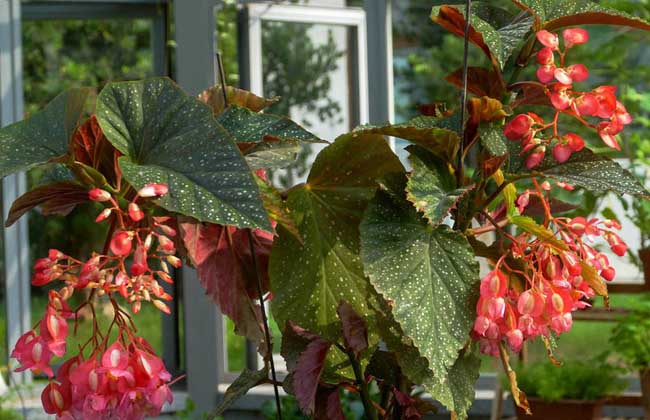
Begonia maculata is a perennial upright or loosely spreading subshrub in the family Begoniaceae, genus Begonia. Its fleshy leaves are obliquely oblong to oblong-ovate, the petioles are thick and purplish-red, and the flowers are borne in loose cymes, pale red or white, blooming in summer and autumn. The foliage is soft and lovely with very high ornamental value, and it is often grown in pots to accent living rooms, display windows, or to decorate home windowsills, balconies, tea tables and other places. Let's take a look at the cultivation methods for Begonia maculata below!
Growth Habits of Begonia maculata
1. Temperature: Begonia maculata grows rapidly in a warm environment, with luxuriant stems and leaves and bright flowers. The optimum growth temperature is 19-24°C, and the winter temperature should not be lower than 10°C, otherwise the leaves are prone to frost damage, though the rhizome is relatively cold-hardy.
2. Light: Begonia maculata is sensitive to light and is best grown under morning light and diffused light; strong light easily causes leaf scorch. Its response to photoperiod is very pronounced, and under short-day conditions the flowering period is noticeably delayed.
3. Soil: Begonia maculata prefers well-drained humus soil, with a suitable pH of 6.5-7.5. Alkaline, heavy, or easily compacted soil is unfavorable for growth, leading to short stems and leaves, dull colors, and susceptibility to chlorosis.
Propagation Methods for Begonia maculata
1. Sowing: Usually a shallow clay pot or a sowing box is used. First, cover the bottom of the pot with pot shards, evenly fill it with loose, fertile sowing soil, then gently press it level with a garden wooden board, and scatter the seeds evenly on top. After sowing, there is no need to cover with soil, as watering would wash the seeds away; instead, the pot is often soaked from the bottom, then removed once moistened. The pot opening is covered with semi-transparent glass to maintain high humidity inside the pot, and it is placed in a semi-shaded spot at a room temperature of 18-22°C, misted morning and evening. Generally, germination occurs 7-30 days after sowing.
2. Stem cuttings: Stem cutting propagation can be carried out year-round at room temperature, but the best results are achieved in April to May. Select a healthy stem tip as the cutting, 10-15 cm long, with 2-3 buds. The cutting medium is loose, well-drained fine river sand, perlite, or rice husk ash. When inserting the cutting, it should not be buried too deep; half of the cutting is appropriate. Maintain high air humidity and a room temperature of 20-22°C. Generally, callusing and rooting occur in 9-27 days.
3. Leaf cuttings: Leaf cutting propagation gives the best results in summer and autumn. Select fully developed mature leaves and lay them flat on a sand bed. Use a blade to make 1 cm cuts at the central midrib of the leaf; each leaf can have 4-5 cuts. Then use "n"-shaped wire to fasten the leaf tightly onto the sand surface. If the cutting medium temperature is below 15°C, rooting will be delayed; below 10°C, rooting becomes difficult.
4. Root cuttings: In spring and autumn, cut the lower rhizome into 3-5 cm sections and insert them obliquely or lay them flat on a sand bed, maintaining a room temperature of 20-22°C and relatively high indoor humidity to induce adventitious roots and adventitious buds. Generally, adventitious roots grow 15-20 days after insertion, and adventitious buds sprout in 30-40 days. Once several small leaves have formed, they can be moved into small pots for care.
Cultivation Methods for Begonia maculata
1. Watering: Begonia maculata is a shallow-rooted plant that likes semi-shade and a mild, moist environment. Its optimum growth temperature is between 15 and 25°C. It is fairly drought-tolerant but afraid of waterlogging, so watering should follow the principle of "dry then wet," keeping the potting soil moist as the ideal. In midsummer, mist the leaves and ground to raise air humidity, which benefits its growth.
2. Fertilizing: Begonia maculata is a heavy feeder. Fertilizer should be applied when the potting soil is dry, with shallow hoeing beforehand; watering after fertilizing helps the plant absorb nutrients. However, when stems and leaves are not vigorous or right after repotting, heavy fertilizing should be avoided. In the vigorous spring growth period, apply a dilute liquid fertilizer once every 10 to 15 days. In the high-temperature summer season, the plant stops growing and fertilizing should be reduced. Fertilizing is paused during the flowering period and in winter.
3. Light: Begonia maculata is sensitive to light and is best grown under morning light and diffused light, suitable for year-round cultivation on a south-facing balcony. In spring, autumn, and winter, give it plenty of sunlight. In summer, avoid strong light exposure, otherwise the leaves will turn yellow and growth will slow. Its response to photoperiod is very pronounced, and under short-day conditions the flowering period is noticeably delayed.
4. Pruning: Pruning Begonia maculata helps maintain a good plant shape. For plants grown for many years, or when the plant grows too tall or the leaves at the lower part of the stem drop off, making the shape unattractive and affecting the ornamental effect, pruning can be done together with spring repotting to encourage new shoots and produce more bright flowers.
5. Diseases: Pest and disease control for Begonia maculata should fully implement the principle of prevention first and integrated control. First, strengthen ventilation and light penetration; the potting soil should not be too wet, and water should never accumulate in the pot. Second, spray a fungicide once every half month, such as thiophanate-methyl or carbendazim, to prevent disease. If red spider mite damage is found, spray dicofol at 1500 times dilution.