How to grow Sedum makinoi? A detailed guide to its cultivation methods
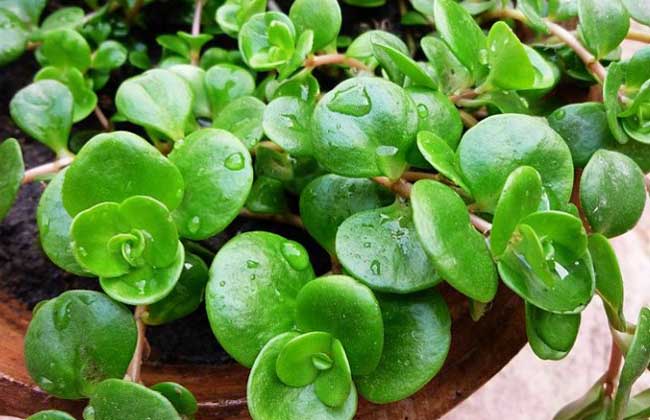
Sedum makinoi is an evergreen perennial succulent herbaceous plant of the genus Sedum in the Crassulaceae family. In landscaping it is often used to arrange flower beds, and can be shaped into circles, squares, cloud scrolls, arcs, fan shapes and other forms. It can also be used as a ground cover plant, or grown in pots or hanging baskets to regulate air humidity and adorn terraces and courtyards. Let's take a look at the cultivation methods for Sedum makinoi below!
Growth habits of Sedum makinoi
Sedum makinoi is native to Huangshan in Anhui, China, and Siming Mountain in Zhejiang, growing in shady, damp places under forests in low-mountain valleys. It prefers cool, humid and semi-shaded environments, has relatively strong cold resistance, does not tolerate high summer temperatures or direct sun, and requires loose, fertile sandy loam. It likes sunny and relatively dry environments; as long as it is cultivated in a sunny, relatively dry spot, it can grow luxuriantly, with strong cold resistance and relatively few pests and diseases.
Propagation methods for Sedum makinoi
Sedum makinoi can root quickly through cuttings without dipping in rooting hormone; generally it roots in 7 days in summer, and 3 to 4 weeks after cuttings are taken the plants begin to grow, with some producing lateral buds and others continuing to grow from the original part at the top. However, during the rooting stage of cuttings, do not water excessively; the rooting medium must have good drainage and must be kept relatively dry, with at least 12 to 14 hours of light per day.
Cultivation methods for Sedum makinoi
1. Soil: The cultivation soil for Sedum makinoi must be well-drained and free of pests and diseases, with a pH between 5.5 and 6.0. River sand or peat soil can be mixed, with a ratio of sand to peat soil of 1:1. To reduce costs, construction leftovers containing crushed bricks can also be used. Flower pots or plug trays can be used as containers.
2. Light: Sedum makinoi likes an environment with sufficient light, but is also slightly shade-tolerant. Growth generally requires direct sunlight, so as to ensure robust growth and healthy leaf color. When placing them, leave a certain spacing to prevent leggy growth, determined according to the size of different plant types.
3. Temperature: Because Sedum makinoi originated in highland regions, it has relatively strong cold resistance and can usually tolerate extreme low temperatures (short periods of freezing) and extremely dry weather, but it does not tolerate high summer temperatures. The suitable temperature for nighttime growth is 15°C to 18°C, and the suitable temperature for daytime growth is 24°C to 26°C.
4. Fertilizing: Sedum makinoi is extremely tolerant of poor soil and generally does not need fertilizing. If fertilizing is truly needed for maintenance, apply fertilizer 1 to 2 times during the growing season, and the concentration must be low, mainly organic nitrogen fertilizer. In early spring, when new buds of the plant just begin to sprout, organic fertilizer can be broadcast on the soil surface, but be careful to use only a small amount.
5. Watering: Sedum makinoi must never be watered excessively. Within the first 10 to 14 days after potting, spray water moderately and do not let the soil become soaked. Follow the principle of “water when dry, stop when wet” when spraying, and reduce the time the soil is soaked, otherwise it will cause root rot. In winter, try not to water, and only water if the plant wilts due to lack of water. In summer, if there is no rainwater irrigation, water once a week.
6. Repotting: In spring, repot Sedum makinoi according to the plant's growth condition, being careful not to damage the leaves. A relatively shallow flat tray or hanging pot can be used as the container. A flower pot with a diameter of 15 to 20 cm is sufficient for later growth. Coarse sand can be mixed into the medium to ensure sufficient air permeability.