How to grow Mussaenda and key points to note
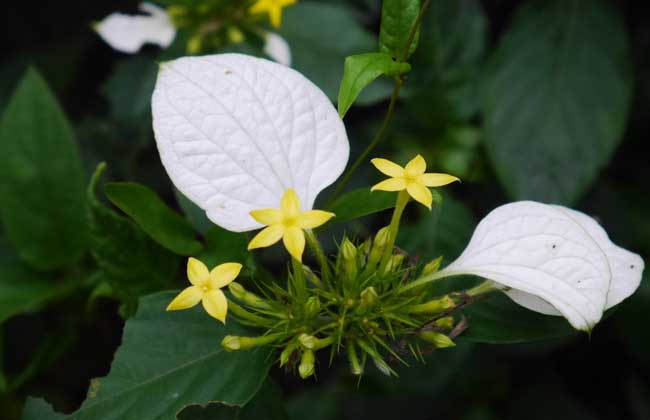
Mussaenda, also known as white paper fan, white butterfly, white leaf and so on, is a climbing shrub of the genus Mussaenda in the family Rubiaceae. Its branches are slender and pliable, so it can be shaped into all kinds of bonsai according to individual preference, and can also be used for vertical greening beside walls and other structures. It plays an important role in greening and beautifying the environment, purifying the air, conserving water, preserving soil and water, and improving the ecological environment. Let us take a look at how to grow Mussaenda!
Growth habits of Mussaenda
Mussaenda is distributed across the provinces and regions south of the Yangtze River in China, including Guangdong, Hong Kong, China, Hainan, Guangxi, Fujian, Hunan, Jiangxi, Zhejiang and Taiwan, China, and often grows wild on hilly slopes, in shrub thickets, at forest edges, in gullies, in the wild and along roadsides. It has strong adaptability, tolerates shade, grows quickly, sprouts vigorously and tolerates pruning extremely well, and can grow in relatively poor soil and in sunny or semi-shady, moist environments.
Propagation methods of Mussaenda
1. Cuttings: In spring, select one-year-old, plump and healthy young shoots, cut cuttings 8-12 cm long and cut their lower ends at a 45-degree angle. Before inserting, soak the base of the cuttings in a low-concentration potassium permanganate solution for 1-2 hours, then insert them into a cutting bed of river sand or perlite with good water and air permeability, at a depth of about 1/2 the length of the cutting. After inserting, water thoroughly once, and take care to shade them and maintain air humidity. They will root and survive after 10-15 days.
2. Sowing: From the start of summer to the grain-full period, dry newly collected seeds in a cool, ventilated place and then sow them. To improve the germination rate and speed up emergence, soak the seeds in a potassium permanganate solution of about 1-2% concentration at around 30°C for 1-2 hours, take them out, dry them and sow. Cover with about 1 cm of soil, and take care to keep them moist and provide shade and ventilation. Seedlings will emerge in 7-10 days.
How to grow Mussaenda
1. Soil: Mussaenda requires fertile, loose, well-drained, slightly acidic soil. For pot cultivation, well-drained loam or sandy loam rich in humus is best.
2. Watering: Mussaenda is somewhat drought-tolerant, so water should be controlled during the growing period. In midsummer, sprinkle water on the leaves to lower the temperature, and in dry conditions promptly spray water on the leaves and the surrounding space to maintain air humidity.
3. Sunlight: Mussaenda is a sun-loving plant, and whether planted in the ground or in a pot, it needs to be placed in a full-sun or half-sun environment.
4. Temperature: When the winter temperature drops below 0°C, Mussaenda plants are prone to leaf drop, and prolonged low temperatures can easily cause the above-ground parts to dry out and die.
5. Fertilizing: During the seedling stage of Mussaenda, apply more phosphorus and potassium fertilizer. During the bud stage, apply light fertilizer frequently, and foliar feeding can also be used. Mature plants can be given 2 additional applications of phosphorus fertilizer during the flowering period.
6. Pruning: Mussaenda needs repeated pinching. During growth, overly long branches can be thinned out, and the plant can also be trained and fixed into shape as needed. At the same time, promptly remove dead branches, old branches, overly dense branches, leggy branches and diseased or pest-infested branches to improve ventilation and light penetration. After flowering, promptly remove the spent branches to reduce nutrient consumption and encourage it to bloom again.