How to grow and care for Haworthia truncata and key points to note
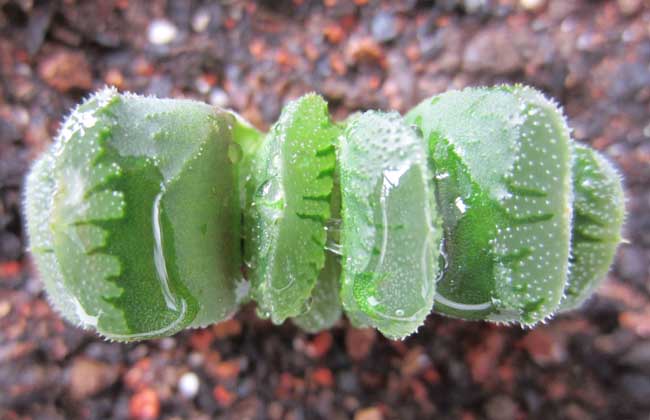
Haworthia truncata, also known as Truncate Haworthia, is a succulent in the genus Haworthia of the family Asphodelaceae. It is robust in habit, with relatively thick roots, a fan-shaped rosette, and fleshy leaves whose transparent tops look like windows. Its patterns are varied, delicate and elegant, like a living work of arts and crafts, and many enthusiasts collect and cultivate it specially. Let's take a look at how to grow Haworthia truncata!
Growth habits of Haworthia truncata
Haworthia truncata is native to southern Africa and can now be cultivated in many places around the world. It likes cool, ample yet soft sunlight. It tolerates drought and partial shade, dislikes damp shade, is not cold-hardy, and fears high temperatures. Give it ample light during the growing seasons of spring and autumn; if light is insufficient, the rosette will become loose, the leaves will stretch out, and the "window" surface will become smaller and cloudy.
Propagation methods of Haworthia truncata
1. Division: Propagation can be done by dividing offsets when repotting. Remove the young plants growing beside the mother plant, let them dry for 2-3 days, then plant them; on the second day after planting, spray a little water.
2. Leaf cuttings: During the growing season, cut healthy semi-lignified fleshy leaves from the base of Haworthia truncata, let them dry for 2-3 days, then insert them into sand or vermiculite, keeping the medium slightly moist; under conditions of 20-25°C, they root in 3-4 weeks.
3. Root cuttings: Root cuttings are done in combination with autumn repotting. Break healthy roots off from the base of the plant and still bury them in the soil, leaving about 1 cm exposed above the soil surface; the tops will then sprout and grow into new plants.
4. Sowing: After Haworthia truncata seeds mature, sow them immediately after harvesting. After sowing, cover the pot surface with glass to keep in moisture, and seedlings emerge in 7-10 days. After sowing and during the seedling stage, water by the "seep irrigation" method to avoid washing out the seeds or knocking over the young seedlings.
How to grow Haworthia truncata
1. Temperature: The growing temperature for Haworthia truncata is 15-20°C. In winter the temperature must be kept above 8°C. If the temperature is too high, it will cause Haworthia truncata to die, because it does not tolerate high temperatures. When growing Haworthia truncata, it can be kept in a dry and semi-shaded environment, and the air humidity must not be too damp.
2. Light: Haworthia truncata is a plant that likes semi-shade and soft, ample sunlight, so when growing it, provide light in spring and autumn, because the light in these two seasons is relatively soft; it must not be exposed to strong sunlight. In winter, give it ample sunlight; above 10°C you can continue watering so the plant grows normally.
3. Watering: Haworthia truncata is a drought-tolerant plant and does not need a lot of water, but during the growing season, because the leaves grow relatively quickly and transpire a relatively large amount of water, it is not suitable to water too much. Generally in summer when temperatures are high, Haworthia truncata is in its dormant period, and it also must not be watered too much.
4. Fertilizing: Fertilizing Haworthia truncata should follow the plant's growth principles, using a small amount at a time and applying it frequently. When fertilizing, pay attention to using a combination of nitrogen, phosphorus and potassium. During the growing season, fertilize once every two weeks; generally a flower fertilizer with a nitrogen-phosphorus-potassium formula is used, to conveniently provide the long-term nutrients needed. When winter temperatures are low, fertilize less or not at all.
5. Repotting: Haworthia truncata generally needs repotting once every two years, and repotting should be done in spring, using loose, fertile sandy soil. At the same time, you can also repot once every September, which can remove old roots and loosen the soil.
6. Pests and diseases: The pests and diseases of Haworthia truncata include leaf rot and dry rot, among others. When growing it, you need to pay extra attention; once such symptoms appear, spray insecticide and fungicide. Generally, spray with a 1500-fold dilution of 50% carbendazim wettable powder. The main pest is whitefly, which can be killed by spraying with a 3000-fold dilution of 10% chuchongjing emulsifiable concentrate.