How to grow Burro's tail? A step-by-step guide to the growing methods
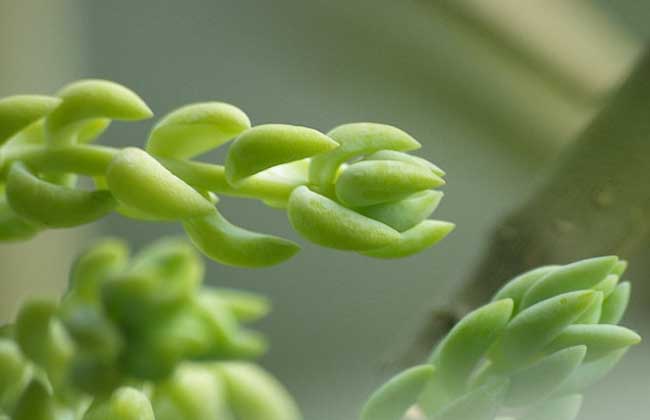
Burro's tail, also known as string-of-beads stonecrop and jade necklace, among other names, is a perennial herbaceous plant of the genus Sedum in the family Crassulaceae. Its fleshy stems grow in a creeping manner and can reach 50 cm in length, and its fleshy leaves grow clasping the stems. The overall plant shape closely resembles a handmade agate bead necklace. Grown as an indoor potted plant, it can beautify the home environment, and it is usually displayed as a hanging specimen or placed in front of a sunny window. Let's take a look at the growing methods for Burro's tail below!
Growth habits of Burro's tail
Burro's tail is native to Mexico, and it is cultivated artificially in many countries around the world. It prefers a warm, semi-shaded environment and dislikes direct strong light, and it is suited to growing in loose sandy soil. For indoor potting, a potting mix made by blending equal amounts of peat soil and fine sand is often used. With insufficient sunlight, the stems and leaves tend to grow leggy, which affects the ornamental effect.
Propagation methods for Burro's tail
Burro's tail is usually propagated by cuttings, which can be done throughout the year, but cuttings taken during the stem and leaf growth period are best. You can cut 5-10 cm long branches and insert them into a sand bed, or scatter the small fleshy leaves on moist sand. After insertion, roots can form in about 30 days, and they can be potted once new leaves grow.
Growing methods for Burro's tail
1. Soil: Burro's tail is suitable for growing in loose, breathable sandy loam. If you are growing it as an indoor potted plant, you can cultivate it in a potting mix made by blending humus-rich peat soil with an appropriate amount of fine sand.
2. Light: Burro's tail is suitable for growing in a ventilated, half-shade and half-sun environment, and it cannot tolerate direct strong light. A semi-shaded environment is the most suitable for the plant's growth. With insufficient sunlight, the stems and leaves tend to grow leggy, which affects the ornamental effect.
3. Temperature: Burro's tail does not have high requirements for temperature, but it is also rather sensitive, especially since the plant's cold tolerance is not very good. When growing it in winter, the temperature absolutely must not be lower than 10 degrees, otherwise it may very likely be damaged by freezing. And when the summer temperature is too high, it is also not good for the plant's growth, so appropriate cooling is needed. In an environment of around 25 degrees, the plant will grow more rapidly and beautifully.
4. Watering: Watering Burro's tail is a troublesome matter, as it needs to be determined according to the needs of different periods. In summer, when the temperature is high, the plant should be watered less, and at the same time it needs to be placed in a cool indoor spot to cool down. In winter, when the temperature is low, watering should follow the principle of watering when dry and stopping when wet, and there should be no water accumulation, otherwise the plant will develop root rot.