Detailed Explanation of Kerria japonica Planting Techniques and Methods
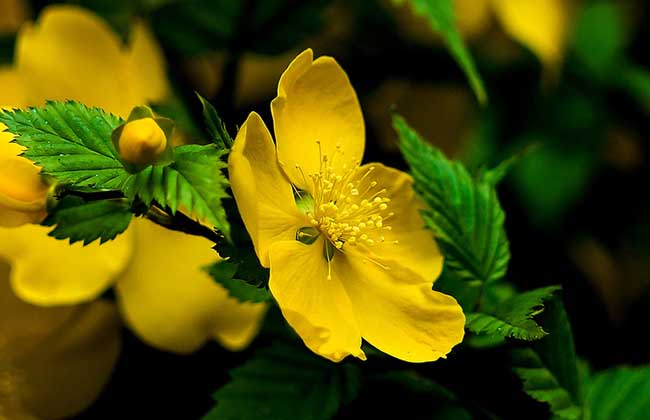
Kerria japonica, also known as Fengtang flower, Huangdumei, Huangyumei, etc., is a deciduous shrub of the genus Kerria in the Rosaceae family. Its branches and leaves are emerald green and slender, and golden flowers cover the tree, giving it a distinctive elegance. Planted at wall corners and beside pipes, it has a screening effect. It is suitable for flower hedges and flower paths, and for group planting in front of evergreen groves, beside old trees, and among mountain rock crevices. Let us take a look at the planting techniques of Kerria japonica below!
Growth Habits of Kerria japonica
Kerria japonica is a deciduous shrub native to North China through South China, distributed in Anhui, Zhejiang, Jiangxi, Fujian, Henan, Hunan, Hubei, Guangdong, Gansu, Shaanxi, Sichuan, Yunnan, Guizhou, Beijing, Tianjin and other places. It prefers warm, humid and semi-shaded environments, has poor cold tolerance, and is not strict about soil requirements, growing best in fertile, loose sandy loam.
Propagation Methods of Kerria japonica
1. Division: Carried out in early spring and late autumn, using a knife or shovel to directly separate new plants each with 1-2 branches from the mother plant in the soil, then take them out for transplanting. The mother plant left in the soil is divided again the following year.
2. Cuttings: For Kerria japonica, hardwood cuttings in March use non-sprouted one-year-old branches, and around June softwood cuttings are used, in brown soil, matured soil or sandy soil. If cuttings are placed in the open field, shade is needed to prevent drying.
3. Sowing: The sowing propagation method is only used when mass-propagating the single-petaled original species. After the seeds are harvested, they need 1-2 months of low-temperature sand storage at 5°C, then sown the following spring. After sowing, cover with fine soil and mulch with grass. After seedlings emerge, build a shed for shade.
Kerria japonica Planting Techniques
1. Soil: The planting site for Kerria japonica should be warm and humid, with soft soil, good drainage, and non-alkaline soil.
2. Transplanting: Apply base fertilizer, compost, barnyard manure, decomposed human feces and urine, etc. to the transplanting site for Kerria japonica, mix evenly, and level. Transplant in the open field or into pots before spring germination or in October.
3. Water and Fertilizer: Kerria japonica generally does not need frequent watering. For potted plants, water with cake fertilizer solution in the afternoon, and avoid watering too much. In summer, water more. During the entire growth period, apply 1-2 times of liquid fertilizer as appropriate according to the seedling's condition.
4. Pruning: When branch dieback is found on Kerria japonica, immediately cut off the dead branches, otherwise it will spread to the roots and cause the whole plant to die. After flowering, leave 50 cm in height and cut off the upper branches to encourage underground buds to sprout.
5. Repotting: In cold regions, repot Kerria japonica about once every 3 years, combining root pruning, division, and renewal of old and weak branches.