How to grow a Jade Plant? Detailed guide to cultivation methods and precautions
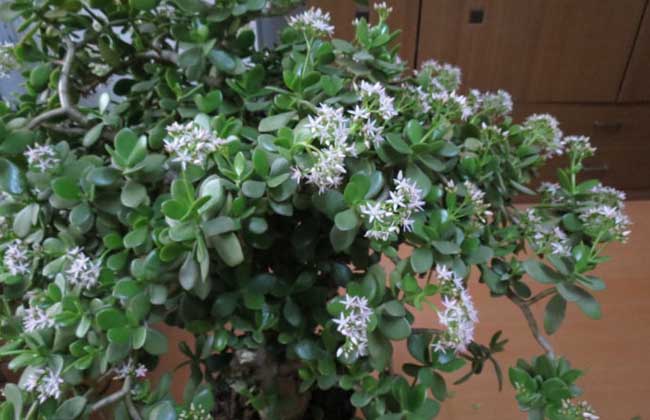
The Jade Plant, also known as Babao, Kanqing, Dongqing and other names, is an evergreen small shrub of the genus Crassula in the family Crassulaceae. Grown as a houseplant, its crown is tall and graceful, its stems and leaves are jade-green and glossy, and it stays green all year round, making it very elegant and distinctive. It can be paired with a pot stand and gravel to make a small bonsai, or grown alone in a pot to decorate a desk, windowsill, coffee table or tabletop, adding a touch of greenery to the home. Now let us take a look at the cultivation methods and precautions for the Jade Plant!
Growth habits of the Jade Plant
The Jade Plant is native to southern Africa. The plant has a multi-branched subshrub form, with distinct, round stems and green or yellowish-brown bark. The leaves have small dots, and the fleshy leaves are opposite, ovate. The flowers bloom in clusters, with small white or white-pink flowers, and are cross-pollinated between different plants, so it does not bloom easily. It likes a warm, dry and sunny environment, is not cold-tolerant, fears strong light, and tolerates slight shade. Fertile, well-drained sandy loam soil is best, and the winter temperature should not fall below 7°C.
Propagation methods for the Jade Plant
1. Cuttings: generally done in spring and autumn. Cut healthy top branches 7-10 cm long, preferably let them dry in a cool place for 1 day, and after the wound is slightly dry, insert them into moist sandy soil or perlite. They root about 3 weeks after insertion, with a very high survival rate. Single-leaf cuttings can also be used: after cutting the leaf, let it dry slightly, then insert it into a sand bed. It roots about 4 weeks after insertion, and when the roots are 2-3 cm long, it can be potted.
2. Water propagation: from April to September, cut off branches of good quality, robust growth and free of disease, each 10-15 cm long, keep 3-4 pairs of leaves at the upper end, remove the two pairs of leaves at the lower end, rinse off the sap on the cut, fix with foam or thick paper and place in a cup. The water depth should preferably submerge 1/2 to 1/3 of the cutting. Place in a ventilated, shaded spot and keep the temperature above 25°C. After planting, change the water every 2-3 days; generally roots appear in about 7 days, with a rooting rate of almost 100%.
Cultivation methods for the Jade Plant
1. Soil: for potted Jade Plants, it is best to use a mix of 2/3 leaf mold and 1/3 garden soil with a small amount of river sand added as the growing medium. A little horn shavings or other slow-release fertilizer can be placed at the bottom of the pot as a base fertilizer. To help drainage, some crushed stone or tiles should also be placed at the bottom of the pot. The Jade Plant needs repotting every spring, with fresh fertile soil added.
2. Temperature: the optimum growing temperature for the Jade Plant is 15-32°C. It fears high temperatures and stuffiness, and enters dormancy when the summer heat exceeds 33°C. It dislikes cold and frost, and the overwintering temperature needs to be kept above 10°C. It also enters dormancy when the winter temperature drops below 7°C, and if the ambient temperature approaches 4°C, it will die from frostbite.
3. Sunlight: the Jade Plant likes sunlight, but in summer it should not be exposed to direct sunlight and should be kept in a ventilated, cool place. In other seasons, light can be appropriately increased, and the leaf color will become more emerald and fuller. In winter, when the temperature is low, increasing light and reducing watering helps improve cold resistance. If kept in a dark place for a long time, the plant will become leggy, and the leaves will become thinner and yellow, reducing its ornamental value.
4. Watering: from spring to autumn, the Jade Plant can be watered once every 1-2 days, but waterlogging in the pot should be avoided. In the high heat of summer, when the temperature reaches above 30°C, the plant is in a dormant or semi-dormant state, so watering should be controlled. At the same time, shade and cooling work should be done well; the ground around the pot can be sprayed with water 2-3 times a day, and attention should be paid to ventilation. In winter, the frequency of watering should be appropriately reduced, keeping the potting soil slightly dry.
5. Fertilizing: the Jade Plant has modest fertilizer and water needs. In spring and autumn, apply a liquid fertilizer for cacti once a month. Generally no fertilizing is needed in summer, and because indoor temperatures are too low in winter, fertilizing is generally not needed then either. Potted Jade Plants are generally repotted once every 3-4 years. When repotting in spring, compound fertilizer or decomposed organic fertilizer can be added as a base fertilizer.
6. Pruning: the Jade Plant grows relatively quickly. If it is not pruned in time, the plant's shape will be ruined and its ornamental value will be greatly reduced. It is best to prune the Jade Plant in spring and autumn; these two periods are its peak growth seasons, so after pruning its "body" recovers quickly and it easily grows new branches again.
7. Pests and diseases: the Jade Plant has few pests and diseases. Under high temperature and high humidity, it can suffer from anthracnose and leaf spot disease, which can be sprayed with a 600-800 times dilution of 70% thiophanate-methyl wettable powder or a 1000 times dilution of 60% propineb · tebuconazole wettable powder. If indoor ventilation is poor, the stems and leaves are prone to damage by scale insects. Once pests are found, they should be immediately washed off by hand. In severe cases, a 300-500 times dilution of 0.5% veratrine soluble concentrate can be sprayed for control.
Precautions for the Jade Plant
1. The Jade Plant likes light. It should be placed in a sunny and warm environment all year round; this is the key to flowering.
2. The Jade Plant is a fleshy, succulent plant and is very drought-tolerant. It should not be watered too much normally; water only when the soil is dry, and water again only after it has dried out completely.
3. In the high-temperature summer season, be careful to avoid heavy rain watering right after sun exposure, which can cause leaf drop.
4. During the growing season, apply a thin, well-rotted liquid fertilizer containing nitrogen, phosphorus and potassium once every 7-10 days, and never make it too concentrated.