How to grow freesia
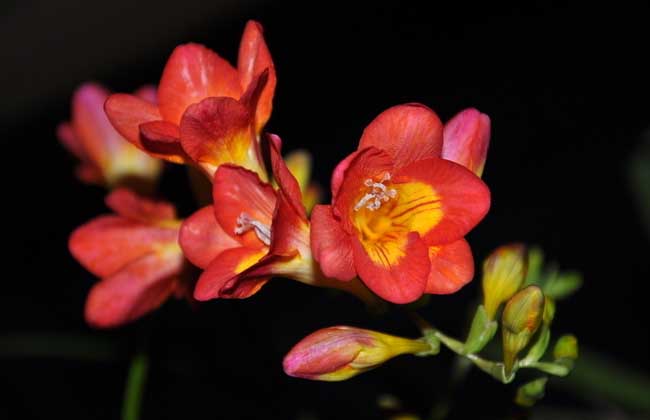
Freesia is also known as xiaocanglan, xiaochanglan, jiandaolan and so on. It is a perennial bulbous herbaceous flower of the genus Freesia in the iris family, named because its flowers are pure white as snow and its fragrance is as delicate as that of an orchid. It is mainly cultivated for ornamental purposes. In southern regions it is mostly grown in the open air, while in northern regions it is mostly grown in pots. It is commonly used as a potted plant or its flowering stems are cut for vases to decorate interiors. Now let us take a look at how to grow freesia!
Freesia's growth habits
Freesia prefers a cool, moist environment with ample light. It has poor cold tolerance. The suitable growing temperature is 15-20°C, and the minimum overwintering temperature is 3-5°C. A large diurnal temperature difference is beneficial to growth and development. The nighttime temperature should preferably be 10-15°C, and the daytime temperature must not exceed 20°C, otherwise growth will be poor. It prefers loose, well-drained soil rich in humus. Under short-day conditions, freesia is helped in promoting flower bud differentiation, and after flower bud differentiation, long days can bring flowering forward. Usually the corms are planted in September, flower bud differentiation begins in early November, differentiation is completed in late November, and by after May of the following year the leaves gradually wither and the corms enter a natural dormant period.
Freesia's propagation methods
1. Sowing: Freesia seeds are usually collected promptly after they mature in May-June, otherwise the capsules split open and the seeds are lost. The seeds have no dormancy habit and can be sown immediately after collection. The optimum temperature for seed germination is 15-20°C, and germination is uniform under dark conditions, taking about 21 days. When the seedlings have 5-7 leaves, the aboveground part turns yellow and withered, and the underground corms enter a high-temperature dormant period. After dormancy, they are planted again and grown into daughter bulbs for 1 year, after which they can serve as flowering mother bulbs.
2. Bulb division: Freesia generally can bear 4-6 daughter bulbs around the mother bulb. They are dug up during the summer dormant period, and the daughter bulbs are separated from the mother bulb and stored, then planted in autumn. For seed bulbs used in cut flower cultivation, corms with a stem circumference of more than 8 cm are required to ensure cut flower quality. The method for cultivating daughter bulbs is to dig up the daughter bulbs during the summer dormant period and store them, and by early August the daughter bulbs can be planted separately in flower pots.
How to grow freesia
1. Soil: Freesia prefers well-drained, loose and fertile sandy loam, or culture soil plus 20%-50% humus soil. Before planting, the soil should be sterilized, which can be done with 50-70 grams of methyl bromide per sq m. After applying the chemical, turn and rake the soil level, and sowing can be done after 5-7 days. For potted culture soil, leaf mold, garden soil, fine river sand and decomposed organic fertilizer can be mixed in equal parts.
2. Planting: The planting time of freesia varies with the type of production and the market demand for fresh flowers. The ordinary planting period is September-October, with the main flowering period in March-April. For forced cultivation, it is from early to mid-September to mid-to-late November; for retarded cultivation, it is from January to March. The general plant and row spacing is 8*12 cm, and the planting density is 80-110 plants per sq m. The planting depth should preferably place the top of the bulb 1-2 cm from the soil surface, with 2-3 cm of soil covering it.
3. Fertilizing: Freesia bulbs are relatively small and their stored nutrients are limited, so phosphorus and potassium liquid fertilizer should be added when there are 2-4 leaves. Before planting, organic compost or coarse granular organic fertilizer should be applied early to improve soil fertility, soil looseness and aeration. The base fertilizer is mainly organic fertilizer, and some chemical fertilizer may also be applied appropriately, but the amount should not be too much, to prevent an increase in the salt concentration in the soil that could cause physiological disorders. Topdressing is mainly liquid fertilizer.
4. Watering: In the early stage after potting, freesia does not need much water. The potting soil should be allowed to dry and then be watered alternately, with a thorough watering once a week being sufficient. By early February, when buds appear and stems are bolting, the plants grow rapidly and consume more water, so the pot should be kept constantly moist. One month after flowering, the water supply should be gradually reduced, and watering once every 2 days can prevent bulb rot. By the end of February, when the leaves turn yellow and withered, watering can be stopped.
5. Temperature: Both root system formation and flower bud differentiation in freesia require a relatively cool environment. The root system grows best at 15-18°C, flower bud differentiation is best at 12-15°C, and inflorescence growth is fastest at 18-20°C. Therefore, at the initial planting stage, keep the room temperature at 15-18°C. At the 5-7 leaf stage, carry out flower primordium induction at 12-15°C and maintain this temperature for 4-6 weeks, so that inflorescence development will not reverse. Then raise the temperature to 16-17°C to make the inflorescence elongate rapidly and enter the flowering period.
6. Light: During freesia cultivation, appropriate shading is beneficial at the seedling stage and flowering stage. During the first leaf growth period, appropriate shading can lower soil temperature and promote root development. Before flower bud differentiation, giving about 10 hours of short-day treatment helps promote flower bud differentiation and increase flower stem length, the number of flowers on the inflorescence and the number of side spikes. After flower bud differentiation is completed, appropriately extending the photoperiod helps promote good inflorescence development and earlier flowering.
7. Pests and diseases: Freesia is prone to mosaic disease, bulb rot and so on. During planting, the soil and seed bulbs must be thoroughly sterilized, and the potting soil must be completely replaced every year. At the same time, attention should be paid to controlling aphids. In the early stage of aphid occurrence, 40% omethoate 1500-fold solution or 90% trichlorfon solution can be sprayed for control.