Vanda Orchid Growing Methods and Precautions
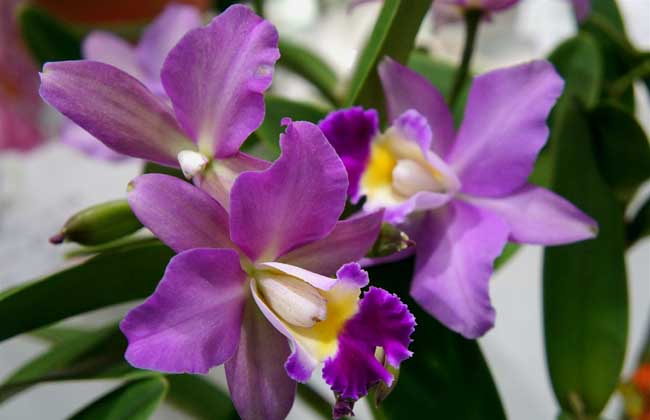
Vanda is the collective name for plants in the orchid family genus Vanda, with about 50 original species and a very rich variety of hybrid cultivars. It is native to India, Malaysia, the Philippines and other places. Chinese experts translated it as "wandai" (ten thousand generations), probably meaning that it has strong vitality and can be passed down forever from generation to generation. Its ornamental value is very high, and it is a flower that can be enjoyed all year round. Let us take a look at the growing methods for Vanda orchids below!
Vanda Orchid Growing Habits
Vanda orchids are afraid of cold but not heat, and afraid of waterlogging but not drought. Even when summer temperatures reach as high as 35°C, it has little effect on their growth, and during cultivation there is no need to use much potting medium. Many flower farms in Thailand grow Vanda orchids very extensively. They often nail wooden strips into small square frames, put in a few pieces of charcoal, broken brick or coconut husk, and the plants can continue to grow. Some even use just a nylon rope to tie up the plant and hang it in an orchid shed or under a tree, looking like "hanging cured ducks," and by frequently sprinkling water and spraying fertilizer on it, it can still grow leaves and bloom.
Vanda Orchid Propagation Methods
Vanda orchids can be propagated by keikis. In late autumn, Vanda orchids grow keikis at the leaf axils. When the keikis grow to 5-7.5 cm, use a sharp and sterilized knife to cut the keikis off from the mother plant and plant them in a pot filled with tree fern fiber, and they can later be transplanted to a larger pot. Remember that the cut surface must be coated with medicine to avoid infection by pathogens. In addition, when a plant cultivated for many years grows to more than 1 m, the top shoot about 30-46 cm long can be cut off, and both cut surfaces should be coated with medicine for disinfection, then planted in a pot and kept moist.
Vanda Orchid Growing Methods
1. Potting medium: Vanda orchid roots are aerial roots, and any medium with good drainage can be used, such as tree fern fiber, broken brick pieces, charcoal, coarse gravel and so on. Whether used alone or mixed, they are all very good potting media.
2. Light: Vanda orchids generally need relatively strong light. In local high-temperature seasons, 40-50% shade netting is needed for shading, while in winter shading is not even needed.
3. Temperature: Vanda orchids like high-temperature environments. The most suitable temperature is 20-30°C, and even when summer temperatures reach as high as 35°C, it has little effect on their growth.
4. Water and moisture: In daily management, Vanda orchids must be guaranteed sufficient water and air humidity. In the rainy season, vigorous growth can be maintained relying on natural conditions. In the dry season, artificial sprinkling must be used to keep air humidity at around 80%.
5. Fertilization: Vanda orchids require more fertilizer than other tropical orchids, so during the period of vigorous growth, diluted fertilizer can be applied once every 7-10 days. The best fertilizer is one with a nitrogen, phosphorus and potassium ratio of 10:10:5.
6. Repotting: Vanda orchids should not be repotted frequently. Unless troubled by pests or diseases, they should be repotted at least only once every 3 years. In spring, Vanda orchids are about to enter their period of vigorous growth, which is a good time for repotting.
Vanda Orchid Pest and Disease Control
1. Phytophthora disease
[Symptoms] It can occur all year round, but is most severe during the plum rain season, when watering is too wet or ventilation is poor, and seedlings that have just come out of the flask are especially vulnerable. Brown lesions appear on infected parts, rapidly expand under high temperature and high humidity, and finally become dark brown spots, with leaves falling and stems rotting until the plant dies.
[Control] ① Avoid excessive moisture, improve ventilation and air circulation, and ensure sufficient light. ② Avoid using nitrogen fertilizer alone, and reduce weak, spindly plant growth. ③ Spray 1/800 carbendazim or 1/1000 thiophanate solution. ④ Coat the wounds from cutting off diseased plants with Dasheng powder, then place them in a dry place and do not water for one week, which can stop the spread of the disease.
2. Anthracnose
[Symptoms] It is easily contracted when planting is too dense, ventilation is poor, water regulation is imbalanced, or wounds are present. In the early stage of the disease, small brown sunken spots appear on the leaves, which later expand into round or irregular lesions. In severe cases, necrosis appears in the center of the lesions.
[Control] ① Do not plant too densely, increase light, and ensure good drainage and ventilation. ② Cultivate strong seedlings and do not frequently move plants, so as to avoid injuries and infection. ③ Cut off diseased leaves, and apply 1/500 Dasheng-45 solution or 1/800 Wanjunqing to the wounds. ④ Spray 1/1000 thiophanate-methyl or carbendazim solution once a week.
3. Soft rot
[Symptoms] This disease is more likely to occur in spring and summer under high temperature and high humidity, poor ventilation, and excessive application of nitrogen fertilizer. In the early stage, bacteria invade the leaves or central leaves and produce water-soaked lesions, which expand rapidly and contain much water. In the later stage, a foul odor develops, diseased leaves turn yellow and fall off, and the whole plant rots soft and dies. The disease spreads extremely quickly and must be controlled as soon as possible.
[Control] ① Improve growing conditions, increase ventilation, and lower temperature and humidity. ② Cut off infected parts and coat them with antibiotic powder. Do not water for one week, which can stop the spread of the disease. ③ Use 1000x streptomycin solution, or 500x lime sulfur mixture or Bordeaux mixture, and spray once a week.
4. Leaf blight
[Symptoms] Small black spots appear at the leaf tips and gradually expand into irregular lesions. The edges of the lesions form a dark brown color, while the center is light grayish brown. In severe cases, they spread over the entire leaf, and finally the leaf withers and falls off.
[Control] ① Cut off diseased leaves and spray 500x Dasheng-45 or 1000x Haoshengling. ② For infected plants, avoid rain or temporarily stop watering to prevent the condition from worsening. ③ Spray 500x Dasheng-45 once daily on a regular basis as a preventive measure.