How to grow a potted sago palm? Master these care methods
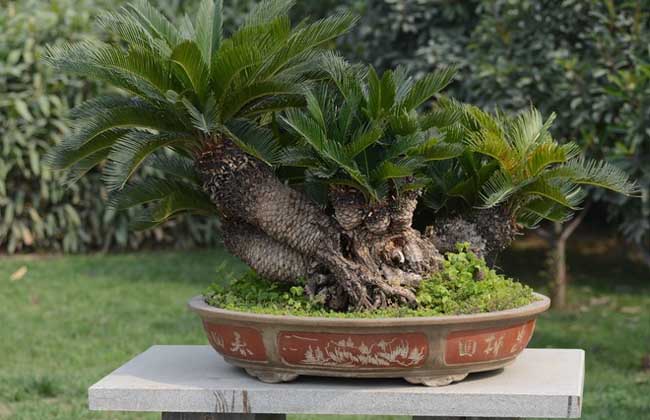
The sago palm, also known as phoenix-tail cycad, phoenix-tail banana, phoenix-tail pine, etc., is a plant of the Cycadaceae family, genus Cycas. It is most famous for its flowering, known as "the sago palm blooms", with an elegant ancient tree shape, a thick trunk as hard as iron, and glossy, smooth, bright feather-like fronds that stay green all year round. In the south it is mostly planted in front of courtyards, beside steps and in lawns, while in the north it is suitable as a large potted plant to decorate courtyards, corridors and halls. Now let us take a look at how to grow a potted sago palm well!
The growth habits of the sago palm
The sago palm likes a warm, hot and humid environment, is not cold-tolerant, grows very slowly, and has a lifespan of about 200 years. In the tropical and southern subtropical regions of southern China, trees over 10 years old bloom and bear fruit almost every year, while cycads cultivated in the Yangtze River basin and various northern regions often never bloom in their lifetime, or occasionally bloom and bear fruit. It likes light and likes iron, and is slightly tolerant of partial shade. When planted in the open ground in the Shanghai area, warm measures such as wrapping with straw are needed in winter. It likes fertile, moist and slightly acidic soil, but can also tolerate drought. It grows slowly, and plants over 10 years old can bloom.
Propagation methods of the sago palm
1. Sowing: when male and female sago palms bloom at the same time, seeds are easily obtained through artificial supplementary pollination. Sow using the large-seed sowing method; the seeds germinate slowly, beginning to sprout 4 to 6 months after sowing, and are divided 2 to 3 years later. However, northern cultivation generally rarely obtains seeds, so division propagation is mostly used.
2. Division: robust perennial sago palms often produce offshoots at the base. Cut off three-year-old offshoots with 4 to 5 leaves, plant them into a flower pot filled with river sand, with a planting depth of about half the plant height, water thoroughly, and place in a shaded place to encourage rooting and care. The pot soil should be dry rather than wet; rooting generally begins in 2 to 3 months, and after rooting they are potted in leaf mold soil.
How to grow a potted sago palm?
1. Soil: the sago palm is suitable for growing in fertile, slightly acidic sandy soil. The growing medium can be prepared with 1 part coarse sand and 4 parts garden soil, or 5 parts leaf mold and 1 part fine stone granules, or 2 parts sandy soil and 2 parts leaf mold, etc. It likes iron, so when preparing the growing medium a small amount of iron filings can be mixed in, or in early spring iron filings can be scattered on the pot soil or buried in the pot. A 0.5% ferrous sulfate spray can also be used to supplement iron, making the leaves firm and emerald green.
2. Fertilizing: during the growing period from May to October, the sago palm can be given compound fertilizer or urea 1 to 2 times a month. Urea is best diluted with water 1000 times and sprayed on the leaves; foliar fertilizing should follow the principle of "small meals, more often". The daily rice-washing water from home, without any oily water mixed in, can be collected in a bucket or basin and used as liquid fertilizer for watering the next day, having a certain fertilizing effect.
3. Watering: the sago palm grows slowly and does not like heavy water. Especially in spring, autumn and winter, watering must strictly follow the principle of alternating wet and dry, that is, after watering once, wait until the pot soil looks dry before watering a second time. In summer, except on rainy days, water once a day and spray water on the leaf cluster, but avoid waterlogging, otherwise the roots rot and the plant dies. After autumn begins, growth gradually slows, water should be controlled, maintaining a certain degree of dryness to facilitate overwintering.
4. Temperature: the suitable growing temperature for the sago palm is 20 to 30°C, but it is fairly tolerant of high heat and severe cold. In winter it can still overwinter outdoors at around minus 5°C, and below minus 10°C it needs protection to overwinter. The sago palm fears snow; if it snows, it should be moved indoors or covered with plastic film, otherwise the old leaves will turn yellow the following spring and lose their ornamental value.
5. Light: the sago palm relatively likes an environment with ample light and fairly warm, humid conditions, and should usually be placed in a spot with direct sunlight. However, potted sago palms are not tolerant of scorching sun exposure, and especially the new leaves of the sago palm are very easily scorched and withered yellow. Therefore, after the new leaves grow out and in midsummer, a certain amount of shading should be provided.
6. Repotting: when potting a sago palm, attention should be paid to repotting, generally at least once every 5 years. When repotting, bone meal and other phosphorus fertilizers can be mixed into the pot soil, and the best repotting time is when the temperature is around 15°C. At this time, for vigorous-growing plants, some old roots should also be appropriately trimmed away to help new roots grow out promptly.
7. Pruning: after the stem of the sago palm grows to 50 cm tall, the old leaves should be cut off in spring, and thereafter one ring should be cut each year, or at least once every 3 years. If the plant is still small and the spread is not ideal, all the leaves can be cut off; this will not affect the angle at which new leaves grow out and will make the plant more perfect. When pruning, cut as close to the base of the leaf stalk as possible, so that the stem is neat and beautiful.
8. Diseases and pests
① Leaf spot disease: the sago palm often suffers from leaf spot disease. In summer, water more with clear water, and diseased old leaves should be removed promptly. In the early stage of the disease, spray 75% carbendazim wettable powder at 800 times dilution, or 50% thiophanate-methyl wettable powder at 800 times dilution, about once every 10 days, with good results.
② Scale insects: when potted sago palms are cultivated on a balcony with insufficient ventilation and light, the leaves are often easily harmed by scale insects. Repeatedly wiping the affected leaves lightly with alcohol can kill the adults and larvae, and lightly wiping the affected leaves with a cotton ball soaked in rice vinegar can also kill the scale insects.