A Detailed Guide to Forget-Me-Not Cultivation Methods and Care Tips
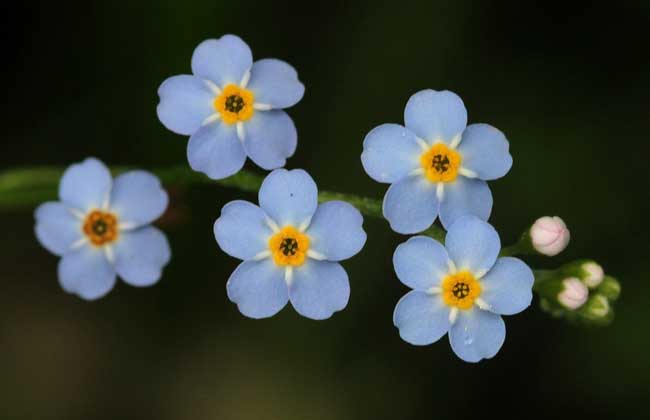
Forget-me-not, also known as forget-me-not herb, starflower, and spoon-leaf grass, is a perennial herbaceous plant of the genus Myosotis in the Boraginaceae family. It mostly grows on mountain forest edges, hillsides, under forest canopies, and in valley grasslands. After its flowers are made into dried flowers, their color does not fade for a long time, making them very suitable for pressing in books or serving as tokens of love, which is how it got its name. Let us take a look at the cultivation methods for forget-me-not below!
Forget-Me-Not Growth Habits
Forget-me-not is distributed in Europe, Iran, Russia, Pakistan, Kashmir, India, China, and other places. In China, it is mainly distributed in Jiangsu, the Northwest, North China, Sichuan, Yunnan, and the Northeast. It has strong adaptability, prefers a dry and cool climate, dislikes damp heat, loves light, is drought-tolerant, and its optimal growth temperature is 20-25°C. It is suitable for growing in loose, fertile, well-drained, slightly alkaline soil.
Forget-Me-Not Propagation Methods
Forget-me-not is usually propagated by sowing. The sowing period is generally from September to January of the following year. The seeds are photophobic, so after broadcasting the seeds, cover them with a thin layer of soil and maintain humidity. Under the optimal temperature of 15-20°C, they germinate after 10-15 days. However, be careful that the temperature does not exceed 25°C. After the sprouts emerge, ventilation is needed. When the seedlings have more than 5 true leaves, they can be planted out. For tissue-cultured seedlings produced through tissue culture technology, plant them out when they have 4-6 leaves.
Forget-Me-Not Cultivation Methods
1. Planting: Forget-me-not prefers dry, fertile, well-aerated, slightly alkaline sandy loam. For ground planting, well-rotted organic fertilizer and slow-release compound fertilizer can be evenly mixed into the soil. The planting spacing is 30×40 cm, and the planting depth should be such that the substrate is slightly higher than the root crown. One month after emergence, they can be planted out or potted. When transplanting, carry as much soil as possible and minimize root damage.
2. Light: Forget-me-not prefers ample sunlight, but the ambient temperature must not be too high or humid. Therefore, during normal care, sufficient sunlight should be provided. Insufficient light will cause the forget-me-not's foliage to grow lushly and affect flowering. However, in summer, try to provide shade measures to avoid sunscald.
3. Temperature: The optimal growth temperature for forget-me-not is 22-28°C. When the temperature is above 30°C or below 5°C, the growth of forget-me-not will be hindered. Therefore, when planting forget-me-not, try to carry out low-temperature treatment first, allowing it to fully receive low temperatures and complete vernalization. After normal growth begins, try to control the temperature within the suitable range.
4. Watering: Forget-me-not is relatively fond of water, but fears waterlogging. During the care period, keep the soil slightly moist, but do not allow water to accumulate at the root position. When sunlight is abundant, water appropriately more to increase air humidity. During the non-growing season, keep the potting soil slightly moist to slightly dry.
5. Fertilizing: When planting forget-me-not, apply sufficient base fertilizer and evenly mix the fertilizer into the soil. During the flowering period, topdressing with potassium fertilizer and boron fertilizer helps improve the quality and yield of cut flowers. When the forget-me-not has grown 6-8 leaves, apply a urea solution once. When the forget-me-not bolts and produces flower stems, apply a 0.1% potassium dihydrogen phosphate solution 2-3 times.
6. Pests and Diseases: Forget-me-not diseases include gray mold, powdery mildew, and viral diseases. Gray mold can be controlled by continuously spraying 800-1000 times diluted chlorothalonil or thiophanate-methyl 3-4 times. Powdery mildew can be controlled by spraying fenarimol, etc. For viral diseases, the main control measures are timely removal and burning of diseased plants, and spraying insecticides to prevent insect transmission. Scale insects are the most common pest of Monstera deliciosa; when few, they can be cleaned off with an old toothbrush and then sprayed with a 1000-fold dilution of 40% omethoate emulsifiable concentrate.