How to grow Brunfelsia pauciflora? Detailed growing methods and precautions
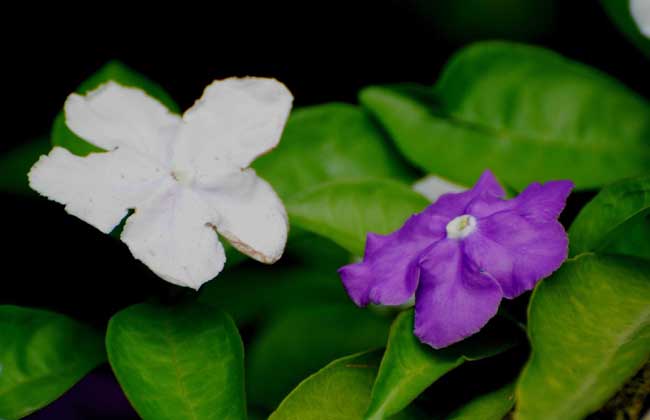
Brunfelsia pauciflora is also known as yesterday-today-and-tomorrow and five-color jasmine, among other names. It gets its name because the flowers bloom in sequence and different colors can be seen at the same time on the same plant. Its English name means "yesterday, today, tomorrow," which vividly depicts the special change in flower color: the small flowers are deep blue when they first open, then turn light purple, and finally become white. Let's take a look at the growing methods for Brunfelsia pauciflora below!
Growth habits of Brunfelsia pauciflora
Brunfelsia pauciflora is native to the tropics of Central America and South America. It prefers warm, humid climatic conditions with ample light, is not very cold-hardy, and its optimum growing temperature is 18-30°C, and it should not be lower than 10°C. It likes semi-shade and a ventilated environment. When grown indoors, it needs at least 4 hours of light, and under sufficient sunlight it blooms profusely. It tolerates partial shade and drought, but not waterlogging or poor, thin soil. In East China and North China it is grown as a potted plant in greenhouses, requiring a fertile, loose, well-drained, slightly acidic soil. In summer, iron sulfate fertilizer solution should be added regularly so that the leaves are dark green and glossy and the branches and flowers are abundant.
Propagation methods for Brunfelsia pauciflora
1. Sowing: Before sowing Brunfelsia pauciflora, the seeds must first be selected. Whether the seeds are chosen well directly affects whether sowing succeeds. After selecting the seeds, they should be disinfected and germinated. After sowing, cover with growing medium to a depth 2-3 times the size of the seeds. Then use a sprayer or a fine-holed watering can to moisten the sowing medium. Afterward, water again when the potting soil is slightly dry. If sowing is done in late autumn, early spring, or winter and a cold wave with low temperatures occurs, the flowerpot can be wrapped in plastic film to help keep it warm and moist.
2. Cuttings: For softwood cuttings of Brunfelsia pauciflora, from late spring to early autumn when the plant is growing vigorously, select strong current-year branches as cuttings. For hardwood cuttings, after the temperature rises in early spring, select robust branches from the previous year as cuttings. For home propagation, ideal cutting medium is hard to obtain due to limited conditions, so it is recommended to use a ready-mixed and sterilized cutting medium. Medium-coarse river sand can also be used, but it should be rinsed several times with clean water before use, and management should be strengthened after inserting the cuttings.
3. Layering: Brunfelsia pauciflora can also be propagated by layering. Select a robust branch and remove a ring of bark about 15-30 cm below the tip. The width of the wound after peeling should be about 1 cm, and the depth should be just enough to remove the outer bark. Cut a piece of plastic film 10-20 cm long and 5-8 cm wide, place some moistened garden soil on it, and wrap the girdled part as if bandaging a wound. Tie the upper and lower ends of the film tightly, leaving the middle bulging. Roots will form in about four to six weeks.
Growing methods for Brunfelsia pauciflora
1. Soil: Brunfelsia pauciflora prefers slightly acidic soil with good drainage and aeration. It is best to use a loose, fertile, breathable, well-drained, slightly acidic soil rich in humus. Generally, use 1 part leaf mold, 1 part garden soil, and 1 part sawdust or coal cinder ash, or use 2 parts garden soil, 1 part coal cinder ash, and a small amount of cake fertilizer residue mixed together. Never use alkaline soil.
2. Light: Brunfelsia pauciflora prefers light, semi-shade, and a well-ventilated environment. It does not tolerate direct strong light and has poor wind resistance. After being moved outdoors around Qingming, place it in a sunny, wind-sheltered spot for cultivation. In summer, place it in a cool, ventilated place or under a shade frame with 50% shading to prevent direct sunlight; otherwise the leaves easily turn yellow and scorch.
3. Watering: Brunfelsia pauciflora prefers moisture and does not tolerate waterlogging. Daily watering should follow the principle of "water when dry, stop when wet." In summer, when temperatures are high and the air is dry, in addition to watering the potting soil thoroughly, spray the leaves with clean water 2-3 times a day and also sprinkle water around the plant to increase air humidity and lower the temperature. In winter, watering should be controlled and the potting soil kept on the dry side. During the rainy season, prevent water from accumulating in the pot.
4. Fertilizing: During the growing season of Brunfelsia pauciflora, after each flowering, apply 1 thin cake fertilizer solution, and 10 days later apply 1 liquid fertilizer mainly containing phosphorus and potassium. Along with watering, spray the leaves with 0.2-0.3% potassium dihydrogen phosphate to promote flower bud differentiation. During the growing period, apply thin iron sulfate fertilizer solution twice to prevent soil alkalization and leaf yellowing. In summer, the fertilizer-to-water ratio is 9:1. Before moving indoors in November, spray 1-2 times with potassium dihydrogen phosphate at the same concentration to improve its cold resistance and help it overwinter safely. Stop fertilizing in winter.
5. Pests and diseases: In spring, Brunfelsia pauciflora is harmed by aphids. If ventilation is poor and it is hot and stuffy, it may also be harmed by scale insects and red spider mites. Diseases occasionally include leaf spot and powdery mildew. If pests are found, spray with 40% omethoate emulsifiable concentrate at 1000 times dilution. For diseases, spray with carbendazim or thiophanate-methyl at 500-800 times dilution for control.
6. Pruning: After the flowering period of Brunfelsia pauciflora, prune and shape the branches to maintain a beautiful plant shape. After each flowering, promptly cut off the spent flowers and cut back some long branches by 1/3-1/2 to encourage more branching, making the plant compact and attractive and helping it bloom more the following month. After the last flowering in late autumn, carry out heavy pruning, that is, keep 2-3 buds on each branch and cut off the rest, and remove thin, weak branches, inward-growing branches, and diseased or pest-damaged branches, so that the following spring growth is vigorous, the crown is beautiful, and there are more flowers.
7. Cold protection: Brunfelsia pauciflora has poor cold tolerance, so it must be grown in a cold room in winter. Generally, move it indoors around mid-November, keep the room temperature above 0°C, control watering, and keep the potting soil on the dry side, and it can overwinter safely. If you want it to bloom in winter, raise the room temperature so that the nighttime temperature reaches above 15°C, provide sufficient light, and continue fertilizing and watering, and it will bloom as desired.