How to care for a potted fiddle-leaf fig? Detailed care methods and tips
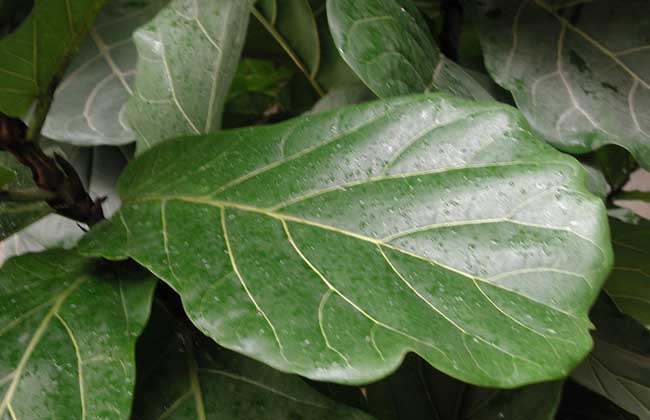
The fiddle-leaf fig, also known as the fiddle-leaf rubber tree, is an evergreen tree in the mulberry family (Moraceae) and the genus Ficus (figs). It gets its name because the tip of the leaf widens into the shape of a fiddle. The plant is tall and upright with an elegant bearing and unusual leaves, giving it high ornamental value. It is often used as an ideal foliage plant for large halls, and can also be used to decorate conference venues or offices. Let's take a look below at how to care for a potted fiddle-leaf fig!
The growth habits of the fiddle-leaf fig
The fiddle-leaf fig is native to the lowland tropical rainforests from Sierra Leone to Morocco in West Africa, and is widely cultivated in the tropics and subtropics, as well as indoors and in greenhouses in temperate zones. In China it is mainly produced in Guangdong, Hainan, Guangxi, Fujian, Hunan, Hubei, Jiangxi, Anhui, Zhejiang and other places. It likes a warm, humid environment with plenty of sunlight. The optimum growth temperature is 25°C to 35°C; it goes dormant at around 15°C and can overwinter safely above 5°C. Its water requirement is to keep it moist rather than dry.
Propagation methods for the fiddle-leaf fig
1. Cuttings: When taking cuttings of the fiddle-leaf fig, choose 1- to 2-year-old branches, cut them off 20-30 cm above the potting soil surface, and cut the stems into 3-4 node segments as cuttings. Keep one leaf on each cutting segment and cut away 2/3 to 3/4 of the leaf to reduce water evaporation. First soak the cut wound of the cutting in water or coat it with plant ash and the like to prevent the sap from flowing out. Insert the cuttings into a cutting bed made of river sand or perlite, and be careful to maintain the bed temperature and a relatively high air humidity around it. At 25-30°C they can take root in about one month.
2. Air layering: Air layering of the fiddle-leaf fig can be done from April to August. Choose a semi-lignified top branch of the mother plant, leave 3-4 leaves at the upper part, make a ring cut or tongue cut below it, then wrap it with moss and the like and tie it with plastic film. It will take root in about 40 days. Once it has grown to about 30 cm, it can be removed and planted in the ground or potted up.
How to care for a potted fiddle-leaf fig?
1. Pot and soil: When potting a fiddle-leaf fig, choose a pot with a somewhat larger volume, and repot every 2-3 years in spring. Cover the bottom of the pot with a tile piece with the convex side facing up, first put in a layer of old potting soil, then add a new mix made of garden soil, peat soil and a small amount of sandy soil. The soil should be slightly acidic.
2. Fertilizing: The fiddle-leaf fig has broad leaves and a fairly high fertilizer requirement, so during the growing season it generally needs liquid fertilizer or granular compound fertilizer applied every 1-2 weeks to promote plant growth and deep green leaves. Generally no fertilizer is applied in late autumn and winter. From the time the new leaves unfold until mid-August, apply fertilizer once every 10 days, mainly nitrogen fertilizer. When growth is vigorous, more fertilizer can be applied; when growth stops or the plant is dormant, do not fertilize.
3. Watering: The amount of water given to a fiddle-leaf fig should depend on the surrounding ambient temperature. Water demand is greater in spring and summer, and should be reduced during the dormant period, keeping the potting soil moist. In summer it can be given a light shower of rain to help growth; spraying it regularly with lukewarm water will make it grow even better. Slightly acidic water is also preferable for watering. Excessive short-term temperature fluctuations or exposure to direct sunlight are both bad for growth. If it is kept at low temperatures for a long time while being overwatered, the plant may die.
4. Light: The fiddle-leaf fig adapts fairly well to light and can grow well in bright, indirect light. Avoid direct sunlight in summer; if it is placed outdoors it must be shaded, and in winter the light should be increased. It is suited to growing in a semi-shady environment. In summer, avoid direct sunlight so the leaves are not scorched and lose their gloss. However, if the light is too weak, the plant will grow thin and weak, so it must be given fairly bright light to grow strong and healthy. During the growing season it generally grows better under 50% shade.
5. Temperature: Compared with other Ficus plants, the fiddle-leaf fig has relatively weak cold tolerance. The optimum growth temperature is 25°C to 35°C; it goes dormant at around 15°C and can overwinter safely above 5°C. To improve its cold tolerance, in addition to controlling the amount of watering in late autumn and winter, you can apply extra phosphorus and potassium fertilizer about one month before winter arrives.
6. Disease prevention: After a potted fiddle-leaf fig becomes diseased, it should be moved quickly to a ventilated, sunny place with ample light, the leaves should not be sprayed with water, and severely diseased leaves should be cut off. For lightly diseased leaves, the diseased spots can be cut away together with some of the healthy tissue, then spray with Bordeaux mixture for protection, or spray with 80% zineb wettable powder at 500 times dilution, 25% metalaxyl wettable powder at 500-800 times dilution, etc. Be careful to rotate the chemicals used.