Planting methods and key technical points for the four o'clock flower
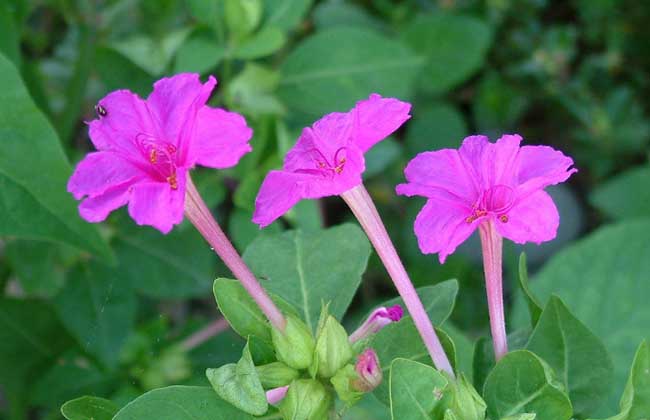
The four o'clock flower, also known as yanzhi flower, fendou flower, wild clove, and zhuangyuan flower, is an annual herbaceous plant of the genus Mirabilis in the family Nyctaginaceae, native to tropical America. It is often cultivated across both northern and southern parts of China as an ornamental flower, and sometimes escapes to the wild. Its roots and leaves can be used medicinally, with effects of clearing heat and detoxifying, activating blood and regulating menstruation, and providing nourishment. Let us take a look at the planting methods for the four o'clock flower.
Growth habits of the four o'clock flower
The four o'clock flower prefers mild and humid climate conditions and is not cold-tolerant. In winter, the aboveground parts die back, while in the Jiangnan region the underground parts can safely overwinter and become a perennial herbaceous flower, sending up new plants the following spring. Open-field cultivation requires deep, loose, and fertile loam; for potted plants, general flower potting mix can be used, and growth is even better in slightly shaded spots. The flowers open from evening to early morning and close under strong light. In summer, if there is shade from trees, growth and flowering are good; under intense heat and direct sun, leaf drop often occurs. It likes a well-ventilated environment and has a mosquito-repelling effect in summer.
Propagation methods for the four o'clock flower
1. Sowing: The four o'clock flower is propagated by seed. It is best to sow and raise seedlings in March to April. When the seedlings grow 2 to 4 leaves, transplant them, with a plant spacing of 50 to 80 cm being suitable. After transplanting, pay attention to shading. The four o'clock flower is easy to manage and grows readily; just pay attention to appropriate fertilizing and watering. The four o'clock flower is a wind-pollinated flower, and different varieties cross easily. If you want to maintain varietal characteristics, isolated cultivation should be used.
2. Cuttings: For cutting propagation of the four o'clock flower, foot buds, terminal buds, axillary buds, and so on can be used as cuttings. Among these, foot buds have the strongest growth vigor, are less prone to varietal degeneration, and have strong disease resistance. Use sand, furnace slag, garden soil, and so on as the substrate. After cutting, control the temperature at about 20°C, and roots will form in 10 days. After rooting, move them into containers to grow into seedlings.
3. Tuberous roots: The tuberous roots of old four o'clock flower plants can be repeatedly propagated and used for 3 to 5 years, and generally after the 2nd year the varietal characteristics gradually decline. South of the Yangtze River, the tuberous roots can safely overwinter and become bulb flowers. In areas where they cannot overwinter, after frost, cut the plants off 3 to 5 cm above the ground, dig out the tuberous roots, dry them in the air until the surface is dry, then place them in a dry place not exposed to direct sunlight. Do not water throughout the winter, keep the temperature at about 10°C, and after replanting the following year they will send out new plants again.
Planting methods for the four o'clock flower
1. Soil: For household potting of the four o'clock flower, fertile sandy and semi-sandy soil is best. When planted in slightly acidic soil with a pH of 6 to 6.5, the root system is dense and growth is vigorous. If the soil is heavy clay, lacks organic matter, has low fertility, and has poor aeration, then the root system will be sparse, the plant will be short, the stems and leaves will be slender, and the flowers will be few and small.
2. Watering: The four o'clock flower is not drought-tolerant, but it also dislikes waterlogging. In rainy seasons, promptly pour out accumulated water in the pot, otherwise the leaves easily turn yellow. In hot, sunny summer days, water twice a day, once in the morning and once in the evening. If leaves are found curling and drooping, spray water on the leaves to promote growth. In the rainy season, loosen the soil often so that water does not accumulate in the pot. In spring and autumn, water thoroughly once every few days. In winter, just keep the potting soil moist; too much watering will cause the roots to turn black and rot, and the leaves to yellow and drop.
3. Light: The four o'clock flower is a light-loving plant, and its growth and development require sufficient light. Long-day direct light is even more favorable for its growth and development. With strong light, the leaf color is deep green, the branches are thick and strong, there are many flower buds, the coloring is good, and the fragrance is strong. If light is insufficient or it is too shaded, the leaf color becomes pale green, the leaves are large and thin, photosynthetic products decrease, physiological activity is inhibited, the plant develops poorly, and flower yield is low and quality is poor.
4. Temperature: The four o'clock flower is relatively sensitive to temperature and requires a warm, humid climate, and it can adapt to relatively high temperatures. It is not tolerant of low temperatures and has poor cold resistance. Below 10°C, growth is extremely slow, or even stops. At about 19°C it can sprout, and only above 25°C does it form flower buds. At 30 to 40°C, flower bud formation and development are better, and the suitable temperature for mature opening is 32 to 38°C.
5. Fertilizing: The peak summer high-temperature season is the vigorous growth period of the four o'clock flower. Apply more organic fertilizer and phosphorus-potassium fertilizer, such as peanut cake powder, bone meal, superphosphate, and multi-element flower fertilizer, twice a month. During the summer growth period, the four o'clock flower often shows lush branches and leaves but no flowering. The main reason is applying too much nitrogen fertilizer, causing excessive vegetative growth. In this situation, control fertilizer and water, increase phosphorus-potassium fertilizer to promote flower bud formation, and at the same time pay attention to moving the four o'clock flower to a place with ample sunlight and good ventilation.
6. Pests and diseases: The four o'clock flower is often harmed by snout moth larvae, scale insects, and red spider mites, with July to September being the most serious. They often bore into and feed on flower buds. You can spray with universal powder or fenvalerate diluted 200 times with water, once every half month. Even if pests and diseases have not occurred, spraying should still be done to achieve prevention first. The best spraying time is 9 a.m. and 4 p.m. on sunny days. Do not spray under the blazing midday sun to prevent phytotoxicity.
7. Pruning: The four o'clock flower grows very fast in summer and should be pruned in time. For potted four o'clock flowers, pruning should retain 10 cm to 15 cm of the base to promote many sturdy new shoots. If the new shoots grow very vigorously, pinch them when they reach 10 cm to promote secondary shoots, which will result in more flowers and a more compact plant shape. After the flowers fade, promptly cut off the flowering branches to reduce nutrient consumption, and this can also promote new shoots, making the branches dense, the buds numerous, and the flowers abundant.