A detailed guide to water lily planting methods, easy for beginners to learn too
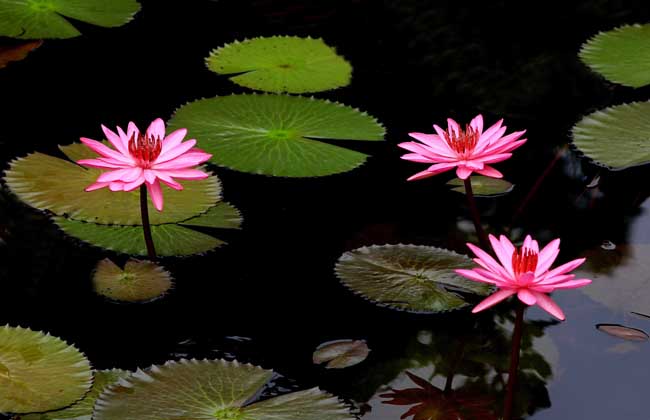
Water lily, also known as Ziwu lotus, pink water lily, wild water lily, etc., is a perennial aquatic herbaceous plant of the genus Nymphaea in the family Nymphaeaceae. In China it is distributed from the Northeast to Yunnan and west to **, growing in still water bodies such as ponds and lakes. It is cultivated as an ornamental plant in many park water bodies, its rhizome can be eaten or used to make wine, it can be used as medicine, and the whole plant can be used as green manure. Now let us take a look at the planting methods of water lilies!
Growth habits of water lilies
Water lilies like sunlight and good ventilation, and have no strict requirements for soil quality. They can grow normally at a pH of 6 to 8. The most suitable water depth is 25 to 30 cm, and it must not exceed 80 cm at the deepest. They prefer loamy soil rich in organic matter. They sprout and grow leaves from March to April, bloom successively from May to August, and each flower blooms for 2 to 5 days. They set fruit after flowering. Stems and leaves wither from October to November. They sprout again the following spring. In the Yangtze River basin, they sprout from late March to early April, form buds in late April or early May, reach full bloom from June to August, enter the yellow-leaf stage from October to November, and enter dormancy after November. They grow in ponds and lakes, and are often cultivated in the pools of some parks.
Propagation methods of water lilies
1. Division: When dividing water lilies, first dig out the rhizomes, select rhizomes with plump new buds, cut them into root segments 8 to 10 cm long, with each segment carrying at least 1 bud, and then plant them. Bury them in the surface soil with the terminal bud facing up. The covering depth should be such that the plant's bud eye is level with the soil surface, with 5 to 7 segments per pot. After planting, expose them to a little sunlight before adding shallow water to help maintain water temperature, but do not pour water too deep, otherwise germination will be affected. When the temperature rises and the new buds begin to sprout, deepen the water level.
2. Sowing: After water lily seeds are collected, they must still be stored in water; if stored dry, they will lose their germination ability. Sow from March to April. Use fertile clay loam for the potting soil. Do not fill the pot too full with soil; it should be 5 to 6 cm below the pot rim. After sowing the seeds, cover with 1 cm of soil, press firmly, and immerse in water with the water surface 3 to 4 cm above the potting soil. Cover the potting soil with glass and place it in a sunny, warm spot to raise the temperature inside the pot. The sowing temperature should preferably be 25 to 30°C. They germinate after about half a month and can bloom the following year.
Water lily planting methods
1. Soil: Water lilies prefer clay soil rich in humus and fertile. Therefore, for cultivation it is best to choose silt that has long accumulated in rivers or ponds.
2. Seed stems: Water lilies are mostly cultivated by division. For planting, select a section of underground rhizome that is vigorous and robust, virus-free, undamaged, not rotten, and bearing new buds, and cut it into segments 6 to 10 cm long.
3. Shallow planting: If the underground stems used for planting water lilies are buried too deep in the mud, first, the soil temperature is relatively low, and second, oxygen is scarce, which is not conducive to early growth and rapid development. The cultivation depth is generally kept moderate by making the new buds on the underground stems level with the soil surface.
4. Light: Water lilies prefer a climate with ample sunlight, warmth and humidity, and good ventilation. Water lilies grown in pots or tubs must be placed in a position with ample light so they receive full sunlight.
5. Water body: Water lilies like to grow in relatively calm water bodies without large waves or strong currents, so planting them in artificial fountain pools with high-pressure water columns or in pools with rapid waterfalls often results in poor growth.
Pest and disease control for water lilies
1. Rot disease: Choose disease-resistant varieties, practice 2 to 3 years of crop rotation in severely affected fields, carefully select disease-free seed lotus roots, and use 50% carbendazim or 20% thiophanate-methyl wettable powder at 800 times dilution plus 75% chlorothalonil wettable powder at 800 times dilution. Spray and then keep the seeds sealed, covering with plastic film and sealing for 24 hours, then dry and plant. Promptly remove diseased plants and spray 50% carbendazim wettable powder at 600 times dilution plus 75% chlorothalonil wettable powder at 600 times dilution.
2. Leaf rot: During harvest, remove diseased and residual plants, bury them deeply or burn them in a centralized way to reduce the source of inoculum. In the early stage of the disease, spray 50% carbendazim wettable powder at 800 times dilution, or 70% thiophanate-methyl wettable powder at 800 times dilution, or 30% basic copper sulfate suspension at 500 times dilution, spraying once every about 10 days for 2 to 3 consecutive sprays.
3. Anthracnose: During the growing season, collect diseased residues and bury them deeply or burn them, apply additional fertilizer at the right time and in the right amount, promptly remove diseased plants, and spray 50% carbendazim wettable powder at 600 times dilution, 75% chlorothalonil wettable powder at 600 times dilution, 36% thiophanate-methyl suspension at 500 times dilution, 50% carbendazim wettable powder at 1500 times dilution, or 80% anthracnose thiram wettable powder at 800 times dilution, spraying once every about 10 days for 2 to 3 consecutive sprays.
4. Small leaf beetles: Small leaf beetles are a devastating pest. Adults overwinter in vegetation near the pond edge, lay eggs on the leaf surface in late spring, and can produce 2 to 3 generations in 1 season. At this time, the leaf surface can be washed with water so that adults and pupae fall into the water and are eaten by fish. Once larvae cause damage, spray with deltamethrin at 1200 times dilution.
5. Rhopalosiphum aphids: Rhopalosiphum aphids damage many aquatic plants with soft leaves, attacking leaves and flower stems in summer and causing flower color changes. Their eggs overwinter on Prunus plants, especially on plum and hawthorn trees, and rarely on cherry trees. Avoid planting large areas of Prunus plants by the water, or wash these host plants with tar in winter. You can also wash the leaves with a hose and spray insecticides, etc.