How to Grow Potted Amaryllis? A Detailed Guide to Care Methods
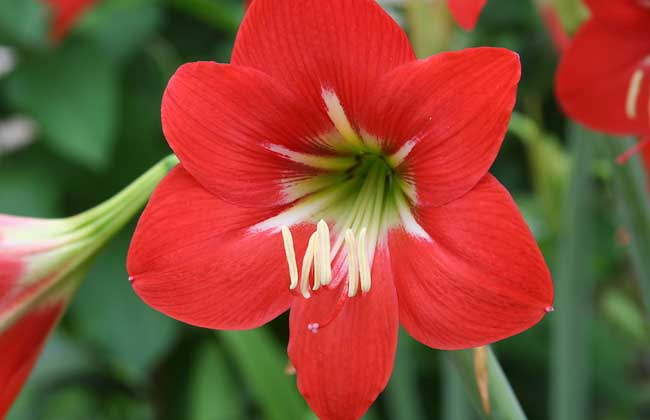
Amaryllis, also known as zhu ding hong, gu ting hua, bai zi lian and so on, is a perennial herbaceous plant of the genus Hippeastrum in the Amaryllidaceae family. It is distributed in Brazil as well as in Hainan Province and other places in mainland China, and has been introduced and cultivated artificially. It is suitable for potting to decorate rooms, living rooms, hallways and corridors, and can also be cultivated in courtyards or planted in flower beds. Now let us take a look at how to grow potted amaryllis!
Growth Habits of Amaryllis
Amaryllis prefers a warm, humid climate, with an optimum growth temperature of 18-25°C. It does not like extreme heat, and sunlight should not be too intense, so it should be kept under a shade structure. It is afraid of waterlogging. In the winter dormant period, it requires a cool and humid climate, ideally 10-12°C, and must not go below 5°C. It prefers sandy loam rich in humus and well-drained, with a pH of 5.5-6.5. If the soil is too moist in winter and the temperature exceeds 25°C, the stems and leaves grow vigorously, hindering dormancy, which will directly affect normal flowering the following year. Light also has a certain influence on the growth and flowering of amaryllis. In summer, avoid prolonged direct strong light; in winter cultivation, sufficient sunlight is needed.
Propagation Methods of Amaryllis
1. Sowing: Amaryllis seeds should be sown immediately after harvesting, with a high germination rate. The sowing soil is a mix of 2 parts peat soil and 1 part river sand. The seeds are relatively large and are best sown in individual spots at a spacing of 2-3 cm. The suitable germination temperature is 15-20°C, seedlings emerge in 10-15 days, and are pricked out when they have 2 true leaves. It takes 2-3 years from sowing to flowering.
2. Bulb division: Amaryllis is mostly propagated in large quantities by artificial cutting of the bulb to produce daughter bulbs, that is, cutting the mother bulb longitudinally into several sections, then cutting each in half at the middle, so that the lower end of each has a portion of the basal plate as a root-forming site, then inserting them into a cutting bed mixed with peat soil and sand, watering appropriately. After 6 weeks, 1-2 small bulbs can form between the scales, and roots develop at the bottom.
3. Cuttage: The mother bulb of amaryllis is cut longitudinally into several sections, then the scales are further cut apart and inserted obliquely into vermiculite or sand. They are planted out when 2 true leaves have grown. When planting the false bulb, if the potting soil is too loose, flowering may be delayed or the number of flowers reduced. A mixed soil of 5 parts sandy loam, 2 parts peat soil and 1 part sand can be used. The planting depth should be such that 1/3 of the bulb is exposed above the soil surface.
How to Grow Potted Amaryllis?
1. Soil: Amaryllis requires loose, fertile sandy loam for planting, with a pH of 5.5-6.5, and must never be waterlogged. The potting soil can be prepared by mixing 2 parts decomposed barnyard manure soil, 6 parts leaf mold and 2 parts sandy soil.
2. Watering: Amaryllis needs to be kept moist, and watering should be thorough. But avoid excessive moisture and poor drainage. Generally, indoor air humidity is sufficient.
3. Sunlight: Amaryllis likes sunlight and can take a moderate amount of direct sunlight, but not for too long. It is best placed by a window with bright light, good ventilation, and no direct strong light.
4. Temperature: Amaryllis prefers warmth and is not cold-tolerant. In summer it should be kept cool, with an ideal temperature of 18-22°C. During the winter dormant period, it requires a cool and dry environment, and the temperature must not go below 5°C.
5. Fertilizing: Amaryllis likes fertilizer. When the leaves grow to 5-6 cm long, start applying topdressing, generally once every half month with decomposed cake fertilizer water. After flowering, change to once every 20 days or so, to promote bulb enlargement and the production of new bulbs.
6. Pruning: Amaryllis grows fast, with long and dense leaves. When repotting and changing soil, the withered leaves, dead roots, and diseased or pest-damaged roots and leaves should be cut away, leaving the vigorous leaves.
Overwintering Management of Amaryllis
1. Bulb overwintering: For bulb overwintering of amaryllis, usually in early October the bulbs are dug out (taking care not to damage them), the upper stems and leaves are cut off, the soil on the roots is washed clean, and they are either sun-dried or shade-dried. After the bulb surface and cut wounds are dry, they are placed in a dry indoor spot or stored in sand in a centralized way.
2. Potted overwintering: For amaryllis overwintered in the original pot with soil, it must be placed in a greenhouse. The potting soil must be kept dry. If the soil is too moist, the plant will continue to grow, hindering its dormancy and affecting normal flowering the following year. When humidity is high in winter, the flower buds inside the bulb are prone to rot, resulting in no flowers the following year. Plants overwintered in pots sprout flowers and leaves earlier than plants overwintered by dry storage.
3. Open-field overwintering: South of the Yangtze River, amaryllis can overwinter in the open field. The method is simple: in late autumn or early winter, cut off the leaves, and mound soil over the bulbs or cover them with rice straw. Plants overwintered in the open field grow vigorously the following year, and the flower buds are robust. However, in areas with frequent rain and snow, or where sunlight and ventilation conditions are poor, rot is likely to occur.
4. Seedling overwintering: Amaryllis seedlings should be placed in a greenhouse for continued cultivation, with continued watering and fertilizing, and kept vigorous through the winter, so that they can grow rapidly as soon as spring begins. This method allows adult bulbs to be obtained earlier.
Pest and Disease Control of Amaryllis
1. Leaf spot disease: Leaf spot disease damages leaves, flowers, scapes and bulbs, causing round or spindle-shaped reddish-brown spots, and occurs especially frequently in autumn. Diseased leaves should be removed. Before planting, the bulbs should be soaked in 0.5% formalin solution for 2 hours, and in spring, Bordeaux mixture of equal proportions should be sprayed regularly.