How to grow potted lavender? I'll teach you the correct care methods
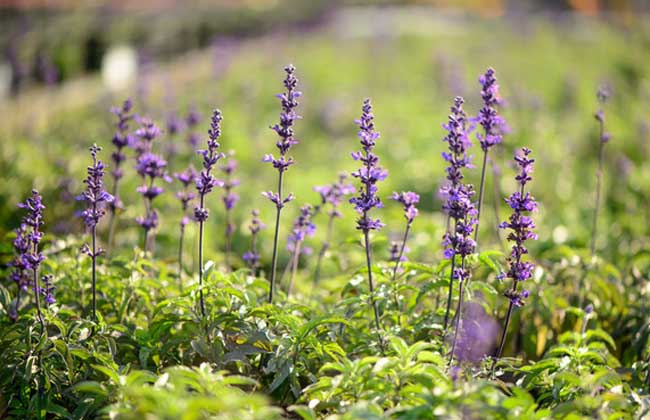
Lavender, also known as lingxiangcao, xiangcao, huangxiangcao, etc., is a small shrub plant of the genus Lavandula in the Lamiaceae family. Its leaf shapes and flower colors are graceful and elegant, and its blue-purple inflorescences are long and beautiful. It is often used as a new perennial cold-resistant flower in courtyards, suitable for clump planting or row planting along flower borders, and can also be grown in pots for ornamental purposes. Now let's take a look at how to grow potted lavender!
Lavender's growth habits
Lavender has strong adaptability. Adult plants tolerate both low and high temperatures, enduring high temperatures of around 40°C during the harvest season, while seedlings can tolerate low temperatures of -10°C. It is a plant that prefers dryness and does not need much water. It needs more water during the regreening stage and the budding stage, less water during the flowering stage, and a moderate amount of water during the seed-setting stage. It is a long-day plant, requiring sufficient sunlight during the growth and development period, with an annual sunshine requirement of more than 2000 hours. Its root system is well developed, and it prefers deep, loose, well-aerated, fertile soil rich in calcium silicate.
Lavender's propagation methods
1. Sowing: The sowing period for lavender is generally chosen in spring. In warm regions, it can be done from March to June or from September to November each year. In cold regions, sowing is best done from April to June. It can also be sown in a greenhouse in winter. Germination takes about 14 to 21 days, and the suitable germination temperature is 18 to 24°C. After germination, adequate light is needed; weak light easily causes spindly growth.
2. Cuttings: Lavender cuttings are generally taken in spring and autumn, and softwood cuttings in summer are also possible. The cutting medium can be 2/3 coarse sand mixed with 1/3 peat moss. Under conditions of good drainage, maintained moisture, and a bed temperature of 20 to 24°C, rooting occurs in about 40 days. Do not use terminal buds that have already produced inflorescences for cuttings, because flowering branches have already aged and will root poorly, affecting future growth vigor.
3. Division: Lavender division propagation can be done in both spring and autumn. Use 3- to 4-year-old plants, and in spring from March to April, divide the old roots of mature plants, with each division bearing bud eyes.
How to grow potted lavender?
1. Soil: Lavender is suitable for slightly alkaline or neutral sandy soil. Special attention must be paid to choosing a well-drained medium. You can use 1/3 perlite, 1/3 vermiculite, and 1/3 peat moss mixed together. If cultivating in open ground, pay attention to soil drainage; you can pile the soil up into raised beds before planting.
2. Watering: Lavender does not like water to remain around its roots for long. After one thorough watering, water again only when the soil has dried, with the surface growing medium dry and the interior moist as the standard, and slight wilting of the leaves as the main indicator. Water in the morning, avoiding sunlight, and do not splash water on the leaves and flowers, otherwise they easily rot and breed pests and diseases. A continuously damp environment will prevent the roots from getting enough air to breathe, leading to poor growth and even sudden death of the entire plant.
3. Light: Lavender is a full-sun plant and needs ample sunlight and a suitably humid environment. An environment that provides full sun is better; it can also grow in partial sun, but it will flower more sparsely. In summer, at least 50% of the sunlight should be blocked, and ventilation should be increased to lower the ambient temperature. Although it will grow weakly under such conditions, it will not die. In winter, lavender can grow well on flat ground and should be cultivated under full sun.
4. Temperature: Lavender is semi-heat-tolerant, prefers coolness, and likes warm winters and cool summers. The suitable growth temperature is 15 to 25°C, and it can grow at 5 to 30°C. The limiting temperature is above 35°C, and long-term exposure above 38 to 40°C causes the top stems and leaves to turn yellow and wither. In northern winters, it begins dormancy when temperatures remain below 0°C for a long time; during dormancy, mature seedlings can tolerate low temperatures of -20 to -25°C.
5. Fertilizing: For fertilizing lavender, bone meal can be placed in the potting soil as a base fertilizer (used once every three months). For small seedlings, Hyponex No. 2 (20——20——20) can be applied. After the plant matures, apply a fertilizer with a higher phosphorus content, such as Hyponex No. 3 (10-30-20). Apply dilute fertilizer; lavender should not be over-fertilized, otherwise its fragrance will become weaker.
6. Pruning: After lavender finishes flowering, it must be pruned. The plant can be pruned to 2/3 of its original size, which makes the plant shape more compact and benefits growth. Pruning should be done in cool seasons such as spring and autumn, generally in spring; pruning in autumn will affect cold resistance. When pruning, be careful not to cut into the lignified parts, so as to avoid weakening and death of the plant.
7. Pests and diseases: For lavender leaf spot disease, spray Bordeaux mixture at 1:200 for 2 to 3 preventive treatments, or zineb at 500 to 800 times dilution. For root rot and Fusarium wilt, use 50% carbendazim at 500 times dilution or 50% thiophanate-methyl at 400 times dilution to drench the roots or spray the leaves. For red spider mites, use 1.8% abamectin diluted 600 to 1000 times, or dicofol, etc., as a foliar spray. For leafhoppers and flea beetles, use 50% phoxim emulsifiable concentrate, 50% fenitrothion emulsifiable concentrate, 12% miechongguan emulsifiable concentrate, and other pyrethroid pesticides for control.