How to care for a potted rubber plant? These methods are very practical
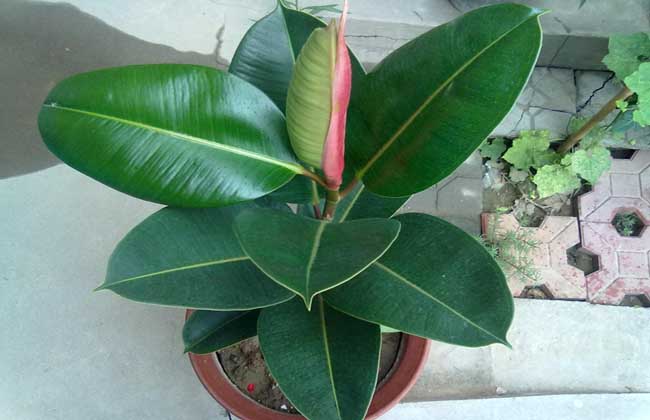
The rubber plant is a large tree species in the Moraceae family, genus Ficus, also known as the rubber tree, Brazilian rubber tree, and so on. It has high ornamental value and is a famous potted foliage plant, extremely suitable for indoor beautification arrangements. Small and medium-sized plants are often used to beautify living rooms and studies, while medium and large plants are suitable for placing on both sides of the entrance halls of large buildings and in the center of lobbies. Let's take a look below at how to care for a potted rubber plant!
Growth habits of the rubber plant
The rubber plant is native to Brazil and is now widely cultivated in tropical regions of Asia. In China, it is cultivated in Taiwan, China, southern Fujian, Guangdong, Guangxi, Hainan, and southern Yunnan, with more planting in Hainan and Yunnan. It prefers a high-temperature, humid environment with ample sunlight. The suitable growth temperature is 20-25°C, and it dislikes direct sunlight. It can also tolerate shade but not cold, with a safe overwintering temperature of 5°C. It tolerates dry air. It dislikes clayey soil and cannot tolerate barrenness or drought. It prefers loose, fertile, well-drained, slightly acidic soil.
Propagation methods of the rubber plant
1. Cuttings: The cutting time is in late spring and early summer, and it can be combined with pruning. The cuttings mostly use 1-year-old semi-lignified middle branches. They are inserted into a cutting bed with plain sand or vermiculite as the substrate. After insertion, maintain high humidity in the cutting bed, but do not let water accumulate. The suitable temperature is 18-25°C. Frequently sprinkle water on the ground to increase air humidity, and do a good job of shading and ventilation. Roots will form in about 2-3 weeks.
2. Layering: Select 2-year-old branches of appropriate size, well-developed, and with solid tissue. At the part where soil is to be wrapped, make a light ring bark girdle about 1 cm wide, and apply 30-50 ppm naphthaleneacetic acid solution. Then use wet soil or a moss mixture or water-saturated vermiculite to wrap the girdled part, and wrap the outside with plastic film. Tie the lower end tightly, and leave an opening at the upper end to facilitate ventilation and watering. Layer in June, roots form in July-August, and after rooting, they can be cut off and potted.
How to care for a potted rubber plant?
1. Soil: The rubber plant prefers loose, fertile, well-drained, slightly acidic soil and cannot tolerate barrenness. The culture soil can be a mixed culture soil prepared with leaf mold, garden soil, and river sand at 1/3 each, with a small amount of cake fertilizer added as base fertilizer. Usually, it needs repotting once every 2 years.
2. Temperature: The rubber plant prefers a high-temperature environment, so it grows fastest in summer and autumn. The environmental temperature should be maintained between 20-30°C. When the environmental temperature is below 10°C, the rubber plant is basically in a state of stagnant growth. The overwintering temperature should not be lower than 5°C.
3. Light: The rubber plant prefers strong direct sunlight and also tolerates shady environments. However, during cultivation, it should receive no less than 4 hours of direct sunlight per day. If conditions permit, it is best to ensure the plant can receive full sun.
4. Fertilization: The rubber plant likes fertilizer but dislikes nitrogen fertilizer. When there is too much nitrogen fertilizer, the stem nodes grow excessively, the leaf spacing widens, and the plant shape becomes unattractive. During the growing season, apply once every 20 days to young plants a fully decomposed 10x liquid fertilizer mixed with an equal amount of 500x potassium dihydrogen phosphate solution, or apply 1000x "Huaduoduo" general fertilizer twice. For established plants, to control height, apply mixed liquid fertilizer once every 2 months during the growing season.
5. Watering: The rubber plant likes moisture but dislikes waterlogging and cannot tolerate drought. In spring and autumn, the potting soil should be kept moist, and water should frequently be sprinkled on its leaves and surroundings to increase air humidity. In summer, the rubber plant needs a large amount of water and should be watered every day to keep the potting soil moist, while also increasing the frequency of sprinkling. When the temperature is lower in winter, watering should be such that the potting soil is on the drier side of moist.
6. Pruning: In spring, prune together with taking the plant out of the shed. Remove the forked branches, inward-growing branches, dead branches, and thin weak branches inside the crown, and shorten the runaway branches protruding beyond the crown, so as to keep good ventilation and light penetration inside the plant and maintain a rounded tree shape. If the crown is too large, the outer branches can be shortened as a whole. During the growth period, excessively dense branches should be thinned at any time and long branches shortened.
Precautions for the rubber plant
1. The suitable growth temperature for the rubber plant is 25-30°C. In winter, if it is below 3°C, the leaves will turn yellow and fall off, so in winter it should be placed in a sunny indoor spot and the room temperature kept above 10°C. When it exceeds 35°C in summer, the plant should be moved to a cool, ventilated place for care, and water should be sprayed at the right time to lower the temperature.
2. The rubber plant is a Moraceae plant, and the whole plant contains milky sap. Therefore, after each pruning, immediately plug the cut with clay or apply charcoal powder to prevent excessive sap flow and cause dehydration and death.
3. During the seedling stage of the rubber plant, it is necessary to regularly rotate the direction of the pot to avoid the plant growing toward one side, which would cause the plant shape to be small and improper and affect its appearance.
4. After the rubber plant becomes an established plant, as the roots grow larger, the soil becomes compacted, hindering soil aeration, causing the rubber plant to turn yellow, and in severe cases possibly dying. It is advisable to repot once every spring before new buds grow, and loosen the soil once every 15-20 days until it returns to normal growth.
Four-season management of the rubber plant