How to Grow Potted Peonies? Detailed Care Methods and Tips
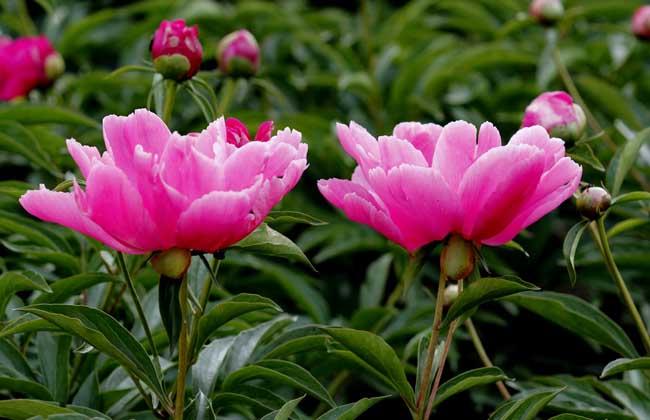
Peony, also known as Jiangli, Licao, Yurong, Hongyao, etc., is a perennial herbaceous plant of the genus Paeonia in the family Paeoniaceae. It is praised as the "Flower Fairy" and "Flower Prime Minister," listed as one of the "Top Ten Famous Flowers," and also called the "May Flower Goddess." Since ancient times it has been regarded as the flower of love, and is now honored as the representative flower of Qixi Festival. Let's take a look below at how to grow potted peonies!
Growth Habits of Peonies
Peonies love sunlight and are drought-tolerant. The plant's periodic developmental changes throughout the year, driven by climate rhythms, mainly manifest as alternating growth and dormancy periods, among which the vernalization stage during dormancy and the photoperiod stage during growth are the most critical. The vernalization stage of peonies requires about 40 days at a low temperature of 0°C before the mixed buds can begin to sprout and grow. It is a long-day plant, and flower buds require long-day conditions to develop and bloom. After the mixed buds sprout, if light duration is insufficient or under short-day conditions, the plant typically only grows leaves without blooming, or blooms abnormally.
Propagation Methods of Peonies
1. Division: Division is the most commonly used propagation method for peonies. Nursery production in peony-growing areas basically adopts this method. It has three advantages: first, it flowers earlier than sowing - seedlings from sowing take 4-5 years to bloom, while divided plants can bloom the following year. Second, division is simple and easy to perform, saves labor in management, and is conducive to widespread application. Third, it can maintain the excellent traits of the original variety. The disadvantage is a low propagation coefficient - a three-year-old mother plant can only be divided into 3-5 daughter plants.
2. Sowing: Peony seeds should be sown immediately after collection. As sowing time is delayed, seed moisture content decreases and germination rate drops. The seeds have a double dormancy characteristic involving both the epicotyl and hypocotyl. After sowing, autumn soil temperature releases the hypocotyl from dormancy, and the radicle develops and roots. The better the rooting in the current year, the more vigorous the growth the following year. If sowing is too late, the soil temperature cannot break hypocotyl dormancy, rooting fails, and the germination rate the following spring is greatly reduced.
3. Cuttings: For peonies, taking cuttings in mid-July gives the best results. Roots form 20-30 days after cutting, along with dormant buds. After rooting, reduce water spraying and watering, and gradually remove the plastic cover and shade net. Cutting-grown plants grow slowly and need to be covered with soil in the bed to overwinter, then moved to open-field planting the following spring.
4. Layering: In spring, thread newly emerged young shoots through the drainage hole of a flower pot into a pot with a diameter of 15-20 cm. Gradually fill with soil as they grow, keeping the potting soil moist. By summer they will have rooted. Before winter, cut the stem below the pot, and a potted peony is formed.
How to Grow Potted Peonies?
1. Soil: Peonies have fleshy roots. When planting, choose loose, fertile, slightly acidic sandy soil. They are not suitable for growing in alkaline soil. If the soil is too alkaline, it will cause leaf yellowing, and even shrinkage and death.
2. Watering: Apart from natural rainfall, peonies generally do not need frequent watering. Usually, water only a few times when water demand is highest - around flowering time and during spring drought - to supplement soil moisture deficiency. Do not water too much each time.
3. Fertilizing: Fertilizing peonies should be controlled. Fertilize three times a year. The first is when new shoots rapidly emerge and leaves and flower buds are extending, mainly with quick-acting fertilizer, called flower-promoting fertilizer.
4. Shaping: Peony shaping mainly includes trunk establishment, branch pruning, bud removal, bud thinning, and removal of spent flowers. Trunk establishment can be done 2-3 years after planting. For varieties with particularly strong and vigorous growth, they can be pruned into single-trunk peonies. For varieties with weak growth and few branches, generally prune thin weak branches and retain strong ones.
5. Pests and Diseases: Common peony pests and diseases include brown spot disease, anthracnose, rust disease, root rot, root-knot nematode disease, longhorn beetles, red spiders, scarab beetles, mole crickets, etc. Among these, brown spot disease, anthracnose, and rust disease are fungal diseases. Pest and disease control should focus on early prevention. Once pests or diseases occur, according to the degree of occurrence and the above-mentioned dosage, appropriately shorten the spraying interval and increase the number of applications.
Precautions for Peonies
1. After planting, peonies should not be frequently transplanted, otherwise the roots will be damaged, affecting growth and flowering. For good peony growth, reasonable fertilization is needed each year. After each fertilization, water thoroughly and immediately loosen the soil to reduce water evaporation.
2. For potted peonies, after Frost's Descent (Shuangjiang), cut off withered branches and leaves to prevent pests and diseases. During winter, there is no need to move them indoors. Place them on a balcony or under the eaves in a sunny spot, and just keep the potting soil from becoming too dry.
3. Before peonies bloom, after side buds appear, they can be removed promptly to concentrate nutrients and promote larger and more beautiful terminal buds. After blooming, if you do not plan to propagate by seed, cut off the flower stems at any time to prevent seed formation and nutrient consumption.