How to care for a potted five-needle pine so it grows lush branches and leaves
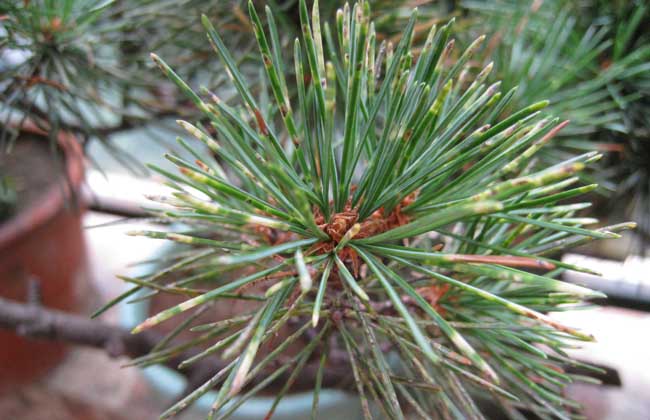
The five-needle pine, also known as the Japanese five-needle pine, five-fascicle pine, Japanese white pine and so on, is an evergreen coniferous tree of the genus Pinus in the family Pinaceae, named for its five needles growing in clusters. The plant is relatively short, grows slowly, has short needles and dense branches, an elegant bearing and a beautiful tree shape, and is often used as a superior tree species for making bonsai. Its bonsai has already been widely cultivated throughout China. Now let us take a look at how to care for a potted five-needle pine!
The growth habits of the five-needle pine
There are many varieties of the five-needle pine, and the most precious is the large-plate pine, which has the shortest needles (needle length about 2 cm) and dense branches. It likes a warm and humid environment, is a light-loving tree species with very high light requirements, and its planting soil must not become waterlogged and must have good drainage and aeration; it grows poorly in damp, shaded places. Although it has strong resistance to sea breezes, it is not suitable for growing in sandy soil. For fertilization, organic fertilizer is best.
Propagation methods of the five-needle pine
1. Sowing: Sowing of the five-needle pine is carried out from March to April. The seed coat is thick and hard and not easy to germinate, so 40 days before sowing it should first be treated with warm water of about 50 degrees for 3 to 4 hours, then removed and mixed evenly with twice its amount of wet sand for sand storage to promote germination, and then sown in a seedbed; it can germinate after 20 to 30 days. In China, the five-needle pine rarely bears seeds and the seed germination rate is low, so grafting is mostly used for propagation.
2. Grafting: The five-needle pine can be propagated by cut grafting or side grafting, with side grafting being more common. It is usually carried out from the time sap flows until just before budding, generally from late February to early to mid-March. The rootstock is chosen from 2-year-old robust black pine, and the scion is chosen from 1- to 2-year-old thick branches or buds, and the graft incision should be as close to the root as possible. After grafting, it should be placed in a semi-shaded place. If the scion's buds gradually turn green and begin to sprout, it means the scion has healed.
3. Cuttings: Cutting propagation of the five-needle pine is usually carried out in spring and autumn. Choose one-year-old branches and cut them into heel cuttings. After cutting, under conditions of shading and maintaining relatively high air humidity, roots can form after 70 to 80 days. After the cuttings take root, gradually increase the light intensity and ventilation time so they gradually adapt to the external environment.
How to care for a potted five-needle pine?
1. Soil: The potting soil for the five-needle pine requires sandy soil with good drainage and aeration, rich in organic matter and slightly acidic. Black mountain soil, peat soil and artificial media are preferable. Commonly, leaf mold is mixed with yellow soil (or black mountain soil) and sandy soil in a ratio of 6:3:1. The potting soil must not be alkaline, otherwise it is unfavorable for growth and the five-needle pine will turn yellow and drop.
2. Light: The five-needle pine is a strongly heliophilic plant. Usually the flower pot should be placed in a dry, ventilated place with ample sunlight for care; being too wet or too shaded is unfavorable for its growth. Generally, for potted five-needle pine seedlings of 1 to 2 years, apart from appropriate shading at the hot midday in summer to prevent the needles from excessive sun exposure and scorching, at other times they should be placed outdoors in the open to fully receive sunlight.
3. Watering: The five-needle pine likes dryness and avoids wetness, so watering should be moderate and must not be excessive; the foliage should be sprayed with water frequently. Soil moisture should preferably be 15 to 30%. Generally, water once every 2 to 3 days in spring and once every 1 to 2 days in autumn. In summer, water once every morning and spray the foliage once in the evening. In winter, water once a week, and usually the foliage needs to be sprayed with clean water frequently.
4. Fertilization: For the five-needle pine, it is advisable to use the method of light fertilizer applied sparingly, and fully decomposed cake fertilizer is suitable. Mature plants should be fertilized in spring and autumn. Spring fertilizer should be applied 2 to 3 months before budding, once every 10 days, at a concentration of about 15%, to promote budding and branch growth. In July and August, when the weather is hot, it is advisable to apply 10% dilute fertilizer water, about once every half a month, and it should be applied in the morning or evening.
5. Pruning: The five-needle pine needs continuous pruning to make its form increasingly perfect. Pruning is best done during the dormant period from December to January of the following year, mainly cutting off leggy branches, messy branches and pest- and disease-damaged branches. After pruning, seal the wounds with lanolin or adhesive tape to prevent resin bleeding. Bud thinning is generally done between April and May, and it is best to thin the buds when they have grown to 2 to 3 cm. Overlong buds on the tips of branches can be removed by 1/3 to 1/2 to avoid producing leggy branches, so that the needles are dense and short and the branches are thick and strong.
6. Repotting: When first potting the five-needle pine, it is advisable to use an unglazed clay pot because of its good aeration, which makes it easy to survive. After it has settled in the pot, change to a purple clay pottery pot with an antique form and deep color. The potting soil should be changed once every 3 to 4 years, and the soil change time should preferably be from late February to early April or from September to mid-October. When repotting, appropriately cut off some old roots and water thoroughly.
7. Pests and diseases: If not properly cared for, the five-needle pine is susceptible to leaf blight, pine needle cast disease, pine tip moths, scale insects and other pests and diseases. Once discovered, diseased leaves should be removed promptly and a 50% thiophanate-methyl wettable powder 800-fold solution should be sprayed. If scale insects or pine tip moths are found, an 80% pyrethroid insecticide diluted 1000-fold with water can be sprayed for control.