How to care for potted February orchid and points to note
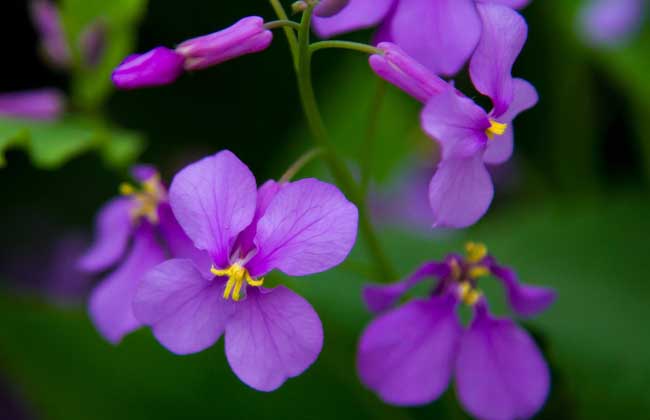
February orchid, also known as Zhuge cai, February blue, purple gold grass, etc., is an annual or biennial herbaceous plant of the genus Orychophragmus in the Brassicaceae family. Because it begins to bloom with blue-purple flowers around the second lunar month, it is called February blue. It has high ornamental value; the flowering period of a population can last more than two months, and the best ornamental effect can last as long as one month. Now let us take a look at how to grow potted February orchid!
The growth habits of February orchid
February orchid has strong adaptability and cold resistance, and few pests or diseases. Even in winter it still has lush green leaves, and in early spring it blooms in masses. It has low requirements for soil, generally growing in ordinary garden soil, and can also adapt to neutral or slightly alkaline soil. It grows vigorously in fertile, moist, sunny environments, and also performs well in shady and damp environments. It has strong self-seeding and growth ability, and also shows good landscape greening effects on barren slopes and relatively dry places. It has strong shade tolerance; under conditions with a certain amount of scattered light, it can grow, bloom, and set seed normally.
Propagation methods of February orchid
The propagation method of February orchid is seed propagation, generally starting with sowing in autumn, so after autumn sowing, warmth measures should be taken in winter. Although February orchid has a certain cold resistance, during the seedling stage attention should still be paid to keeping warm to ensure the seedlings survive. In addition, before propagation the soil should be prepared to ensure it is loose and fertile, and watering should be increased according to seedling growth. When the young sprouts grow into seedlings, fertilization should be increased to provide the nutrients they need for growth, and during the growth of February orchid, some light exposure should be correspondingly increased to enhance photosynthesis and promote plant growth.
How do you grow potted February orchid?
1. Soil: Potted February orchid has relatively high requirements for potting soil. You can consider evenly mixing 6 parts garden soil, 2 parts perlite, and 1 part plant ash, and sufficient base fertilizer should be placed in the pot.
2. Humidity: February orchid has relatively strong cold resistance and shade tolerance, and with a certain amount of scattered light it can grow, bloom, and set seed normally.
3. Temperature: February orchid is cold-resistant but not heat-resistant, with a temperature between 15°C and 25°C.
4. Light: February orchid is a short-day plant, so it does not need too long of daily sunlight; indoor scattered light exposure is sufficient.
5. Fertilization: February orchid likes fertilizer. Sufficient fertility will not only make February orchid grow faster, but also promote its flowering and fruiting.
6. Watering: February orchid has very strong vitality and does not need much care; just remember to water after the soil dries out.
7. Pruning: To maintain a relatively good ornamental effect, February orchid must be controlled so it does not set seed. Generally, during the seed-setting period, prune it to a height of 10-15 cm.
8. Repotting: February orchid is best repotted once a year, as this is beneficial to its growth.