What are the flower meanings and legends of the rose of Sharon?
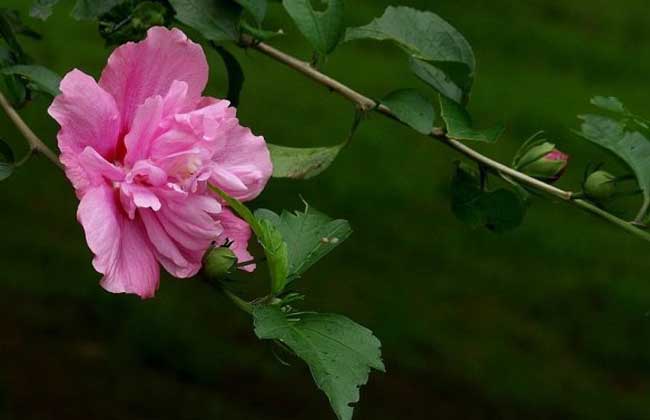
The rose of Sharon is a common flowering shrub for courtyards, also known as plum hibiscus, white hibiscus, and palm tree flower. It is a deciduous shrub or small tree of the mallow family, Hibiscus genus, with brilliant colors. It is often an excellent plant for free-growing flowering hedges, suitable for planting along roadsides, in parks, courtyards and other places, and can be planted alone, in rows or in masses. Now let us take a look at the flower meanings and legends of the rose of Sharon!
The flower meanings of the rose of Sharon
Resilience, simplicity, eternity, beauty. The rose of Sharon blooms in the morning and falls at dusk, but every withering is for a more splendid bloom next time. Just like the sun that keeps setting and rising, like spring going and autumn coming as the four seasons turn, yet life goes on endlessly. It is even more like loving someone: there will be low points, there will be troubles, but those who understand love will still persevere gently. Because they understand that ups and downs are always unavoidable, but nothing will make them waver in their original choice; the faith in love remains eternal and unchanging.
The symbolism of the rose of Sharon
Resilience, eternal beauty. The rose of Sharon has strong vitality, and its flower symbolizes a character that, having endured hardships, remains ever more steadfast in purpose. It also symbolizes prosperity, and symbolizes nostalgia and valuing affection and loyalty. The national emblem of South Korea takes the national flower, the rose of Sharon, as its main subject. Many buds grow on the branches of the rose of Sharon, and after one flower withers, the other buds will continue to bloom one after another. Therefore, South Koreans also call it the “flower of infinity,” symbolizing the national spirit of endless life from generation to generation. The white rose of Sharon can also represent a noble and aloof national spirit. The rose of Sharon is also the national flower of Malaysia.
The legend of the rose of Sharon
In ancient times, east of the ancient capital hill there was a ridge called Mount Li. At the foot of Mount Li grew three clumps of rose of Sharon, about two zhang tall, with crowns that could fill a mu. Every summer and autumn, flowers covered the trees, brilliant as brocade. In one early autumn season, the so-called “Four Fiends” - “Hundun,” “Qiongqi,” “Taowu,” and “Taotie” - also came to Mount Li to sightsee.
Seeing such beautiful scenery, they immediately had wicked intentions, vainly attempting to move the plants away and claim them as their own. So the “Four Fiends” launched a battle at Mount Li over the rose of Sharon. The “Four Fiends” and their subordinates all fought until their heads were bloodied, and finally they dug up the three clumps of rose of Sharon. Strangely enough, as soon as the rose of Sharon trees fell, they quickly withered, even losing their flowers and leaves.
Seeing this sight, the “Four Fiends” expected that even if they took them back, it would be difficult for them to survive, so one by one they left Mount Li dejected. Yu Shun, who was leading farmers in cultivation at Mount Li, came upon hearing the news. He called the farmers to lift up the three clumps of rose of Sharon and draw water to irrigate them. A miracle appeared: the branches and leaves of the three clumps of rose of Sharon immediately revived, and the flowers bloomed as before. Yu Shun smiled, and the farmers were happy.
To repay Yu Shun's grace for saving their lives, the rose of Sharon fairies took Yu Shun's taboo name as their surname to show remembrance. Yu Shun understood this very clearly in his heart. It turned out that on the night the rose of Sharon revived, Yu Shun saw the fair faces of three fairies in his dream, and they told him the above matters. In the haze, Yu Shun saw three fairy maidens floating over; looking closely, each had a face like a peach blossom, like three lotuses emerging from water.
Just as Yu Shun was gazing entranced, he saw the three fairies salute and call him “benefactor.” Yu Shun did not know what to do, and asked blankly: “Where do you come from, and why call me benefactor?” The three fairies smiled and said: “We are not human; we are rose of Sharon fairies. Thanks to our benefactor's rescue in time of danger, we were able to preserve our bodies.” Hearing this, Yu Shun rose in alarm and made a long bow, saying, “I did not know immortals had descended; I have failed in proper courtesy. I hope the high immortals will forgive me.”
Hearing this, the three fairies could not help laughing. One fairy said solemnly: “We sisters are only members of the hundred flowers; our benefactor is a proud son of heaven, so how dare we trouble you with great courtesy? Moreover, we sisters have already reported to the Heavenly Emperor and taken our benefactor's taboo name Shun as our surname, to repay the great kindness.” Yu Shun was about to ask again, but the fair figures had already vanished, and he saw only streaks of moonlight before the bed. After Yu Shun moved to Fuxia, he divided the clumps and transplanted them inside the new city, and the rose of Sharon branches flourished and leaves were luxuriant. After he assumed the throne of Son of Heaven, he transplanted them again to Pugu, and the rose of Sharon bloomed in profusion like brocade.