How to grow star jasmine (Trachelospermum jasminoides)? Detailed introduction to cultivation methods
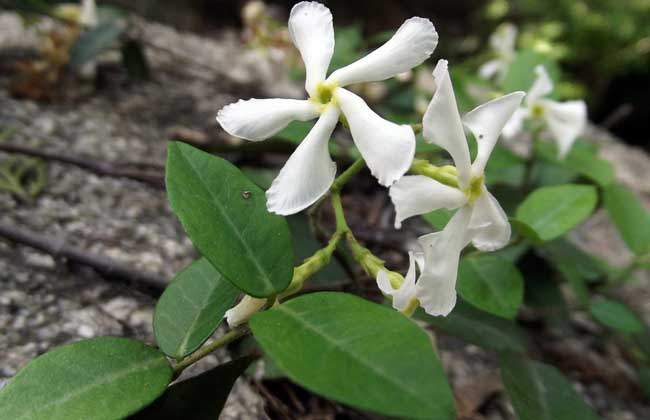
Star jasmine, also known as Shilongteng, Wanzihua, Wanzi jasmine and so on, is an evergreen woody climbing plant of the genus Trachelospermum in the Apocynaceae family. It has strong creeping and climbing ability and can be used in combination for color band and color block landscaping. In gardens it is mostly used as ground cover or grown in pots for ornamental purposes, but this species is a toxic plant included in the Chinese plant atlas database, with the whole plant being toxic. The symptoms of poisoning are similar to those of sea mango. Let us take a look at the cultivation methods for star jasmine below!
Growth habits of star jasmine
Star jasmine is native to China south of the Yellow River basin, and is cultivated in both northern and southern regions. It has strong adaptability to climate, can tolerate cold and also tolerates summer heat, but dislikes severe cold. It likes humid environments and dislikes dry wind. It likes weak light and also tolerates strong sunlight and high temperatures. It can climb walls, on both the sunny side and the shady side. It is not demanding about soil; generally, light clay and sandy loam with medium fertility are suitable, and it can grow in both acidic and alkaline soil. It is relatively tolerant of drought but dislikes waterlogging. When grown in pots, it should not be watered too much; keeping the soil moist is enough.
Propagation methods for star jasmine
1. Layering: During the plum rain season, the tender stems of star jasmine easily grow aerial roots. Taking advantage of this characteristic, its tender stems can be propagated by continuous layering, then cut apart from the middle in autumn, yielding a large number of seedlings.
2. Cuttings: For star jasmine, during the plum rain season, cut tender stems that have aerial roots and insert them into plain soil, placing them in half shade; the survival rate is very high, but the survival rate of cuttings from old stems is low.
3. Sowing: Potted star jasmine generally does not set seed after flowering. When planted in the ground, it can bear cylindrical fruit after flowering. After the fruit ripens in October, collect it and sow it the following spring, but seedlings grown from seed only flower after three to four years.
Cultivation methods for star jasmine
1. Fertilizer: Variegated star jasmine likes fertilizer but is not demanding; all kinds of fertilizer can be used. It can still flower without fertilizing for a year, but the number of flowers will be somewhat fewer. If you want potted variegated star jasmine to bloom profusely, you can apply more bone meal and phosphorus-potassium fertilizer and use less nitrogen fertilizer. For variegated star jasmine planted in the ground, applying a nitrogen-phosphorus-potassium compound fertilizer once each in spring and autumn is enough; do not fertilize in winter and summer.
2. Watering: Variegated star jasmine likes moisture. During the growing season, the potting soil should be kept slightly moist. In spring and autumn, water once every two days; in summer, water once a day; in winter, water about once every half month. The potting soil should be slightly moist but not dry; at no time should there be waterlogging. For potted variegated star jasmine placed on a roof garden or in a courtyard, pay attention to draining accumulated water during the rainy season. Ground-planted star jasmine should not be planted in low-lying land, otherwise the roots rot easily. During the growing season, it is fine to water again only when the soil is dry; for ground-planted plants in winter, watering can be omitted.
3. Pruning: Variegated star jasmine tolerates pruning and stays evergreen through all four seasons. It can also be combined with golden privet and red-leaf barberry for color band and color block landscaping. By pruning to control vine length, branching can be promoted, which helps make the plant shape full. The first pruning is done when the vine reaches 8 cm in length, cutting it back to leave about 6 cm. After that, prune every time it grows 4-5 cm. Usually 2-3 prunings are enough to produce a very good pot shape.
4. Light: Variegated star jasmine is a temperate-zone flower that likes warmth and light. When planted in the ground, it should be planted in a sunny spot; in shade it grows poorly, with few flowers and faint fragrance, or even no flowers. For potted plants, place them in a spot with ample sunlight in spring, autumn and winter. In midsummer, if placed in half shade where it can see the sun in the morning or evening and avoid direct strong sunlight at noon, it will bloom continuously. If it is too sunny at noon, the flowers will be few, or even none. Star jasmine is relatively cold-tolerant. In the Yellow River basin and areas to its south, it can overwinter safely outdoors; in the north, it is still better to move it into a low-temperature room to overwinter.
5. Pests and diseases: The main diseases of variegated star jasmine include anthracnose and leaf spot. Use 50% thiophanate-methyl at 600-800 times dilution or 70% mancozeb wettable powder at 800-1000 times dilution for control. For damage by mites such as red spider mites and moth larvae, use 15% pyridaben at 1000-1500 times dilution for control. For aphids, use imidacloprid 25% wettable powder at 1500 times dilution or 48% chlorpyrifos EC at 2000-3000 times dilution for control.