Potted Phalaenopsis Care Methods and Precautions
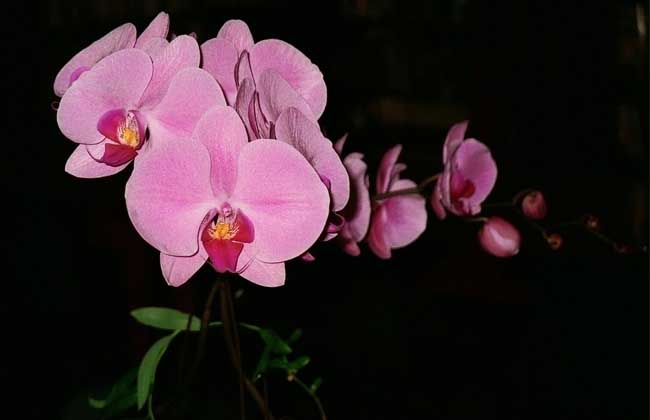
Phalaenopsis is an epiphytic plant of the genus Phalaenopsis in the orchid family (Orchidaceae). Its scientific name means "orchid resembling a butterfly" in Greek. It is native to subtropical rainforest regions. During the Chinese New Year season, the plant sends out long flower stalks from the leaf axils and blooms with flowers shaped like dancing butterflies, making it highly favored by flower enthusiasts and earning it the title "Queen of Foreign Orchids." Let's take a look at how to care for potted Phalaenopsis!
Growth Habits of Phalaenopsis
Phalaenopsis is native to tropical rainforest regions. The forest trees along riverbanks and coasts with high temperature and high humidity are where Phalaenopsis grows as an epiphyte. The most suitable relative humidity range is 60-80% RH, but in overly wet environments, diseases often accompany it. It prefers warmth and fears cold. The optimal growth temperature is 15-20°C. Below 10°C in winter, growth stops, and below 5°C, it easily dies.
Propagation Methods of Phalaenopsis
1. Flower stalk bud induction: First cut off the portion of the flower stalk that has already finished blooming, then carefully use a blade or sharp knife to remove the bracts between the first and third nodes on the upper part of the flower stalk, exposing the buds in the nodes. Use a cotton swab to evenly apply a bud-inducing agent or hormones such as indolebutyric acid to the exposed nodes. After treatment, place the orchid plant in a semi-shaded area at a temperature of 25-28°C. After 2-3 weeks, the buds will grow leaves, and after 3 months, they develop into small Phalaenopsis seedlings with 3-4 leaves and aerial roots.
2. Crown cutting for bud induction: When the growing point of a Phalaenopsis plant is damaged by various factors, after some time, 1-2 new shoots will grow from the stem nodes near the base of the plant. This characteristic can be used to propagate Phalaenopsis.
3. Stem cutting propagation: Although there are 1-3 dormant buds in the leaf axils of Phalaenopsis plants, most cannot sprout into new plants. After the plant grows continuously upward and the stem nodes become longer, use a sterilized sharp knife or scissors to cut off the upper part of the plant with roots, plant it in a new pot to continue growing, and give the lower part with the rhizome proper water management. New shoots will soon sprout.
4. Tissue culture: Using tissue culture to propagate Phalaenopsis can produce excellent genetic characteristics identical to the mother plant. Phalaenopsis seedlings produced by this method are called meristem seedlings or tissue-cultured seedlings. The plant tissue (explant) used for meristem culture can be the terminal bud (shoot tip), stem segments (dormant buds), young leaves, or root tips, but currently the most commonly used is the flower stalk of Phalaenopsis.
How to care for potted Phalaenopsis?
1. Temperature: Phalaenopsis likes high-temperature and high-humidity environments. Attention should be paid to increasing temperature during autumn and winter, the transition between winter and spring, and when winter temperatures are low. When summer temperatures are high, cooling and ventilation are needed. If the temperature exceeds 32°C, it enters a semi-dormant state, and prolonged high temperatures should be avoided. The peak flowering period is around the Chinese New Year. Properly lowering the temperature can extend the viewing time. During flowering, the nighttime temperature is best controlled between 13-16°C, but must not be lower than 13°C.
2. Humidity: The suitable air humidity for Phalaenopsis growth is 60-80%. Water more during the period of vigorous new root growth, and water less during the dormant period after flowering. In spring and autumn, water once daily around 5 PM. In summer, when the plant grows vigorously, water once at 9 AM and once at 5 PM each day. In winter, with weak light and low temperatures, watering once every other week is sufficient, preferably before 10 AM. If a cold wave arrives, do not water; keep it dry and resume watering after the cold wave passes.
3. Light: Although Phalaenopsis prefers shade, the orchid plant still needs to receive some light, especially before and after the flowering period. Proper light can promote flowering and make the flowers more vibrant and long-lasting. Generally, it should be placed in a location with diffused light indoors, away from direct sunlight.
4. Ventilation: The normal growth of Phalaenopsis requires circulating fresh air, so home-grown Phalaenopsis must have good ventilation, especially during the high-humidity period in summer. Good ventilation is essential to prevent heat stress and also to avoid infection from pests and diseases.
5. Fertilization: Phalaenopsis should be fertilized year-round. Unless low temperatures persist for a long time, fertilization should not be stopped. Winter is the flower bud differentiation period for Phalaenopsis, and stopping fertilization can easily lead to no flowers or few flowers. Spring and summer are the growth periods. Apply a dilute liquid fertilizer once every 7-10 days, preferably organic fertilizer, or use a special nutrient solution for Phalaenopsis. However, do not apply when there are flower buds, as this can easily cause premature bud drop. Fertilize after watering in the afternoon. After several fertilizations, flush the pot and plant with plenty of water to prevent residual inorganic salts from damaging the roots.
6. Diseases: Phalaenopsis is susceptible to soft rot and gray leaf spot. Soft rot is extremely contagious. Once discovered, immediately isolate the diseased plant. The diseased plant can be treated with mancozeb or thiophanate-methyl, typically sterilizing once every 15 days. The common growing media for Phalaenopsis are mainly sphagnum moss and moss. Therefore, the potting medium should not use soil but should use sphagnum moss, pumice, tree fern fiber, crushed charcoal, etc.
Precautions for Phalaenopsis
1. Overwatering: Friends who grow Phalaenopsis always worry that the orchid lacks water and water it daily regardless of whether the growing medium is dry, causing severe root rot.
2. Temperature too low: Usually, blooming Phalaenopsis plants are mostly available on the market in early spring. After buying them and taking them home, they are generally placed in living rooms and other places for appreciation. Although the daytime temperature in these places is sufficient, the nighttime temperature is somewhat on the low side.