Detailed Explanation of Key Points of Jackfruit Cultivation Techniques
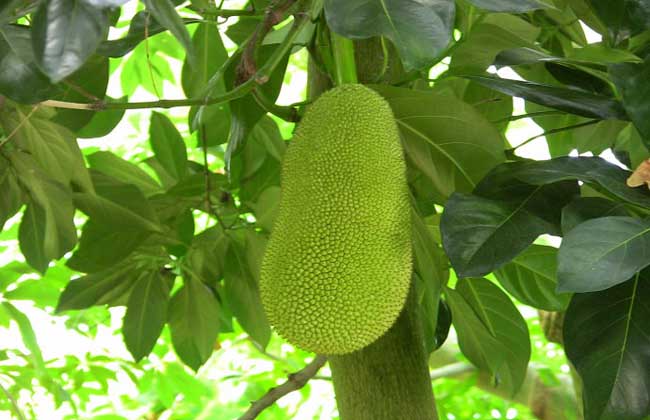
Jackfruit is a tropical tree species that combines fruit, woody food, and valuable timber. Also known as wood pineapple, tree pineapple, honey wax gourd, etc., it is an evergreen tree of the genus Artocarpus in the Moraceae family. It originated in India and Southeast Asia and was introduced to China nearly a thousand years ago. It is now mainly cultivated in Hainan, Guangxi, Guangdong, Taiwan, China, and other parts of South China. It has extremely high cultivation value. Let us take a look at jackfruit cultivation techniques together below!
Orchard Site Selection
Jackfruit prefers a warm and humid tropical climate. It is not cold-tolerant. The annual average temperature of the planting site is required to be ≥21°C, the average temperature of the coldest month ≥13°C, and the absolute minimum temperature ≥0°C. It has low requirements for soil and can grow normally in deep, fertile, loose, well-drained acidic soil, as well as slightly alkaline clay or sandy loam. Cultivation in low hilly areas or flat land below 600 m elevation is optimal.
Seed Propagation
For jackfruit, during the main ripening period, select fully mature, normally developed fruits free of pests and diseases for seed selection. Wash them clean with water, then spread them evenly on a sand bed for germination, cover the sand bed with fine sand 1-2 cm thick, then cover with a layer of rice straw, and water 1-2 times daily. After about 1 week, they will gradually sprout and take root. When the seedlings grow 1-2 true leaves, they can be transplanted to separate beds.
Bud Grafting Propagation
Jackfruit seedlings can be bud-grafted once they grow to more than 1 cm, using the patch budding method. Select one-year-old, sun-facing, mature branches from superior varieties as scions. The scions should be kept moist during storage, and it is best to graft immediately after collecting. In Hainan, budding can be done throughout the year, but the survival rate of budding is higher during the rainy season and tree growth season from April to October, when the rootstock and scion bark are easy to peel and the grafts easily survive.
Orchard Establishment and Planting
Jackfruit planting spacing is 5-6 m × 6-7 m. Dig planting holes of 80 cm × 80 cm × 80 cm. Place weeds and branches at the bottom of the hole mixed with 0.5 kg of lime, then backfill a layer of topsoil, and add pond mud, 30 kg of poultry and livestock manure, and 0.5 kg of phosphate fertilizer. Jackfruit can be planted throughout the year, but spring planting (March to April) and autumn planting (September to November) are best. When planting, break up the soil in the planting hole finely, straighten and arrange the seedling roots, then press in fine soil layer by layer, with the root collar level with the ground. After planting, water thoroughly immediately and cover the tree base with plastic film.
Rational Fertilization
1. Young trees: Young trees have relatively shallow and narrow root distribution, so frequent light applications are suitable, preferably applied as liquid fertilizer. Generally, two fertilizer applications per flush is more reasonable, namely the shoot-promoting fertilizer and the shoot-strengthening fertilizer. From before bud sprouting to when a small number of shoots have sprouted, apply 20 g of urea per tree per application in the first year to promote shoots. When most young shoots have grown to 6 cm and the new leaves from the base of the shoot change from light green to dark green, apply compound fertilizer and potassium fertilizer to strengthen the shoots. In the first year, apply (20 g compound fertilizer + 15 g potassium sulfate) per tree per application, increasing year by year thereafter.
2. Fruiting trees: Fruiting trees are generally fertilized 3 times a year. Apply flower-promoting fertilizer before flower spikes emerge, mainly compound fertilizer, with 1 kg compound fertilizer, 0.5 kg potassium sulfate, and 5 kg manure water per tree. Apply fruit-strengthening fertilizer during the young fruit stage, mainly nitrogen and potassium, to promote rapid fruit enlargement, with 5 kg pig manure water, 0.5 kg urea, 0.5 kg compound fertilizer, and 0.5 kg potassium sulfate per tree. Apply post-harvest fertilizer in October together with renewal pruning. Organic fertilizer should be applied heavily to promote adventitious bud sprouting and accumulate nutrients for canopy renewal, with 15 kg chicken manure, 0.5 kg urea, 1 kg compound fertilizer, and 0.5 kg superphosphate per tree.
Shaping and Pruning
Jackfruit bears fruit on the trunk, main branches, and small secondary branches. In production, tree canopy height should be controlled and a good round-headed canopy should be cultivated. Young trees should focus on canopy development, with shaping as a supplement. When the trunk height reaches 1 m, cut back the trunk to promote branching. Remove crossing branches, densely growing branches, and overlapping branches as necessary. Generally, cultivate 3-4 first-order branches and a canopy height of 3.5 m. Pruning of fruiting trees is mainly winter pruning, mainly removing dead branches, weak branches, overly dense branches, residual fruiting branches, and male flower branches. To control the canopy well, individual large branches and water sprouts should also be appropriately cut back to keep branches evenly distributed.
Promoting Flowering and Fruiting
If vegetative growth of jackfruit after planting is too vigorous and affects flowering and fruiting, ring barking or ring cutting can be done on the trunk and main branches to allow more nutrients to accumulate in the aboveground branches and trunk, promoting the emergence of fruiting branches and flowering and fruiting. Alternatively, scoring wounds every 30 cm on the trunk and main branches can also achieve the effect of promoting flowering and fruiting. The degree should be piercing the bark without damaging the xylem, and there is no need to wipe away the sap that flows out.