A detailed explanation of Torreya grandis planting techniques, teaching you to master the key points of cultivation and management
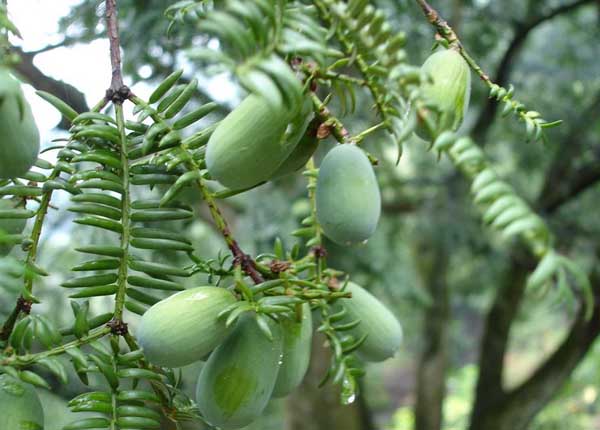
Torreya grandis is an excellent variety of the Torreya tree and a rare dried-fruit tree species native to China. It not only has high cultivation value but also good ecological and landscape benefits. Hangzhou has already listed Torreya grandis as a characteristic and advantageous industry belt for dried-fruit development. Afforestation on Torreya grandis bases uses grafted seedlings of "2+3" or above. Generally, they can flower and bear fruit in the 3rd year, and in the 6th year each tree can produce 1-2 kg of dried seeds. A mature tree produces about 10 kg of dried seeds, and the yield per mu can reach more than 10,000 yuan, so the economic benefits are very considerable. Developing the Torreya grandis industry is one of the important ways for mountain farmers to escape poverty, become well-off and move toward a moderately prosperous life.
Woodland selection
The ideal afforestation site for Torreya grandis requires low hills and hilly land that is shady, with high air humidity, not too strong light, and good drainage. Slightly acidic to neutral sandy loam, purple soil, limestone soil and other soils are all suitable for planting Torreya grandis. Soil with a pH value below 5 is not suitable for developing Torreya grandis. Soil that is deep, fertile, well aerated and has a low groundwater table is the most suitable. After Torreya grandis begins to bear fruit, it requires sufficient sunlight, so afforestation above 400 m in altitude should choose sunny slopes or semi-sunny slopes.
Woodland preparation
According to the shade-loving characteristics of young Torreya grandis and the need for soil and water conservation, woodland vegetation should be retained to create side shade, which is beneficial to survival and growth after afforestation. Generally, slopes below 15°C can be fully cleared, and intercropping with grain is encouraged; slopes of 15-30°C should be prepared in strips, retaining vegetation on the terrace edges, and grain intercropping can be carried out on the strips; slopes above 30°C should be prepared in fish-scale pit blocks, with large holes dug (80 cm in diameter and more than 50 cm deep), retaining vegetation around the holes.
Intercropping under the forest
Torreya grandis grows slowly and needs shade during its young stage, so a three-dimensional management model of intercropping Torreya grandis under the forest can be adopted. Suitable deciduous arbor stands and other economic forests that need improvement can be selected for intercropping Torreya grandis. Note that the canopy density should not be too high, and a light transmittance above 40% is best.
Planting techniques
1. Apply sufficient base fertilizer: In each planting hole, apply 10-20 kg of fully decomposed organic fertilizer. If conditions do not allow, weeds, fallen leaves, turf and the like should also be filled in layer by layer. Tread it down slightly, with the height not exceeding half the depth of the hole, then backfill the topsoil from around the planting hole, and let it rise about 10 cm above the ground level. It can also be backfilled in two rounds. Before planting, apply 0.5 kg of calcium magnesium phosphate fertilizer to each hole and mix it evenly with the soil in the hole.
2. Planting density: Torreya grandis has an extremely long economic life. A single large tree several hundred years old can occupy several hundred square meters. At the same time, Torreya grandis grows extremely slowly. Considering the early economic benefits, the initial planting density is generally 4×4 or 4×5 m, with about 35-42 trees per mu being appropriate.
3. Seedling specifications: Authentic Torreya grandis and excellent clones verified through clonal testing are required as afforestation material. The seedling specifications require grafted seedlings of “2+3” or above, and they must be balled seedlings or container seedlings. The specific requirements for good varieties and strong seedlings are: vigorous growth, well-developed root system, and many main and lateral roots; seedling height above 50 cm; ground diameter above 1.5 cm; grafted seedlings are required to have more than 3 branches.
4. Planting time: Early spring (late February to early March) is appropriate; late autumn and early winter (November to February) can also be used for afforestation, but note that the temperature must be above 0°C and the water supply must be sufficient.
5. Planting method: Torreya grandis seedlings should be planted shallowly. The soil surface being 2-3 cm above the root collar is sufficient. Never bury the grafted part in the soil. When planting, make sure the seedling is upright and the root system is spread out. After filling half the soil, lift the seedling and tread it down, then fill more soil and tread it down again, and finally cover with loose soil. After planting, shade it promptly with a shade net.
6. Pollinator tree arrangement: Torreya grandis is dioecious. When afforestation is carried out in areas with no male trees nearby, 3%-5% male Torreya grafted seedlings must be arranged as pollinator trees. Torreya grandis is wind-pollinated, so it should be planted on the windward side of female Torreya grandis trees.
Young forest tending
First, shading: 1-3 years after planting small seedlings, set up protective rings around the seedlings and use shade nets for shading; second, hoeing and weeding. During the spring and autumn growing seasons 1-2 years after afforestation, weed frequently inside the protective rings, and retain vegetation outside the rings as much as possible; third, fertilization. After the 2nd year, young trees should be given organic fertilizer combined with chemical fertilizers (nitrogen fertilizer, compound fertilizer), with 50-100 g of nitrogen fertilizer, 100-150 g of compound fertilizer, and 5-15 kg of organic fertilizer per tree. Chemical fertilizers should not directly contact the root system. Use the ring trench method.