NCC Invites Industry Representatives to Communicate, Calls for Passage of the Three Broadcasting and Television Acts
NCC invites industry representatives to communicate, calls for completion of the amendments to the three broadcasting and television acts
To build consensus across all sectors on the amendments to the three broadcasting and television acts and to facilitate the completion of the amendments in the Legislative Yuan during the current session, on September 22, Shih Shih-hao, Chairperson of the National Communications Commission (NCC), along with several commissioners, specially invited industry representatives, including the chairperson of the Television Society, the chairperson of the Taiwan Cable Broadband Industry Association, and the secretary-general of the Satellite Broadcasting Association, to attend a meeting for discussions on the draft amendments to the three broadcasting and television acts and related issues.
NCC Chairperson Shih Shih-hao emphasized that when the current three broadcasting and television acts were enacted, it was still the era of analog signals, and to this day they still retain a martial-law mindset of control, such as provisions requiring prior review of broadcasting and television programs by the competent authority, which have long been out of step with the trend of digital convergence and also violate the requirements of the human rights covenants; the amendments to the three broadcasting and television acts are intended to adjust these outdated regulations and address the various problems that have become unworkable due to outdated laws. The current session is already the last session of the current-term legislators. If the amendments cannot be completed this session, under the rule of discontinuity across sessions, the bills will inevitably be sent back to the Executive Yuan, which will seriously delay the normal development of the broadcasting and television industry.
During the discussion, industry representatives expressed their earnest expectations for the amendments to the three broadcasting and television acts, among which the issue of "must-carry" for over-the-air television channels still drew attention. NCC Chairperson Shih Shih-hao pointed out that the amended provisions proposed by the Executive Yuan, after review and approval by the Transportation Committee of the Legislative Yuan, are completely identical to current regulatory practice; however, in order to narrow the differing positions among public associations and industry associations, the NCC proposed a "conditional basic channel tier" amendment suggestion, attempting thereby to reconcile the interests of all parties: regardless of whether the channels are produced and broadcast by over-the-air television or satellite channel operators, those whose domestically produced high-definition programs meet a certain standard may all be eligible, and after reaching agreement with cable system operators, they may be listed as basic channels, with formal implementation planned only after full digitization of cable television, by which time the systems will also have sufficient bandwidth to accommodate the newly added high-definition channels.
In this way, cable television subscribers can watch more high-quality programs, while also respecting the long-established commercial mechanism for channel placement, breaking out of the "zero-sum" deadlock over whether "must-carry" should exist or how many channels should be carried. Regarding the "must-carry" issue, the NCC calls on all sectors to build consensus and complete the amendment process so as to clarify the regulatory legal framework and avoid disputes arising from the obvious gap between current provisions and industry practice. The commission emphasized: it respects the negotiation results of the Legislative Yuan and is committed to assisting the smooth completion of the amendments to the three broadcasting and television acts.
The attending representatives also raised some problems facing the three broadcasting and television acts, and NCC Chairperson Shih Shih-hao explained them one by one. He pointed out that some concerns may stem from information gaps or misunderstandings; for example, under the current legal framework for over-the-air television, the NCC has already adjusted its enforcement methods in line with the implementation acts of the two human rights covenants, and the regulatory gap between over-the-air and satellite broadcasting and television has also been reconciled as much as possible, and relevant materials can be provided to clarify these matters; as for channel agents, if monopoly issues are involved, the NCC and the Fair Trade Commission will properly handle them in accordance with their respective statutory duties; as for some long-term, overarching issues, the commission is currently drafting convergence-related legislation and will, from the height of digital convergence, comprehensively construct a new communications and broadcasting legal framework, step up to keep pace with technological development, and ensure public welfare.
NCC Chairperson Shih Shih-hao finally emphasized that whether it is the amendment of the three broadcasting and television acts or the formulation of convergence legislation, the NCC hopes to "build clouds for industry development, rather than sit high above the clouds," and therefore is happy to listen to suggestions from all sectors, never stops external communication and dialogue, and will take forward-looking, macro-level and feasible approaches as the goal of the amendments; even after the amendments are completed and the new system is implemented, it will do its utmost to ease the impact through appropriate administrative measures. He hopes that with everyone's joint efforts, the amendments to the three broadcasting and television acts can be completed as soon as possible, making the communications and broadcasting convergence legal framework more complete.
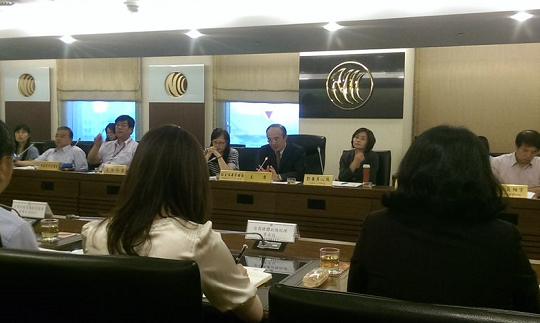
▲NCC invites industry representatives to communicate, calls for completion of the amendments to the three broadcasting and television acts