Detailed Explanation of Key Cultivation Techniques for Murcott Mandarin
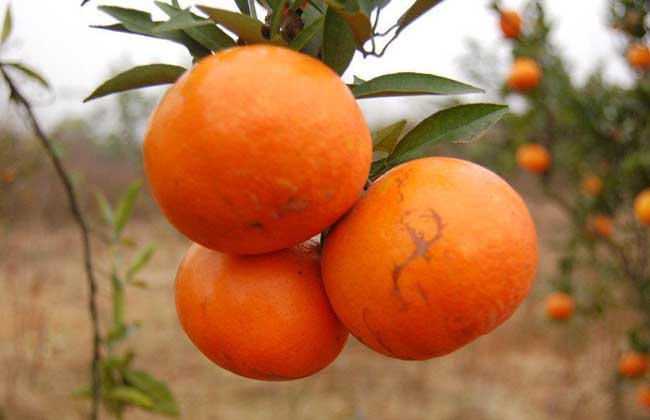
Murcott mandarin is a hybrid of mandarin and sweet orange bred in the United States in 1913. In the 1970s, Professor Lin Pu from the Department of Horticulture at National Taiwan University introduced it to northern Taiwan, China for trial planting. Because of its high sugar content, excellent and rich flavor, thin peel, abundant juice, and later ripening than Banana mandarin, its cultivation area increased year by year. In recent years, it has also been introduced and trial-planted in southern Fujian. Now let us take a look at Murcott mandarin cultivation techniques!
Planting Techniques
Select loose, fertile, well-drained, wind-sheltered and sunny sloping land or paddy field with a pH of 5.5-6.5 as the orchard site. Use a planting spacing of 3×2 m between rows and plants, 111 plants/mu, or 2.5×2 m between rows and plants, 133 plants/mu. Dig pits or trenches 80 cm wide and 60 cm deep. Place 50 kg of composted organic fertilizer and 1 kg of calcium magnesium phosphate fertilizer in each pit. Mix 30-50 kg of green manure (weeds) with soil and return it to the pit. The returned soil should be about 30 cm above the ground. Plant about 15 days after the Beginning of Spring, before spring budding. At this time, the roots have already begun activity, so the survival rate is relatively high. In areas with good irrigation, autumn planting is also possible. About one month after planting, when the seedlings have basically survived, apply some dilute manure water plus 0.2-0.5% urea or compound fertilizer. After that, apply one fertilizer before each new shoot sprouts and one before the shoots mature, to promote and strengthen the shoots. The fertilizers are basically quick-acting fertilizers.
Canopy Training
Murcott mandarin has a very strong shoot-sprouting ability and often grows in clusters. If not controlled, it will inevitably cause insufficient nutrient supply to the tree, poor shoot growth and development, short, weak, and shaded shoots that are prone to pests and diseases. Therefore, shoot removal and shaping, and training a canopy with good ventilation and light transmission and reasonable shoot distribution, are the key to stable tree vigor, high quality, and high yield. Generally, for strong shoots, keep only 3-4; for ordinary shoots, keep 2-3 strong buds in different directions. In the Guilin area, 3 batches of shoots are released each year in spring, summer, and autumn; in areas south of Liuzhou, 3-5 batches of shoots can be released, gradually forming a compact and stable canopy.
Fertilizer and Water Management
Murcott mandarin has many flowers, sets fruit easily, is high-yielding, and has high soluble solids content, so fertilizer and water management are very important. We summarize this part of the management in three sentences: "Spring nitrogen, summer potassium, autumn compound; during expansion, drench with bran water; after harvest, apply heavily to promote recovery." "Spring nitrogen" means after the Beginning of Spring, before buds break and when roots begin activity, mainly apply nitrogen fertilizer to promote shoots and flowers. Specifically, spread 25 kg of composted organic fertilizer plus 0.5 kg of urea under the canopy of each tree, gently loosen the soil, and turn the fertilizer under the surface soil. "Summer potassium" means in early May, before physiological fruit drop, mainly apply potassium fertilizer to stabilize fruit. Spray 0.3% potassium dihydrogen phosphate on the leaves and apply 0.2 kg of potassium chloride per tree to the ground, which can reduce fruit drop. "Autumn compound" means before releasing autumn shoots in mid-July, apply 0.2 kg of compound fertilizer per tree. "Bran water drench" means from July to early December, drench once every half month with light bran water plus 0.1%-0.2% urea, about 25 kg per tree. "Heavy application after harvest" means after fruit harvest, along the drip line of 1/4 of the canopy, dig a small trench 40 cm wide and 60 cm deep, and apply 20-30 kg of fresh grass, 30 kg of composted organic fertilizer plus 1 kg of superphosphate per tree.
Shaping and Pruning
The shaping and pruning of Murcott mandarin seedlings can be summarized in four sentences: "Keep spring shoots as appropriate, remove summer shoots, release autumn shoots uniformly, and strictly control late autumn shoots and winter shoots." That is, when spring shoots grow to 5 cm long, keep 2-3 strong buds in different directions on each shoot. The principles for keeping buds are: thin out dense ones and keep sparse ones, thin out short ones and keep long ones, thin out weak ones and keep strong ones. For overly vigorous branches, pinch them by leaving 6-7 leaves. Remove all summer shoots. Before releasing autumn shoots (early to mid-July), remove scattered buds and cut back shoots. The cutting position should not be too high or too low, preferably between the 6th and 7th nodes. For trees with weaker vigor or a non-compact shape, a small number of late autumn shoots may be kept as appropriate, and the rest and all winter shoots should be removed. In winter pruning, based on good ventilation and light transmission, reasonable shoot distribution, and a compact canopy, cut off crossing branches, shaded branches, water sprouts, pest- and disease-damaged branches, weak branches, and dead branches, burn them centrally, and clean the orchard at the same time.
Flower and Fruit Retention
1. Flower and fruit thinning: Because Murcott mandarin has many flowers and a high fruit-setting rate, it easily causes insufficient nutrient supply, poor growth and development of flowers and fruits, small fruit, and poor quality, and it also easily causes alternate bearing. Therefore, it is very necessary to thin out some flowers and fruits. The method is to remove weak flowers and fruits, pest- and disease-damaged flowers and fruits, and flowers and fruits on leafless or few-leaved branches. When flowers show white, spray 500-times trichlorfon on the ground and 800-times fenpropathrin on the trees to control flower bud midges and thrips.
2. Wind protection and sun protection: Murcott mandarin fruits are mostly borne at the top of shoots, making them prone to sunburn and wind scars, especially young trees, where this is more obvious. Therefore, when the fruit reaches 4 cm in transverse diameter, attach white paper or bag the sun-facing side, which can reduce sunburn damage. Although Murcott mandarin has relatively strong cold resistance, severe frost, snow, and freezing can still affect fruit quality and yield, so irrigation, covering, smoke, and spraying foliar fertilizers such as Zhuwulong before and after frost and snow all have certain protective effects.