Detailed Guide to Plum Planting Techniques and Cultivation Management Methods
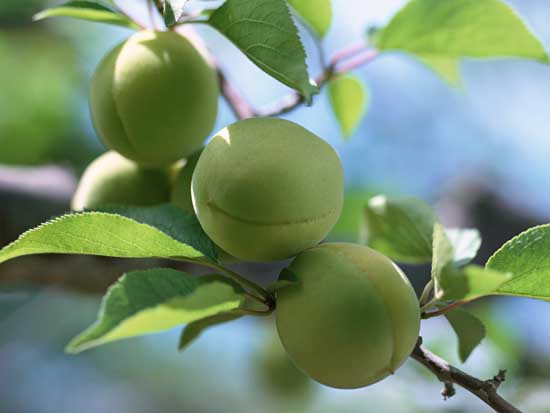
Plum, also known as green plum (Chinese plum, Prunus mume), is a tree of the family Dipterocarpaceae, reaching up to 30m tall with a diameter at breast height of up to 1.2m. The bark is blue-gray. Young branches and tender leaves are densely covered with stellate hairs. It has cymose panicles with small, white flowers. The fruit is nearly spherical, with 2 long and 3 short wings enlarged from the sepals. It is mostly distributed in Zhao'an, Fujian; Puning, Guangdong; Hainan; Taiwan, China; and southeastern Anhui, including Xuancheng City, Guangde County, Tongxi Township, Songchen Village, and Baitai Group. It grows from beaches at an altitude of 3-4m up to barren thin-soiled slopes at an altitude of 900m, and is more common at altitudes of 200-500m. It is also distributed in Thailand, Malaysia, Indonesia, and the Philippines. It is a national third-class protected vulnerable species. The main cultivar classifications of plum include Qingzhumei (green plum), Baifenmei, and Ruanzhi Dali Mei.
Site Conditions
The altitude range of 1800m–2550m is suitable for the growth of fruiting plum. Within this range, plots with good soil conditions, deep and fertile soil, convenient transportation, and good irrigation conditions should be selected, avoiding planting in low-lying, wet, and poorly drained plots.
Seedling Requirements
Cultivated fruiting plum seedlings must be of pure cultivar, grafted from superior tree scions onto plum rootstock. The seedlings should be robust, with plump and full branches and axillary buds, a height of more than 80cm, a root collar diameter of more than 0.8cm, complete main and lateral roots, many fibrous roots, no pests or diseases, and strong stress resistance.
Planting Time
Generally, fruiting plum is suitable for transplanting in spring, autumn, or the rainy season. According to the actual climatic conditions of Eryuan, transplanting is suitable in the rainy season from July to August.
Transplanting Measures
1. Transplanting density: For flat land or gentle slopes with good soil conditions, use a plant-to-row spacing of 4m×4m, planting 42 trees per mu. For sloping land, to increase early yield, planned close planting can be carried out using a plant-to-row spacing of 3m×4m, planting 55 trees per mu.
2. Transplanting pit preparation: According to standardized planting requirements, staking and marking by line are needed, that is, marking points by line according to the set plant-to-row spacing, with rows aligned both horizontally and vertically. The transplanting pit specifications require 80cm×80cm×80cm. When digging the pits, topsoil and subsoil should be placed separately. When backfilling, apply 25-30kg of farmyard manure per pit, mix the soil and fertilizer evenly, and backfill to about 35cm. Then place the mature soil (topsoil) facing down and the raw soil (subsoil) facing up, backfilling until it is 20cm-30cm above the ground, and make a circular tree basin.
3. Transplanting method: First, determine the center position of the transplanting pit as the transplanting point, then dig a hole 30cm deep and 40cm wide. Next, after removing the wrapping material from the selected grafted seedling, place the seedling upright in the transplanting hole, distribute the root system evenly within the hole, lightly cultivate soil over the root system, and after covering, gently lift the seedling so that the roots spread out and fully contact the soil. Firm the soil while filling, taking care that the graft union is exposed 5-10cm above the ground and the tree basin is 20cm above the ground. After watering thoroughly for root establishment, cover with plastic film. If any seedlings die within one month, replant them promptly.
Soil Management
1. Pit expansion and soil improvement
This refers to improving the soil outside the transplanting pit. It is generally carried out in the autumn of the following year when applying base fertilizer. Dig pits at the edge of the canopy and backfill with base fertilizer. The base fertilizer accounts for 70% of the annual fertilization amount. As the canopy expands year by year, fertilizer is applied outward in pits to achieve the effect of deep soil maturation.
2. Cultivation management
Cultivation management mainly includes hilling soil to protect roots and cultivation and weeding. Because fruiting plum has a shallow root system and sheds leaves early, attention should be paid to deep plowing to mature the soil and guide roots deeper into the soil, so as to thicken the root soil layer, prevent exposed roots from being sunburned, and conserve water. Generally, in autumn during deep plowing and loosening of the soil, fertilized soil is applied at the same time, and weeding is carried out in a timely manner according to the local climate and the number of weed species in the soil, keeping the soil in the tree basin loose and free of weeds.
3. Reasonable intercropping
Within 1—3 years after transplanting, short-stalked crops such as vegetables and beans or green manure can be intercropped between rows, so as to support the orchard with the orchard.
Fertilizer and Water Management
1. Fertilization of plum trees
Fertilization of plum trees includes base fertilizer, pre-flowering fertilizer, post-flowering fertilizer, fruit-swelling fertilizer, and post-harvest fertilizer.
(1) Base fertilizer is generally applied in autumn each year, at the latest in August, to facilitate root absorption. It accounts for 60%—70% of the total annual fertilization amount, mainly farmyard manure, generally 50kg per tree, combined with 1kg phosphate fertilizer and 0.5kg nitrogen fertilizer; for young trees, it may be reduced as appropriate.
(2) Pre-flowering fertilizer is applied during the flower bud swelling stage, generally from November to December. For young trees, apply 0.25kg nitrogen fertilizer, 0.25kg potassium sulfate, and 1kg decomposed cake fertilizer per tree. For fruiting trees, apply 1kg nitrogen fertilizer, 1kg potassium fertilizer, and 1.5kg decomposed cake fertilizer per tree, while adjusting the fertilization ratio appropriately according to the amount of fruit set in that year.
(3) Post-flowering fertilizer: Apply to plum trees with weak vigor and abundant flowers; it is not necessary to apply it to plum trees with sufficient base fertilizer and strong vigor. Fertilization is mainly with quick-acting nitrogen fertilizer.