Detailed Explanation of Key Peach Cultivation Techniques and Management Methods
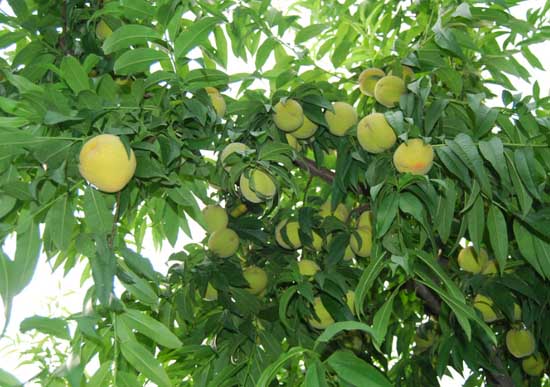
Peach fruit is rich in nutrients, with sweet and juicy flesh and a distinctive flavor, and is loved by people in both urban and rural areas. Peach trees have the characteristics of early fruiting, early high yield, early returns, and ease of cultivation. They are suitable for planting in both northern and southern parts of our country, and therefore are widely distributed.
Establishment of the Peach Orchard
1. Site selection: For peaches, it is best to choose well-drained, loose sandy loam soil, with a south-facing slope being optimal, but continuous cropping is taboo, meaning land where peaches have already been planted cannot be planted with peaches again.
2. Soil improvement before planting: Before planting peaches, deep plowing and soil improvement must be carried out. Sloped land should be terraced, the soil layer thickened, and then planting holes or planting trenches dug according to the spacing between plants and rows. The holes should be 2.5—3 chi deep and wide, and each hole should have at least 100 jin of residue fertilizer pressed in, applied in 3—4 layers, to achieve the goal of looseness and aeration and improving the soil's physical and chemical properties. Flat land and clayey soil also need improvement, using deep furrow and high bed cultivation, with drainage ditches more than 2.5 chi deep. Within the beds, soil improvement should be done with strip trenches, 80CM deep and 70CM wide, pressing in garbage and residue fertilizer in three layers.
3. Planting time: Both spring and autumn planting are possible, but autumn planting is best. In autumn, temperatures are high and there is more rain, so after root damage the roots recover easily, which can reduce the seedling establishment period the following year, with uniform sprouting. Planting from October to December is appropriate.
4. Planting density: Generally, this should be determined according to variety characteristics, terrain, soil conditions, training system, and cultivation method. Varieties with strong tree vigor can be planted more sparsely, while varieties with weak tree vigor can be planted more densely; flat land should have greater planting spacing than mountainous land; fertile soil should have greater planting spacing than poor soil; planned dense planting orchards should have greater planting density than fixed planting orchards; "Y"-shaped training should have greater planting density than open-center training. The general spacing between plants and rows is 3×4 m2 or 3×3 m2, with 56 or 74 plants per mu.
5. Planting: Before planting, trim damaged roots and overly large main roots, then straighten the plant, spread the root system, cover with 5-10CM of soil, firm it with the feet, build a soil ridge around the seedling to form a circular basin, then irrigate thoroughly. After the water infiltrates, cover with a layer of fine soil, and optionally another layer of grass, which can reduce water evaporation and help survival.
Soil, Fertilizer, and Water Management
1. Soil management
① Intercropping: In young orchards, vegetables can be planted in summer and green manure in winter, which can both increase orchard income and improve soil fertility. Adult orchards are not intercropped;
② Summer cultivation and loosening of the soil, and weeding;
③ In autumn and winter, deep plowing and hole expansion, and increased application of organic fertilizer, to improve the soil's physical and chemical properties.
2. Fertilizer and water management
① Fertilizer and water management for peach trees in the first year after planting: The first year after planting is key for the peach tree to grow and take shape. In fertilizer and water management, "light fertilizer applied frequently" should be achieved. From March to June, apply fertilizer about once every half month, 8 times in total. The first 6 times are one load of clear manure water plus 2 liang of urea applied to 4 trees, to promote more branch growth and leaf development and rapid shaping. The last 2 times are one load of clear manure water plus 2 liang of monopotassium phosphate applied to 4 trees, to promote branch maturity and flower bud differentiation.
② Fertilizer and water management for peach trees in the second year after planting and thereafter: Peach trees are more tolerant of poor soil than citrus and apples, but after they begin bearing, they should be fertilized at least three times each year.
◆ Sprouting fertilizer: The amount applied should account for 10—20% of the annual fertilizer application. Irrigation should be the main focus. Most areas of Sichuan have dry winters and spring droughts, and peach roots have no absolute dormancy period. In early spring when growth starts, water demand is relatively high. For normally growing trees and trees with plump flower buds, irrigation should be the main focus. For weak trees, a small amount of quick-acting nitrogen fertilizer can be appropriately added to promote the weak trees' growth to become vigorous. The fertilization time is from late January to early-to-mid February.
◆ Fruit-swelling fertilizer: This is carried out after May 10, when young fruit stop dropping, that is, before the pit hardens. This fertilizer should be mainly potassium fertilizer, to promote fruit enlargement, promote flower bud differentiation, and fill out new shoots. For early-maturing varieties, do not apply phosphorus and potassium fertilizer. For mid-maturing and late-maturing varieties, apply 40% potassium, 15—20% nitrogen, and 20—30% phosphorus. For trees with vigorous growth and few fruits set, fertilizer may be omitted.
◆ Post-harvest fertilizer: Generally applied before or after harvest. Its purpose is to promptly restore tree vigor, promote the activity of leaf functions, enhance assimilation, increase nutrient accumulation, improve the quantity and quality of flower bud differentiation, and improve the cold resistance of peach trees for overwintering. Generally, early-maturing and mid-maturing varieties should be fertilized promptly after harvest, while late-maturing varieties should be fertilized before harvest. The amount applied should account for 50—60% of the annual fertilizer application, with nitrogen, phosphorus, and potassium applied in combination. The fertilization ratio is nitrogen:phosphorus:potassium = 1:0.5:1.
◆ Autumn basal fertilizer: Applied from October to December, mainly decomposed organic fertilizer, generally applied according to the principle of one jin of fertilizer per jin of fruit.
◆ Foliar topdressing: Spraying boron fertilizer at the early full-bloom stage and young fruit stage of peaches can increase the fruit-setting rate. Spraying phosphorus and potassium fertilizer during the fruit enlargement stage can promote fruit development and reduce pre-harvest fruit drop. Spraying nitrogen, phosphorus, and potassium fertilizer after harvest can protect leaves, delay leaf fall, and promote flower bud differentiation. Spray concentrations for various fertilizers: borax or boric acid 0.1—0.3%, urea 0.3—0.4%, potassium sulfate 0.3—0.5%, monopotassium phosphate 0.2—0.3%, zinc sulfate 0.3%.
3. Fertilization methods: Soil fertilization methods include the ring fertilization method, the trench fertilization method, and the hole fertilization method. Young trees use the ring fertilization method, large-area adult trees use the trench fertilization method, and mountainous land uses the hole fertilization method. Generally, fertilization holes are dug along the drip line of the canopy.
Peach Tree Training
1. Training principles
① Large branches should be few and strong, while small branches should be numerous and even.
② Maintain the spacing between rows, achieving dense plants but not dense rows, forming a wave-like population structure, expanding the light-receiving surface, and strengthening air convection.