Detailed Explanation of Persimmon Cultivation Techniques and Management Key Points
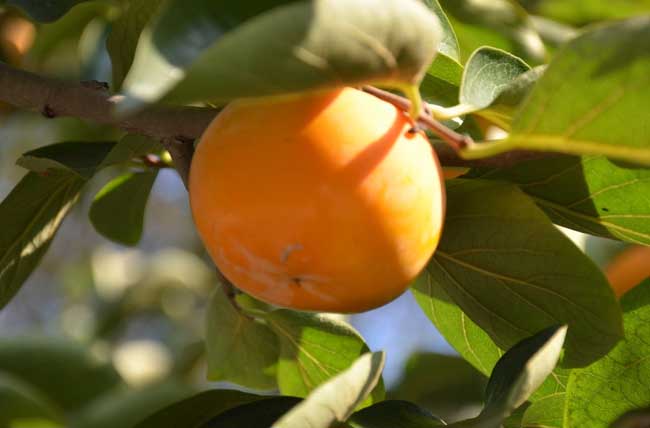
Orchard Site Selection
Persimmon trees are best suited to calcareous soil, and also suitable for neutral or slightly acidic soil. It is advisable to choose a site with fertile, loose soil, a relatively low groundwater table and good drainage, sheltered from the wind and facing the sun.
Seedling Selection
Choose new varieties that have been certified by departments at or above the provincial level, are suitable for local planting and worthy of promotion; you may also choose varieties with a long history of local cultivation and good growth and sales for planting. Grafted seedlings 1~2 years old have a relatively high survival rate. The seedling should have a height of more than 1m, a ground diameter of more than 1.2cm, a main root length of more than 20cm, more than 15 lateral roots, and a good, plump, robust graft union free of pests and diseases.
Seedling Planting
Before planting, dig large holes, bring in foreign soil and apply sufficient base fertilizer to create favorable conditions for root development. The planting density should be 4×5m, and the holes should be dug 1×0.8×0.6m in height, width and depth. Planting is mainly done in spring when the persimmon seedlings begin to sprout, so as to avoid frost damage; planting should achieve the three speeds of lifting, transporting and planting.
Soil, Fertilizer and Water Management
The persimmon tree is a deep-rooted species, so the planting holes should be enlarged and the soil improved with additional fertilizer if the tree is to grow vigorously. Persimmon trees are prone to root rot in acidic soil, so the soil should be improved when the pH value is too low. For persimmon trees in production, the holes should be enlarged and the soil improved in winter; when backfilling the topsoil, apply 50kg of pig and cattle manure or 1~1.5kg of calcium magnesium phosphate fertilizer per tree, mix it evenly with the topsoil and fill it into the lower layer. For high-yielding trees, apply sufficient pure N6.5kg, pure P2.5kg and pure K0.6kg per mu; the fertilizer concentration should not be too high and can be applied in several split applications. Watering generally consists of bud-break water, pre-flowering water, fruit-swelling water and overwintering water to keep the soil moist.
Training and Pruning
Winter pruning of persimmon trees is beneficial for early fruiting of young trees, high and stable yields of mature trees, and renewal and rejuvenation of aging trees. Winter pruning is generally carried out from after leaf fall to before bud break the following spring.
1. Pruning of young trees
Select 3~4 suitable branches as scaffold branch leaders, generally without heading back, and thin out nearby weak and vigorous branches growing in the same direction. At present, the multi-main-branch natural open-center form is generally used. During training, temporarily retain the central leader and cut it back by 1/2~1/3 each year to maintain the open-center state; once the canopy is formed, remove the central leader.
2. Pruning of trees in full fruiting stage
① Adjust the angle of scaffold branches to balance the growth vigor inside and outside. Excessive large branches should be thinned out over several years to promote the growth of inner-canopy branches, develop small fruiting branch groups, and support large branches to grow outward and upward at an angle, gradually replacing the original branch leaders and raising the angle of the main branches.
② Combine thinning with renewal pruning to develop inner-canopy branches. Renew overly tall and overly vigorous branch groups to prevent the fruiting zone from moving outward, promote the emergence of renewal branches at the rear, and remove weak branches while keeping vigorous ones. Fruiting branches are generally not headed back; remove dense branches, water sprouts, crossing branches and diseased or dead branches so that the branches are distributed reasonably.
③ Retain more reserve branches to overcome alternate bearing. Each year, shorten the fruiting branches or 1/3 of the fruiting mother branches as reserve branches so that they bear fruit every other year, thus extending the fruiting years.
3. Pruning of aging trees
Because the latent buds of persimmon trees have a long lifespan and strong sprouting ability, this characteristic can be used to carry out repeated renewal, keeping the tree vigor from declining over a long period and extending the fruiting years.
Pest and Disease Control
1. Clean the orchard in winter to reduce the overwintering pest and disease base. Combined with winter pruning, thoroughly clean up diseased fruit, diseased calyxes, dead branches and fallen leaves to eliminate overwintering sources of pests and diseases.
2. Before bud break in spring, spray once with 5-degree lime sulfur mixture or 95% petroleum oil emulsion at 150 times dilution.
3. To control major pests such as persimmon mealybug, persimmon calyx borer and giant mealybug, in addition to the above control measures, scraping off old bark and applying omethoate at 5~10 times dilution in a ring is markedly effective. In addition, use biological pesticides such as Bacillus thuringiensis or diflubenzuron as much as possible to control leaf-eating pests.