How to grow jasmine? Detailed guide to cultivation methods and precautions
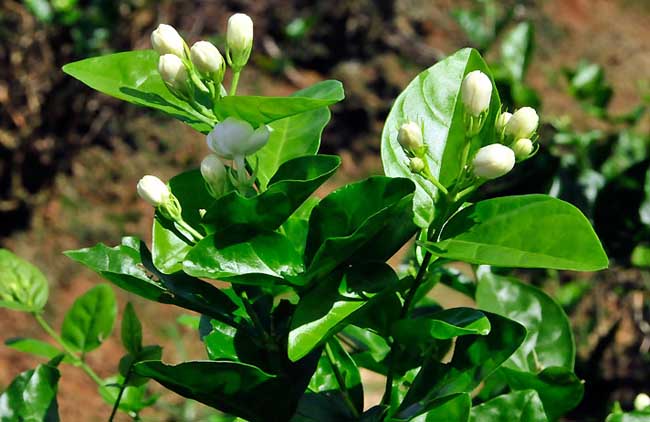
Jasmine prefers warmth and humidity, and grows best in a well-ventilated, semi-shaded environment. The most suitable soil is slightly acidic sandy soil rich in humus. Most varieties are sensitive to cold and drought, and cannot tolerate frost, waterlogging or alkaline soil. When the winter temperature drops below 3°C, the branches and leaves are prone to cold damage, and if it lasts for a long time, the plant will die.
Growing environment for jasmine
1. Light: Jasmine likes hot, humid, well-ventilated conditions and needs plenty of light. Jasmine is sensitive to cold; in the south, potted jasmine can be grown outdoors through the winter, while in the north it needs protection in autumn and winter, and should be moved indoors to a south-facing spot. With strong light, the branches are sturdy, the leaves are dark green, and there are many fragrant flowers; with insufficient sunlight, the nodes are sparse, the flowers are few and not fragrant.
2. Water: Jasmine is not drought-tolerant, but it also dislikes waterlogging. In the rainy season, the accumulated water in the pot should be poured out promptly, otherwise the leaves tend to turn yellow. In hot summer weather, water twice a day, once in the morning and once in the evening. If the leaves are found to curl and droop, spray water on the leaves to promote growth.
3. Soil: For growing jasmine, fertile sandy and semi-sandy soil is best. When planted in slightly acidic soil with a pH of 6 to 6.5, the root system is dense and growth is vigorous. If the soil is heavy clay, lacks organic matter, has low fertility and poor aeration, then the root system will be sparse, the plant will be short, the stems and leaves will be thin, and the flowers will be few and small.
Propagation methods for jasmine
Jasmine is mostly propagated by cuttings, and can also be propagated by layering or division.
1. Cutting propagation: Carry out from April to October. Select mature 1-year-old branches and cut them into cuttings with more than two nodes, remove the lower leaves, insert them into a cutting bed of half sand and half soil, cover with plastic film, and maintain relatively high air humidity. Roots form after about 40 to 60 days.
2. Layering propagation: Choose a relatively long branch, gently score the lower part of a node, bury it in a small pot filled with sand and soil, and keep it moist regularly. Roots begin to form in 20 to 30 days, and after 2 months it can be cut away from the mother plant as a new plant and planted separately.
Planting methods for jasmine
In midsummer, water every morning and evening; if the air is dry, supplement with spraying. During the winter dormancy period, control the amount of watering; if the potting soil is too wet, it will cause root rot or leaf drop. During the growth period, apply a dilute cake fertilizer once a week. After repotting in spring, pinch back and shape regularly; after the full flowering period, prune heavily to encourage new branches, so that the plant is neat and sturdy and blooms abundantly.
Fertilization methods for jasmine
From June to September, during the flowering period, frequently apply liquid fertilizer containing more phosphorus, preferably once every 2 to 3 days. The fertilizer can be well-rotted soybean cake and fishy water fertilizer liquid, or ammonium sulfate and superphosphate; generally, if chemical fertilizer components are mixed too strongly, it will burn the jasmine plant to death. A 0.1% potassium dihydrogen phosphate aqueous solution can also be sprayed on the leaves in the evening, which can also encourage more flowering.
Flowering-period care for jasmine
Jasmine loves fertilizer very much. As long as it is cared for properly, a potted jasmine can bloom three times a year. If fertilizer is insufficient and nutrients are inadequate, it will bloom once and then stop blooming. With proper management, it can bloom continuously from the end of May to the beginning of November. The key is pruning, sunlight, and the control of fertilizer and water.
Jasmine begins to bloom one after another from early summer. With proper management, three peak flowering periods can occur.
In early June, jasmine gradually produces early flowers. The method of picking flowers is to remove the flower together with the leafy young branch, prompting new branches to grow again and the branches and leaves to flourish. At this time, apply dilute fertilizer water twice a week and keep the potting soil moist.
From late June to early July is the first peak flowering period. At this time, fertilizer and water management should be strengthened, with frequent applications of thin fertilizer, applying fertilizer once every 2 days, using fully rotted organic liquid fertilizer, with a fertilizer-to-water ratio of 1:4. Watering should be sufficient, generally once a day. Usually watering is best done in the morning, while fertilizing is best done in the evening. Continue this until late July; because of sufficient fertilizer and water, the flowers can be large and numerous.
In early August, the second flowering period forms. At this time, the fertilizer should be slightly stronger than before, generally half fertilizer and half water. To encourage jasmine to bloom better, a superphosphate solution can also be sprayed on the leaves. By late August, gradually reduce fertilization to once every 6 to 7 days, while watering still needs to be relatively frequent, maintaining once every 2 days.
From early September to early October, the third flowering period forms. At this time, fertilization should be stopped, and the amount of watering should also be gradually reduced. Because the weather has gradually turned cooler, this will affect the formation of flower buds, so the number of flowers in this batch is relatively small. After mid-October, flowering ends, and it is only necessary to keep the potting soil slightly moist.
Pest and disease control
1. Pest control
The main pests of jasmine are leaf roller moths and red spider mites, which harm the tender leaves at the tips of the shoots, and timely control should be carried out. For red spider mites (mites), try not to use dichlorvos or dimethoate, because these two pesticides have too strong an odor (which cannot dissipate for many days and is especially pungent), and they are not specifically effective against red spider mites.