A Detailed Guide to Growing Pothos and Spider Plants
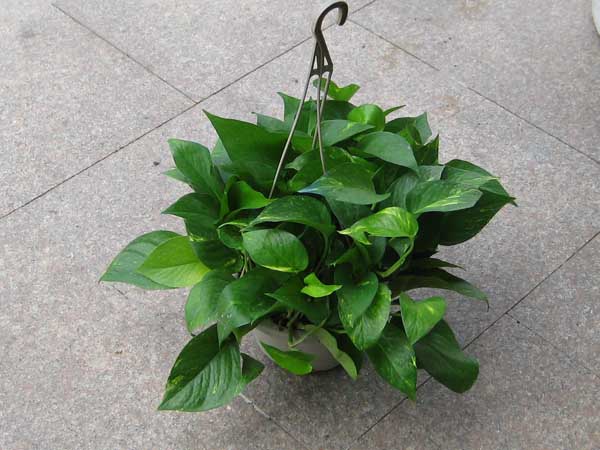
Pothos is native to Central and South America. Its vines grow several meters long, with aerial roots at the nodes. As the plant ages, the stems thicken and the leaves grow larger and larger. The leaves are alternate, green, with a few leaves slightly mottled with yellow, entire, heart-shaped. It is a large evergreen climbing plant that grows in tropical regions, often climbing over rocks and tree trunks in rainforests, and can grow into a huge vine.
Physiological Characteristics
It prefers a warm, humid environment and requires loose, fertile, well-drained soil. For potted pothos, choose fertile, loose, well-drained leaf mold soil, preferably slightly acidic. Pothos is extremely shade-tolerant and can be placed in a sunny spot indoors all year round. In dimly lit rooms, it should be moved every half month to a brighter environment to recover for a period, otherwise the internodes tend to lengthen and the leaves become smaller. Pothos likes a hot and humid environment. The overwintering temperature should not be lower than 15°C. The potting soil should be kept moist, and the leaves should be sprayed with water frequently to raise air humidity and encourage the growth of aerial roots. During the vigorous growth period, apply liquid fertilizer once a month. For plants kept indoors for viewing over a long period, the leaves at the base of the stems tend to drop, reducing their ornamental value. In May and June, when the temperature warms up, pruning and renewal can be carried out together with cuttings to encourage new shoots to sprout from the base of the stems.
Temperature
In winter, pothos can overwinter safely above 10°C, and generally grows normally above 20°C. Therefore, an ordinary home environment is quite suitable for growing pothos. The original growing conditions of pothos are forests shaded by towering trees, so its heliotropism is not strong. However, in northern China in autumn and winter, to make up for the lack of temperature and photosynthesis, its light exposure should be increased. The method is to place the pothos in the brightest spot indoors, or move it to a sealed balcony to bask in the sun at noon. At the same time, when the temperature is low, open windows as little as possible, because the leaves may be frostbitten within a very short time.
Light
Pothos does not have strong heliotropism, so when growing it, place it in a spot indoors with good light, and at noon you can put it in the sun for a while. In northern China, pothos can overwinter safely at a room temperature above 10°C, and can grow normally at a room temperature above 20°C. Generally, households have no problem reaching this temperature. What needs attention is avoiding large temperature differences, and also making sure the leaves are not close to heating equipment.
Water
When growing pothos, do not water too much. You can spray water at the rooting area, which can reduce the evaporation rate of water. Water daily to keep the soil moist, but do not let water accumulate and breed mosquitoes. In autumn and winter, the amount of watering should be strictly controlled according to room temperature. Before heating is turned on, the temperature is lower, the soil of the plant evaporates more slowly, so watering should be reduced, and the amount should be controlled between 1/4 and 1/2 of the original. Even after heating is turned on, watering should not be too frequent. When watering, pour less into the pot; water should seep through the coir. In addition, spray water on the aerial roots growing on the coir column to reduce insufficient water uptake by the roots caused by too-rapid evaporation. For winter watering, water that has been left to sit for a day is better; water that is too cold can easily damage the roots.
Fertilizer
For fertilizing pothos leaves, since ordinary inorganic fertilizers are hard to absorb, a special fertilizer is needed. In autumn and winter in northern China, most plants grow slowly or even stop growing, so fertilization should be reduced. Before winter begins, mainly apply liquid inorganic fertilizer, about once every 15 days. After winter begins, fertilization is mainly by foliar spraying, applied mainly through the stomata on the leaf surface; the fertilizer is absorbed through the stomata on the leaf surface, and the fertilizer effect can act directly on the leaf surface. Foliar fertilizer should be a special fertilizer; ordinary inorganic fertilizers are not easily absorbed by the leaf surface. Beidahu Huashen series and the Japanese-made Hua Yifan, among others, can all be used as foliar fertilizers.
Pothos Pest and Disease Control
1. Pothos anthracnose: This pathogen mostly harms the middle section of leaves, and can also harm flowers. At first, small pustule-like spots of moist reddish-brown or dark brown appear on the diseased part, with a faded green halo around the spots. After expanding, they form long oval or long strip-shaped patches, with dark brown edges and a yellow-brown interior, and with ring-shaped markings formed by dark spots gathering together. Because its spots are dark brown, it is also called black spot disease or black-brown disease. It can repeatedly infect the plant during the growing period. Control methods for pothos anthracnose:
① There are many pesticides that can control anthracnose, such as mancozeb, carbendazim, thiophanate, Tante Ling, etc., all of which have a certain control effect.
② The German-made "Shibaogong" at 1,500 times dilution is a specific remedy for treating anthracnose.