How to care for a jade plant? Detailed explanation of cultivation methods and precautions
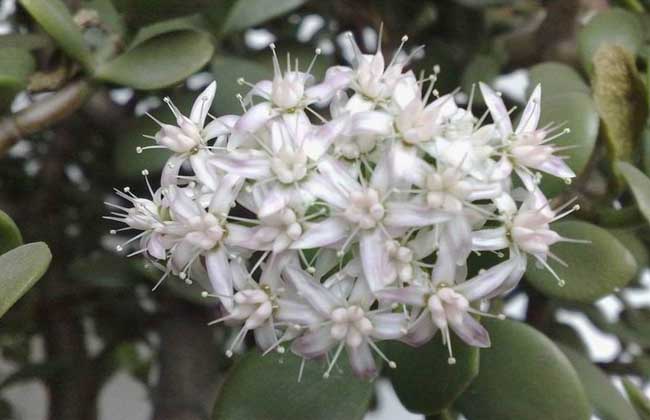
The jade plant is also known as the sedum tree, glass tree, succulent evergreen, etc. It is a multi-succulent subshrub plant of the genus Crassula in the family Crassulaceae. Its crown is tall and elegant, its stems and leaves are emerald green, and it bears white flowers at the top, making it very elegant and unique. If matched with a pot stand and gravel to make a small bonsai, the decoration is even more beautiful. If cared for well, it blooms every year; if not, it may not bloom even once in 20 years. Now let us take a look at the cultivation methods and precautions for the jade plant!
Growth habits of the jade plant
The jade plant is native to southern Africa and likes a warm, dry natural environment with plenty of sunlight. It fears strong light, is slightly shade-tolerant, and is not cold-tolerant. The winter temperature must not be lower than 7°C. The growing soil is best as fertile, well-drained sandy loam. The flowering period is late spring and early summer, the tubular flowers are 2 cm in diameter, white or light pink, but the juice of the leaves is toxic.
Propagation methods for the jade plant
The jade plant is usually propagated by cuttings, and soft branches or leaves can be used for cuttings. This can be done during the growing period, but before inserting, the cuttings need to be dried in the shade. For soft branch cuttings, during the growing season cut off full-grown soft branches, let them dry slightly, then insert them into plain sand or sandy soil. After inserting, maintain a certain humidity, and they can take root in 20-30 days. For leaf cuttings, during the growing season, twist off 1-2 year old leaves from the base, dry them for 8-10 hours, and insert them into plain sand or sandy soil. It is best to insert them obliquely, with a depth of 1/4-1/3 of the leaf length. After inserting, spray a small amount of clean water, place in a shaded and ventilated place, and keep them slightly moist often. They can take root in about 30 days and produce young buds.
Cultivation methods for the jade plant
1. Flower pot: The jade plant can use clay pots, plastic pots, porcelain pots, or ceramic pots. To coordinate with home decor, porcelain pots can be used. Generally, pots with a diameter of 16-28 cm are chosen for planting. The north is usually relatively dry, so porcelain pots are very good. In the south, it is recommended to use tile pots, because the jade plant is a succulent, and too much accumulated water easily causes black rot.
2. Soil: The jade plant does not have strict soil requirements, and loose, well-drained sandy soil is suitable. For potting soil, use 5 parts leaf mold, 2 parts garden soil, and 3 parts river sand. It is extremely drought-tolerant and avoids overly wet soil. It likes dry air and relatively dry soil, and avoids moist soil. Moist potting soil easily causes root and stem rot.
3. Watering: During the growth period of the jade plant, keep the potting soil moderately moist often. If the potting soil drains poorly and too much water is given, the roots will rot due to water accumulation. If the potting soil is too dry, the weather is stuffy and hot, and the air is not circulating, it easily causes leaf drop. The amount of water should be controlled according to temperature. In summer, watering can be appropriately increased, and at the same time pay attention to indoor ventilation and cooling to promote growth. In winter, watering should be controlled, and generally watering once every 7-10 days is enough.
4. Fertilizing: The jade plant does not have high fertilizer requirements. Topdressing begins after new stems grow in spring. During the growing season, apply once a month a mixture of 15 times diluted decomposed liquid fertilizer and an equal amount of 1000 times potassium dihydrogen phosphate solution, or 1000 times “Huaduoduo” general fertilizer. Do not fertilize when summer temperatures are relatively high or winter temperatures are relatively low. When the plant shape is relatively large, only apply base fertilizer and no topdressing is needed, in order to control height. Base fertilizer can use decomposed bean cake fertilizer, soybean milk residue, and other organic fertilizers.
5. Temperature and light: The jade plant is relatively shade-tolerant. For home care, it can be placed year-round indoors in a place without direct light, or in a place with bright scattered light. Keep room temperature at 6-10°C. Too high a temperature easily causes leggy growth, leaf drop, or pests and diseases. Low temperatures in winter can promote flower bud differentiation. Below 5°C, the plant enters a dormant state.
Four-season management of the jade plant
1. Spring: Jade plant seedlings grow relatively fast. Repot once a year, and repot formed plants once every 2-3 years. Repotting should be done in spring when the temperature is stably above 10°C. Stop watering for several days before repotting, so that the potting soil dries and the plant can be removed from the pot. Because its branches and leaves are rich in water and easily broken, handle them gently to avoid breaking the plant. After removing from the pot, prune away dead roots and broken roots, dry for 1-2 days, and then plant. After planting, place in a semi-shaded place, do not water for the time being, water slightly after 2-3 days, and keep the potting soil on the dry side.
2. Summer: The jade plant likes strong light. When summer temperatures are not high, shading is not needed, and an appropriate water supply should be maintained. When placed indoors, it should maintain a certain amount of light and pay attention to indoor ventilation. When summer temperatures are relatively high (above 35°C), growth is in a stagnant state. Attention should be paid to controlling water to prevent root rot caused by high temperature and too much water. At the same time, shade the light around noon and stop fertilizing. After the temperature becomes cool in late summer, fertilizing can continue.
3. Autumn: In autumn, the jade plant should be placed in a place with sufficient light for cultivation. Water after the potting soil dries completely. When the weather gradually turns cool, gradually reduce the amount of watering and stop fertilizing, so that the potting soil is dry but not parched. When the temperature drops to about 5°C, it should be moved in time to a closed balcony or room with light for cultivation.
4. Winter: In winter, the indoor temperature for the jade plant should be kept above 5°C, and at this time growth is in a stagnant state. Potted plants should be placed on a windowsill with sufficient light or in a closed balcony for cultivation. Pay attention to controlling water so that the potting soil is dry but not parched, and do not fertilize. If conditions permit, the pot can be moved into a warm shed. If conditions do not permit, a plastic film cover can also be used, but attention should be paid to the humidity inside the cover. If excessive moisture is found, uncover the cover in time for ventilation to prevent leaf rot.