How to grow the Angel's Tears succulent? A detailed guide to care methods
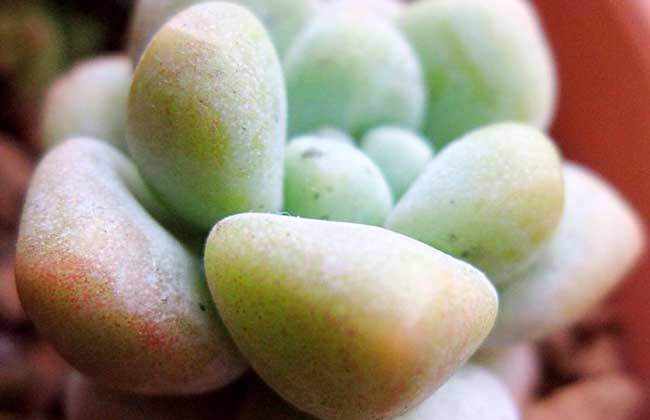
Angel's Tears, also known as Beauty's Tears and Round-leaf Sedeveria, is a succulent in the Crassulaceae family. It looks somewhat like Sedeveria 'Harry Butterfield' (the round-leaf eight thousand generation), but as a cultivated horticultural variety its leaves are larger than those of Sedeveria 'Harry Butterfield'. Its pale green leaves stay tender year-round and hardly change at all, and while the stem is not very thick it can form woody branches and will gradually form clusters over time. Let's take a look below at how to grow the Angel's Tears succulent!
Growth habits of Angel's Tears
Angel's Tears originates from Mexico. It is a summer-dormant succulent, though its dormant period is not obvious, and it grows fairly quickly. It likes light; under sufficient light the leaves of Angel's Tears are arranged more compactly and have more white powder on the surface, and combined with the large temperature difference between day and night in autumn and winter, the leaf color takes on a hint of yellow, which is very striking. Under insufficient light, the leaf arrangement appears looser and the leaves are more slender and elongated.
Morphological characteristics of Angel's Tears
1. Leaves: The leaves of Angel's Tears are ovate and covered with white powder, with a smooth surface and an extremely rounded convex curve on the back; the leaf tip is noticeably swollen, and the leaves grow in a ring around the branches.
2. Branches: The branches of Angel's Tears can keep growing upward, and side shoots readily sprout from the lower part of the branches, forming offshoots.
3. Flowers: Angel's Tears produces clustered small yellow flowers in late spring or autumn. The small flowers are bell-shaped, produced in great numbers, and have a faint fruity fragrance.
Propagation methods for Angel's Tears
1. Stem cuttings: During the growing season, you can twist off shoots sprouting from the base of Angel's Tears, let them dry for a few days until the wound is dry, then insert them into akadama soil.
2. Leaf cuttings: Angel's Tears can also be propagated by leaf cuttings using complete, plump leaves, but the success rate is not high.
3. Sowing: Angel's Tears can also be grown from seed obtained by manual pollination. Sow the seeds as soon as they mature, but seedlings grown from seed vary considerably, so care should be taken to select seedlings of good quality from among them.
How to grow Angel's Tears
1. Soil: The potting soil for Angel's Tears should be loose, breathable, well-draining, and fairly coarse-grained. At present, growers in China commonly use akadama mixed with humus soil or leaf mold and peat soil, plus a small amount of bone meal and other calcareous materials.
2. Temperature: Angel's Tears likes a warm environment and has the characteristics of going dormant in high summer temperatures and growing slowly in low winter temperatures. In winter, if the nighttime minimum temperature is not below 10°C and there is a day-night temperature difference of around 10°C, you can water normally so the plant continues to grow.
3. Light: The growing season of Angel's Tears is in spring and autumn, and it requires plenty of sunlight; insufficient light causes the plant to grow leggy and the plant shape to become loose. It needs sufficient sunlight for the leaf color to be vivid, the plant shape to be more compact and attractive, and the leaves to stay short rather than leggy. Too little sunlight makes the leaf color pale and the leaf arrangement loose.
4. Watering: For Angel's Tears, follow "don't water until dry, and water thoroughly when you do," and avoid water accumulating in the potting soil, which can cause root rot. After Angel's Tears has clustered for many years, the plant is very spectacular, and the growing medium must be dry before watering. Angel's Tears blooms with yellow clustered flowers, and the flowers are quite beautiful.
5. Fertilizing: Because Angel's Tears grows slowly, do not fertilize it; you can place granular slow-release fertilizer on the surface of the soil for the plant to absorb gradually.